Full Article
about Secastilla
Hide article Read full article
First Steps in a Very Small Village
In Secastilla, the first thing to sort out is the car. The old centre is compact and the streets are narrow, so driving through it is not the best idea. Most visitors leave the car near the main square or on a nearby side street. Outside August, finding a space is usually straightforward. If you see a gap, take it and continue on foot.
Secastilla is a small village in La Ribagorza, a comarca in the province of Huesca. The population is low and it shows. Walking through the centre does not take long. In under an hour, without rushing, you can see the main parts.
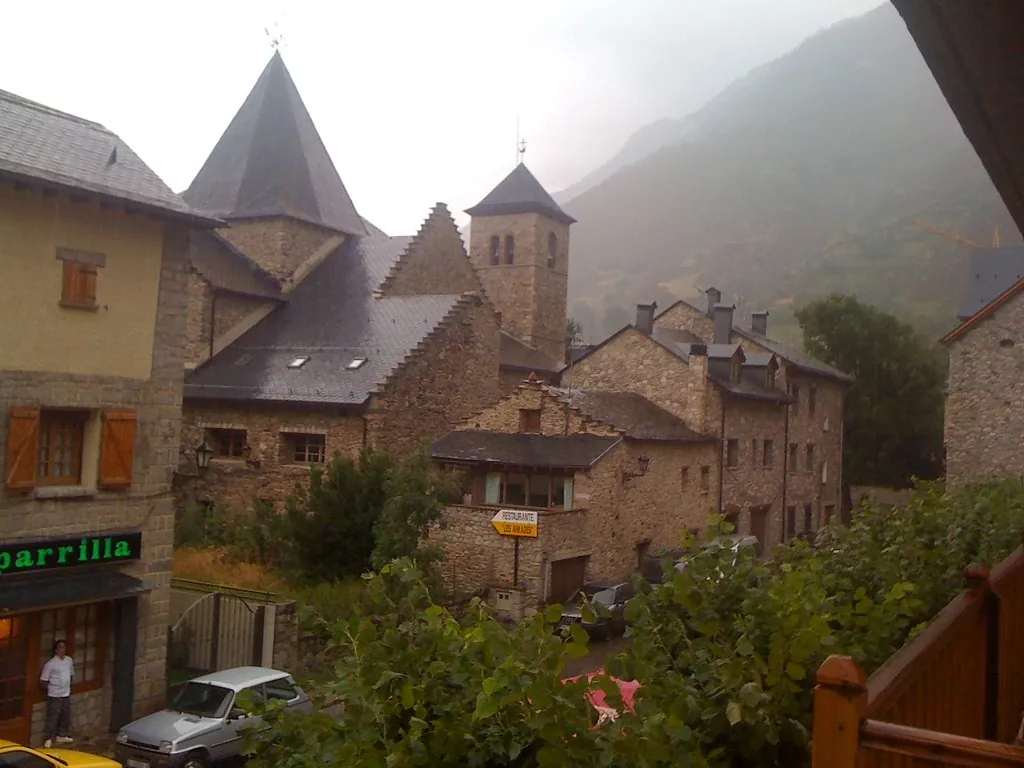
The main square has a fountain and several stone houses around it. There is nothing grand about it. At the far end stands the church of the Asunción, set at the highest point of the village. The streets slope gently upwards in its direction.
The buildings are simple. Narrow doorways, stone walls, some recent renovations and others that look much as they did decades ago. It does not feel like a place reshaped for tourism. It is a settlement that continues to function in a practical, everyday way.
The Shape of the Old Centre
The streets are short and slightly irregular. Some end in small open spaces or threshing areas where grain used to be processed or animals kept. Several of these spaces are still visible.
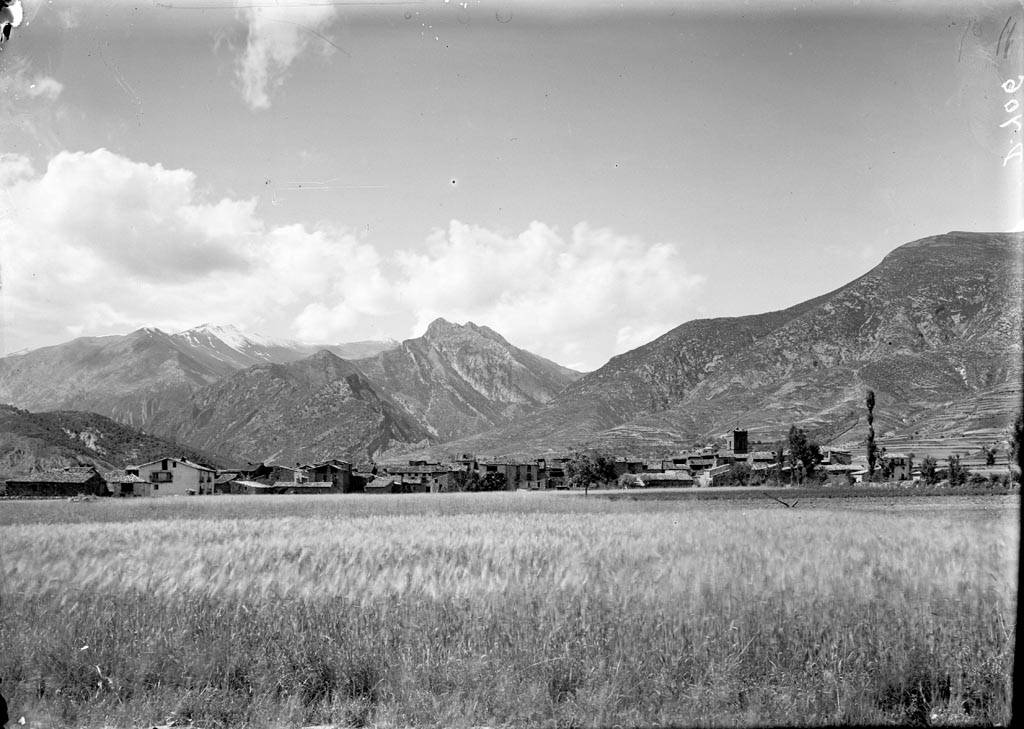
From almost anywhere, you can see the surrounding fields. For much of the year, they are used for cereal crops. There are also olive trees and almond trees in nearby plots. On some slopes, vineyards appear.
There are no tourist signs or marked routes within the village, and none are really needed. The layout is easy to follow and can be explored without a map.
The overall impression is of a place that has not been reorganised for visitors. There is no defined circuit or sequence of stops. You walk, turn corners, and gradually reach the edges where the fields begin.
Walking the Surroundings
Around Secastilla, old agricultural paths still exist. Many of them were once used to reach neighbouring villages before modern roads were built. Some remain clearly visible, while others fade into vegetation or abandoned land.
They are suitable for a simple walk without much planning. These are dirt tracks or footpaths formed by regular use rather than formal design. The terrain is open, with wide views towards the pre-Pyrenean ranges.
There is no signage or information panels. People tend to walk in their own way, choosing a path and seeing where it leads. The experience is informal and unstructured, closer to a casual wander than a defined hike.
The landscape plays a constant role. Even short walks give a sense of the agricultural setting, with fields, low hills and distant ridgelines shaping the view.
Daily Life and Local Rhythm
Life in Secastilla is quiet. There are few people in the streets and little movement during the week. In winter, the village becomes especially still.
In summer and during local festivities, people return who have family homes here. Traditionally, the main celebrations take place in August and on certain dates linked to the religious calendar. Even then, the atmosphere remains largely local rather than outward-facing.
The food seen in the area reflects inland Aragon. Lamb, cured meats, cheese and seasonal produce when available. It is straightforward, home-style cooking rather than anything elaborate.
There are no strong signs of tourism shaping daily life. The rhythm of the place follows its own pattern, with changes mainly tied to the seasons and to the return of residents during holiday periods.
Before You Go
Secastilla is just over an hour from Huesca by car. The usual approach is via Barbastro, then continuing towards the area of Graus along regional roads.
The final stretch includes gentle bends, although the road narrows in places. It is best to take it slowly.
There is no need to set aside a full day for the village. It can be seen quickly. It makes more sense as a stop along a wider route through La Ribagorza.
A simple tip is to arrive in the morning or towards the end of the day. The walk is short, and softer light helps bring out the surrounding landscape. After that, most people continue their journey. There is not much more to linger over here, and that is part of its character.