Full Article
about Azaila
Ocultar artículo Leer artículo completo
The village that forgot to be busy
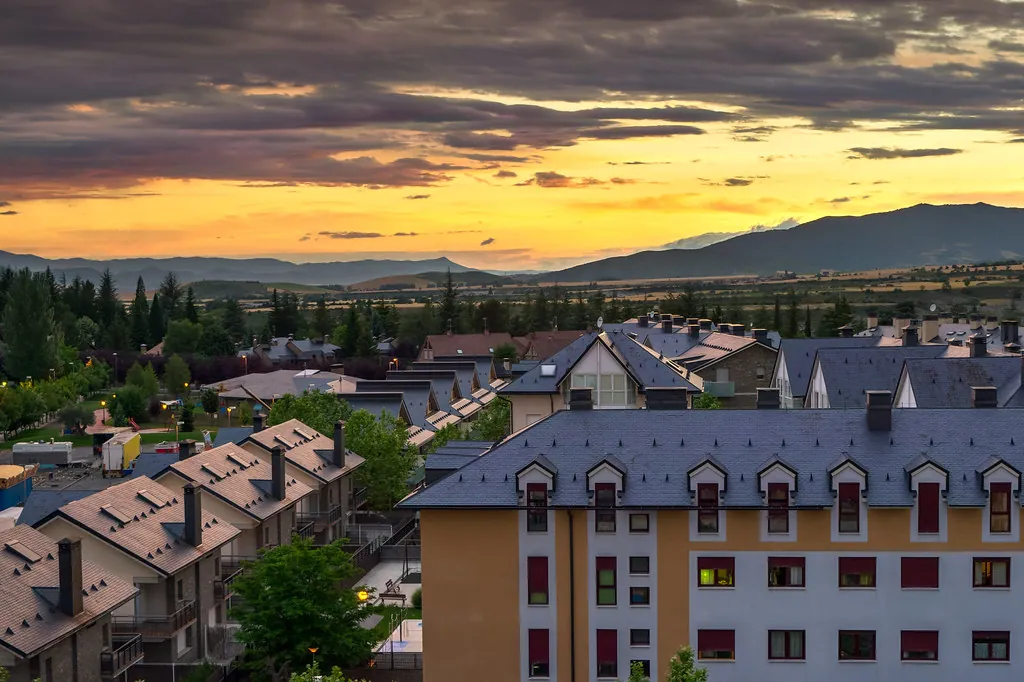
Stand on the ridge above Azaila at seven in the morning and you can watch the day arrive twice. First, a low band of peach-coloured light lifts over the Monegros plain; then, five minutes later, the same glow slips between the houses and ignites the stone bell-tower of the parish church. By the time the sun clears the horizon, the village’s entire population – 89 at the last count – is probably already awake. There simply isn’t enough traffic, nightlife or next-door neighbour to keep anyone asleep.
Azaila sits 276 m above sea-level on the lip of the Bajo Martín basin, an hour’s drive south-east of Teruel city. It is not high enough to be a mountain retreat, nor low enough to feel the full heat of the Ebro valley, so the air arrives with a dry, thyme-scented snap that makes walking feel effortless. The surrounding hills are too gentle to register on most contour maps; instead they roll away like a rumpled table-cloth, patched with almond groves and barley that turns from green to silver to ochre depending on the month.
What passes for a high street
There is no square worth bragging about, no mirador lined with souvenir stalls. The village core is a T-junction flanked by single-storey houses the colour of digestive biscuits. One branch leads past the church, the other past the only bar-restaurant. Both streets dead-end within 200 m into farm tracks and the open plain. Park too far from the centre and your car becomes an obstruction; locals leave theirs on the verge so tractors can squeeze through.
The bar answers to the functional name Restaurante Multiservicio Azaila. Inside are four pine tables, a television that stays mercifully silent, and a handwritten menu that changes according to whatever José María has found in Calanda that morning. A grilled pork fillet, chips and a tinaja of Somontano garnacha costs €12. Phone before 11 a.m. or the kitchen stays cold – a courtesy that doubles as a survival strategy when custom might mean two tables all week.
Empire leftovers without the crowds
Ten minutes on foot east of the last house, a gravel lane climbs to the Cabezo de Alcalá, a grassy plateau fenced only by rusty wire. Scattered across it are the basalt blocks of an Iberian-Roman settlement: jigsaw walls, a cistern you can still climb into, the ghost-grid of streets that once lined the main road between Zaragoza and the coast. No ticket office, no audio guide, just skylarks and the occasional passing shepherd who will point out the best-preserved stretch of wall in exchange for a cigarette. Sunrise here is spectacular; the stones glow like embers and you will share the view with precisely no-one.
Walking until the signal dies
Footpaths radiate from the village in four directions, all following the dry-stone boundaries of plots long since merged by mechanised farming. Markings are intermittent – a stripe of faded yellow on a telegraph pole, a cairn of almond shells – so carry an offline map. The shortest loop, north to the abandoned hamlet of Las Carpas and back, is 7 km of gentle gradient and takes two hours if you stop to watch rollers dive from the power lines. Longer routes reach isolated masías whose roofs have collapsed inward like broken pies; inside you will find hand-painted ration lists from the 1940s and the smell of wild marjoram drifting through the rafters.
April and late-October are the comfortable months: mid-20s by day, cool enough at night for a jumper. August is a furnace; thermometers touch 38 °C before breakfast and the only shade is your own shadow. Winter brings crystal skies but also the cierzo, a wind that rips across the plain and can drop the temperature to –5 °C within an hour. If you visit between December and February, book a house with central heating; Aragonese farmhouses were designed for summer survival, not winter comfort.
Darkness you can taste
Azaila applied for Starlight certification a few years ago, then quietly withdrew when the paperwork demanded more street-lighting upgrades than the council could afford. The result is accidental perfection. Once the solitary sodium lamp outside the church switches off at midnight, the sky reverts to an inky vault salted with stars. On clear nights the Milky Way is bright enough to cast shadows; shooting stars leave smoke-trails you can follow for seconds. Bring a blanket, lie on the football pitch (no goals, just two piles of stones) and listen for owls quarrelling in the cemetery pines.
How to arrive and why you might turn back
From Zaragoza, take the A-23 towards Sagunto, peel off at the Alcañiz exit and follow the A-226 through miles of wheat and silence. Six kilometres short of Valdealgorfa a narrow side road twists uphill; the tarmac stops at the village boundary. There is no petrol station, no cash machine, no shop – the last colmado closed when its proprietor died in 2018. Fill the tank and the wallet in Alcañiz or Calanda, stock up on groceries, and download offline maps before the phone signal falters among the almond groves.
Accommodation is limited to three self-catering houses marketed jointly as Casa del Bajo Martín. Expect thick walls, uneven floors and Wi-Fi that works only in the kitchen. Prices hover around €70 a night for two people, minimum stay two nights at weekends. Breakfast ingredients – olive oil, tomatoes, coffee – are left on the table; everything else you bring with you.
A festival that doubles the head-count
Every 15 August the village re-inflates. Exiles return from Zaragoza, Barcelona, even Munich; marquees go up in the lane, a sound system appears overnight, and for four days Azaila hosts what might politely be called a family reunion with fireworks. The programme is reassuringly parochial: paella for 200 served in the school playground, mass sung by a priest who once baptised half the congregation, and a disco that finishes before two so the farmers can milk. Outsiders are welcome but anonymity is impossible; by the second beer someone will ask which of your grandparents grew up here.
When silence feels like a luxury
Azaila will never feature on a glossy list of “Spain’s prettiest villages” – it lacks the necessary archways, geranium pots and boutique hotels. Instead it offers something British suburbia has almost forgotten: enough quiet to hear your blood move, skies wide enough to reset your compass, and the novel sensation of being the only stranger in a place that has not reorganised itself for your convenience. Come for the Roman ruins, stay for the pork fillet, but above all come before someone decides the silence is worth bottling and selling back to us.