Full Article
about Azanuy Alins
Ocultar artículo Leer artículo completo
The church bell strikes noon and the only other sound is wheat stalks brushing against each other in the wind. From the stone bench beside the portico you can watch the entire village cross the single paved street: a woman carrying shopping in a plastic Lidl bag, two boys kicking a half-deflated football, a farmer in a battered Seat Ibiza who raises one finger from the steering wheel in greeting. One hundred and seventy-seven souls, one bar, zero traffic lights. Welcome to Azanuy-Alins.
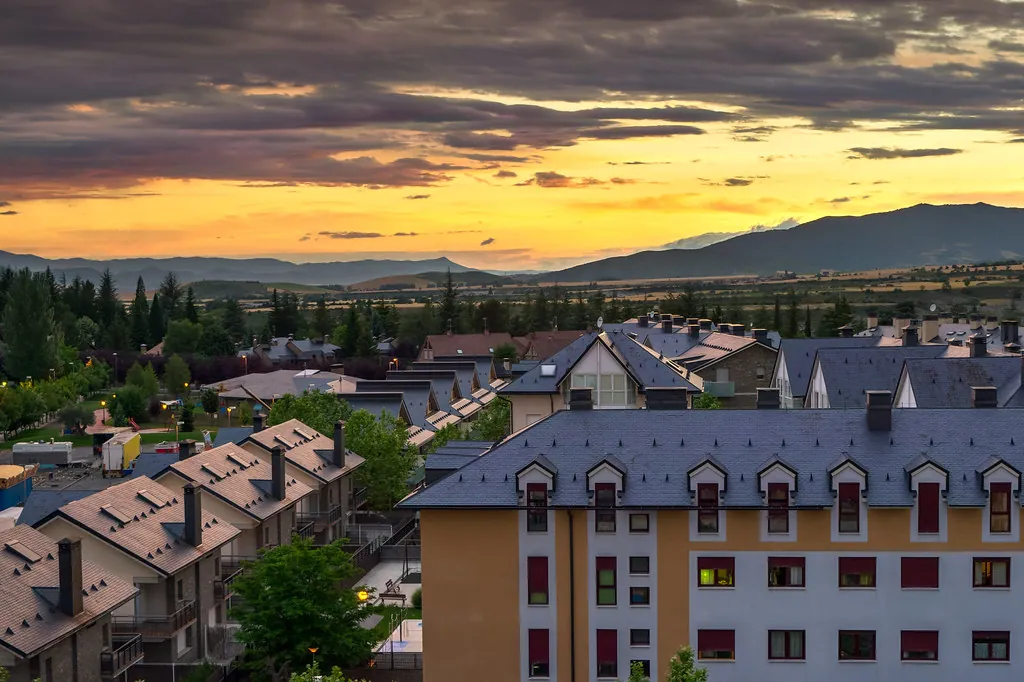
This is not the Aragón of postcard castles or wine-tasting circuits. It sits on the upper lip of La Litera, a cereal plateau that glides gently towards Lleida’s orchards and, somewhere far beyond, the Pyrenees. The houses are built from the very earth they stand on: ochre stone, sun-baked adobe, the odd timber beam darkened by centuries of grain dust. Some have been patched up as weekend hideouts for families from Zaragoza; others still have 1950s enamel numbers nailed to the door and a lean-to stable for a donkey that may, or may not, be retired.
What passes for a skyline
The parish church of San Pedro rises exactly 23 metres, measured by a local who once worked on the clock. The tower wears a skirt of ochre masonry, a belt of Renaissance brick, and a hat that looks suspiciously nineteenth-century. Inside, the nave smells of candle wax and damp stone; the priest arrives only twice a month, so the brass bell does most of the talking. Stand at the west door at sunset and the western cereal sea turns gold; on clear days you can just make out the jagged silhouette of the Pyrenees, 70 kilometres away, floating like a rumour.
Below the tower the streets follow the logic of animals rather than town planners. One lane narrows to the width of a hay bale before widening into an accidental square where the village fountain still runs. Children use it as a goalpost; grandparents use it to rinse lettuce. Beside it, a stone block shows the grain measures of 1846: one cahíz equals twelve fanegas, a piece of arithmetic that once decided whether families ate or migrated.
Walk downhill and you’ll pass troughs hacked out of bedrock, now full of last night’s rain; uphill, the lanes tilt so sharply that cars scrape their exhausts. Halfway up is the old bread oven, its iron door rusted open like a black mouth. On feast days someone still sweeps it out and bakes coques—flat dough topped with onion and sardine—while the rest of the village forms an impromptu queue that doubles as the day’s social network.
A landscape that keeps its own hours
Leave the last streetlamp behind and you are instantly inside the harvest calendar. Almond blossom in March, barley swaying by May, stubble burning in July. The GR-131 long-distance footpath skirts the village, but here it is nothing more than a farm track marked by two faded stripes on a telegraph pole. Follow it east for twenty minutes and you reach the Barranco de la Fou, a limestone gash where red-rumped swallows dive for water. Continue another hour and the plateau collapses into the river Sosa, a ribbon of green that smells of mint and damp willow. You will meet no souvenir sellers, no ticket booths, probably no one at all except a shepherd on a motorbike arguing with his sheepdog over WhatsApp.
Cyclists arrive with panniers loaded as if for the Himalayas, then realise the biggest climb is the 3 km back to the village. The reward is silence loud enough to hear your own tyres crunch. Spring brings poppies between the wheat rows; autumn paints the stubble bronze and the sky a theatrical violet that makes even the locals stop and stare.
How to eat when nothing is open
There is no ATM, no boutique deli, no Sunday farmers’ market. What you will find is a tiny grocery run by Conchi, open “nine until the bread runs out”. She stocks UHT milk, tinned squid and a local olive oil that costs €6 a litre if you bring your own bottle. The bar, Mesón de Azanuy, unlocks at seven for the farmers’ breakfast: coffee with a shot of brandy, thick toast rubbed with tomato, and a plate of chorizo that tastes of paprika and wood smoke. Order the lamb chops—three ribs, precisely grilled, €9—and the owner will drag the grill lid aside so you can watch the flames kiss the meat. Vegetarians get an omelette; vegans get the omelette without egg.
Evening meals require forward planning. Hotel Villa San Jorge, 2 km down the lane towards Fonz, will grill chicken and chips if you ask before noon. The wine list is short: Somontano reds, a local Moristel that drinks like Beaujolais with more backbone, and water from the village spring. Finish with a shot of hierbas—half the alcohol of grappa, twice the herbs—and drive back carefully; the road is unlit and the night belongs to wild boar.
Timing the trip (and the temperature)
April and May turn the plateau emerald; thermometer hovers around 18 °C at midday, 6 °C at dawn—perfect for walking before the sun gathers strength. September softens the light again and the barley stubble gives way to vetch and purple thistle. Mid-July to mid-August is furnace-hot: 35 °C by eleven, cicadas screaming, everything shuttered until six. The village fiesta happens around 15 August; the population quadruples, portable bars pump out reggaeton, and someone invariably drives a tractor into the fountain. Book accommodation early, or better yet, come a week later when the streets are swept and the wheat dust has settled.
Winter is a gamble. The plain sits at 450 m, high enough for frost to silver the almond bark, low enough for snow to melt by lunchtime. Roads become glassy after dusk; if the wind swings north, the Pyreneos deliver an icy slap that makes the stone houses inhospitable unless someone remembers to light the hearth. Many weekenders simply drain the pipes and head back to the city, leaving only the year-rounders and a silence so complete you can hear the church bell rust moving in the tower.
Getting here, leaving again
The closest fast road is the A-22, twenty minutes south; from there it is dual-carriageway all the way to Zaragoza (1 hr 30) or Barcelona (2 hr 15). Leave the autopista at Monzón and weave north on the HU-V-9031, a lane barely wider than a Tesco lorry. After 11 km you pass a sign reading “Azanuy-Alins 4 km” with an arrow that looks like an afterthought. The tarmac narrows further; hedges of almond and olive scratch the paintwork. Park on the small plateau before the village—turning circles are theoretical once inside.
There is no railway station. Monzón’s Renfe stop, 17 km away, gets three regional trains daily from Zaragoza; the bus that once met them was cancelled in 2011. Hire a car at Huesca or Lleida, fill the tank at El Grado (last 24-hour garage for 40 km), and arrive with everything you need because the shops will not open again until the bread arrives tomorrow.
When it is time to go
British visitors tend to describe Azanuy-Alins in negatives: no souvenirs, no queues, no night-life. That, of course, is the point. Come if you want to calibrate your watch to wheat rather than Wi-Fi, to remember that villages once lived by grain measures, fountains and the patience of mules. Leave before you start rating sunsets on TripAdvisor—this place has managed without stars for nine centuries and intends to keep it that way.