Full Article
about Beranuy
Ocultar artículo Leer artículo completo
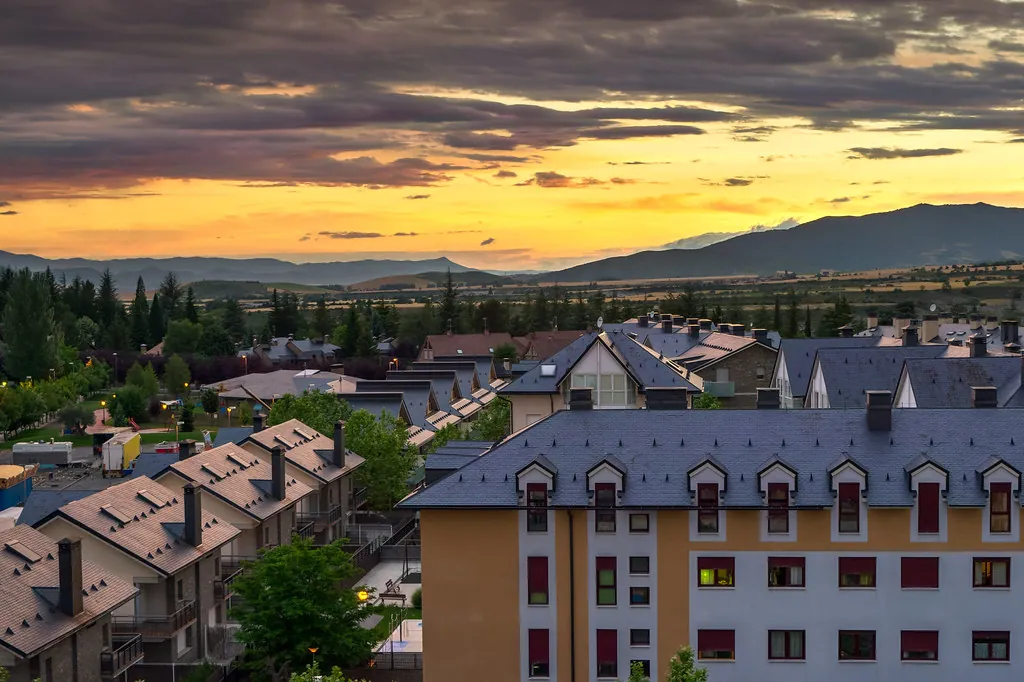
The church bell strikes noon, yet only the wind rushing up from the Esera valley answers back. At 904 metres above sea level, Beranuy’s stone houses sit scattered across a ridge like loose change emptied from a pocket—seventy-eight residents, four hamlets, and a silence so complete you can hear your own pulse while walking the single paved lane.
This is not a postcard village. No souvenir stalls, no guided tours, no restaurant terraces draped in fairy lights. Instead, slate roofs weigh down on thick walls the colour of weathered pewter, and the only traffic jam involves three sheep and a farmer who greets them by name. The municipality measures just 37 square kilometres, yet it contains three distinct biomes: dry Mediterranean scrub on south-facing slopes, oak and beech forest in the shady gullies, and, above 1,400 m, wind-scoured pastures where snow can linger until Easter. In April you can breakfast in shirt-sleeves on the village bench and, two hours later, crunch across a fragile crust of spring snow on the ridge path to neighbouring Castilló.
Walking the Vertical Past
Every path out of Beranuy starts by dropping. The old cart track to La Vall plunges 200 metres in barely a kilometre, past abandoned grain terraces so narrow a mule would struggle to turn round. Stone retaining walls bulge outward like old dictionaries on a sagging shelf; they were built in the 1700s, abandoned in the 1960s, and are now being quietly dismantled by frost and ivy. Once you reach the river, the only way is up again—an unspoken rule of Pyrenean geography. The reward is a loop through holm-oak and scots-pine forest where red kites ride thermals above the canopy and, if you sit still, a wild boar may shuffle across the path without noticing you.
Maps call these routes “PR-HU 123” or similar, but locals still use older names: Camí de la Nevera (the ice-store path), Camí de la Carbonera (charcoal-makers), Camí dels Traders. None are strenuous by Alpine standards, yet the cumulative ascent adds up. A circular walk from the church, down to the Esera, up to the ruined chapel of Santa Magdalena and back via the col of Lo Raconet is 8 km on paper, 600 m of climb in the legs, and takes a slow four hours with binocular stops. Mobile reception dies after the first kilometre; the GPS track wobbles off the screen. Bring paper, or simply follow the cairns and the smell of resin.
Summer hikers should start early. By 11 a.m. the sun ricochets off the limestone and temperatures can touch 34 °C in the valley even when the peaks still hold pockets of cool air. Autumn is kinder: long shadows, rowan berries the colour of rust, and the distant thud of shotguns as hunting parties flush partridge from the maquis. Winter walks are possible on the lower loops if you pack micro-crampons; the tarmac road from Campo to Beranuy is shaded and ices over first, so carry snow chains even when the forecast merely threatens.
What Passes for a Centre
The village nucleus clusters around the fifteenth-century parish church of San Andrés. Its bell tower doubles as the communal mobile-phone hotspot—locals prop their smartphones on the southern buttress and check WhatsApp while the priest inside polishes candlesticks for the one Sunday mass that still draws a crowd. The nave is plain, dim, and smells of paraffin and damp stone; frescoes were whitewashed in 1833 and never restored. Wedged into a side wall is a marble plaque listing the 14 men who left for Barcelona in 1957 to work at the SEAT factory; only three returned to retire here.
Opposite the church, Bar Casa Julian opens three days a week (Thursday to Saturday, 18.00-22.00). Inside, a single tap of Cruzcampo costs €1.80 and comes with a saucer of olives grown on the owner’s 200-year-old tree. There is no printed menu; if the hunting syndicate shot a wild boar on Wednesday, Thursday’s stew arrives thick with bay and clove. Otherwise, expect migas—fried breadcrumbs flecked with chorizo—served in an enamel bowl big enough for two. Payment is cash only; Julian writes the bill in pencil on a paper napkin.
For anything more elaborate you drive 18 km to Graus, the comarcal capital, where restaurants along Calle Mayor serve ribagorzana stew (lamb, chorizo and mountain beans) for €12. The road drops 500 m in tight hairpins; allow 25 minutes each way and pray you don’t meet a timber lorry at the narrowest bend.
Festivals and the Other 360 Days
The fiesta mayor happens on the last weekend of July. Population swells to perhaps 400 as emigrants return with grandchildren and deck chairs. Saturday night brings a communal paella cooked in a pan two metres wide; everyone brings their own spoon and wine. At midnight the village square turns into an open-air ballroom with a sound system run off a petrol generator; couples in their seventies dance the jota until the generator splutters out around 03.30. Sunday morning is hung-over and gentle: mass at eleven, followed by a sack race for children and a raffle whose top prize is a ham leg and a €20 petrol voucher.
The rest of the year is quieter. August evenings smell of cut hay and diesel from the single tractor still working. November is the month of matanza: families slaughter a pig in the backyard, spend three days making morcilla and chorizo, then hang the rest from attic beams where mountain air cures it slowly. If you rent a cottage and detect a faint sweet-fat aroma upstairs, that is why.
Arriving and Staying
No train comes closer than Huesca, 90 km south. From there a twice-daily Alosa bus reaches Campo (population 320) at the valley bottom; the 14:15 service connects with the Thursday market. From Campo you phone for a taxi—Juanito charges a flat €18 to Beranuy, but you must ring before 20:00 or he shuts his mobile and goes to bed. Car hire from Zaragoza airport (two-hour drive) is the realistic option; the A-22 motorway slashes across the plain, then the N-123 climbs into the foothills. Petrol stations close at 20:00 and all day Sunday; fill up in Barbastro.
Accommodation is limited. Three stone cottages have been restored as holiday lets; the largest, Casa Gallinero, sleeps six and costs €90 per night with a two-night minimum. Heating is by pellet stove; instructions are in Spanish taped to the chimney breast. The village has no shop, so stock up in Graus: bread, milk, and a couple of bottles of Somontano wine to sip while the stove ticks itself to life. Mobile coverage on Vodafone works if you stand by the east-facing window; EE and O2 are hopeless anywhere inside the parish boundaries.
The Honest Verdict
Beranuy will not keep you busy. You will not tick off Unesco sites or fill an Instagram grid with pastel façades. What it offers is gradient—physical and temporal. Walk uphill for an hour and the twenty-first century thins out with every step: phone signal, traffic hum, even the contrails fade. You reach a ridge where the only markers are dry-stone walls and a view that stretches north to the high Pyrenees, still white in May. Turn around and the village looks even smaller, a handful of roofs between two rivers, holding its ground against the mountain and the slow drift of people towards the cities.
Come prepared for that smallness. If it rains all weekend you will reread the one paperback you packed and listen to water drip from the chestnut beams. If the road ices over you may spend an unplanned night because the council gritter refuses to climb above 800 metres. Yet if you arrive willing to match the village’s tempo—up at dawn, siesta at noon, stars without light pollution—Beranuy gives back a calibration point. Somewhere between the church bell that no one winds and the shepherd who still counts his flock aloud is a measure of time less frantic than the one your phone delivers. Take it home with you; the signal returns soon enough on the descent to the plain.