Full Article
about Bielsa
Ocultar artículo Leer artículo completo
The morning bus from Aínsa wheezes to a halt at 1 023 m, doors fling open, and the air bites six degrees colder than it did thirty kilometres back. That’s the first lesson in Bielsa: altitude matters. The second is delivered by the Cinca river that barrels past the stone houses – it’s louder than the traffic, and in May it’s the colour of well-steeped tea from melting snow upstream.
Stone, slate and frontier light
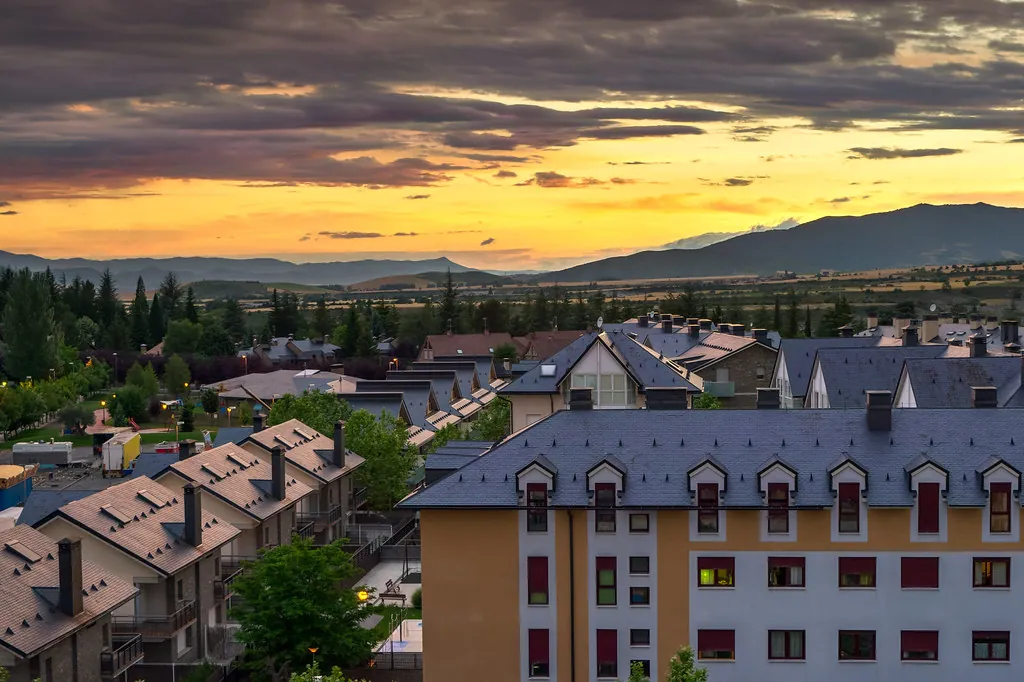
No one arrives here by accident. The road ends 8 km further up the valley, so the village has never had to prettify itself for through-traffic. Houses are still wedged into the slope the way farmers left them: roofs of thick grey slate, walls the same ochre granite as the cliffs behind. The only concession to ornament is the occasional wooden balcony, added in the 1920s when the Guardia Civil barracks went up and officers wanted somewhere to dry their boots.
A five-minute stroll from the tiny plaza takes you to the top of the old town. Narrow lanes funnel the wind; chimneys smell of oak and of lamb fat dripping onto coals. The seventeenth-century church of San Pedro squats rather than soars – its bell tower doubles as a lightning conductor and a lookout for summer fires. Inside, the altarpiece is painted pine, not gilt, and the votive candles are paid for by the proceeds of the Saturday lottery stall outside the baker’s. It’s a working building, not a set.
Opposite, the Museo Etnológico occupies a former grain store. Entry is €3 and you’ll need it: the exhibits explain why every doorway is five foot six, why kitchen beams are black only on the north side, and why the local dialect rolls its ‘r’ more fiercely than Castilian Spanish. There’s a threshing sledge with teeth made from deer's antlers – the Pyrenean equivalent of recycling.
Valley of the cirque
Drive, cycle or thumb the twice-daily minibus another 10 minutes and the valley walls close in until only a ribbon of sky remains. This is the Pineta cirque, a glacial amphitheatre whose headwall climbs 1 500 m in one continuous sweep to the summits of Monte Perdido (3 355 m) and Cilindro de Marboré (3 328 m). The Parador de Bielsa sits at the foot of it, a 1970s concrete block that somehow got permission inside the national park. Book a terrace coffee even if you’re not staying: the view comes free and the waiters’ brusqueness is locally famous, so you can tick that off too.
From the hotel door a gravel track continues up-valley. Within thirty minutes you pass waterfalls that would be headline news in the Lake District but here don’t even merit a name on the map. La Larri cascade is signed after 3 km; the path crosses two avalanche gullies where the birch trees grow at 45°, permanently bent by winter snow. Add another hour and you reach the Refugio de Pineta, a stone hut selling cheese sandwiches and cans of beer kept cold in the stream. Serious walkers leave at dawn for the Balcón de Pineta, a limestone terrace that stares straight into Monte Perdido’s north face – eight hours round trip, 1 100 m of ascent, and the weather can turn before you’ve tightened your laces.
When the snow arrives
Between December and March the road is kept open only as far as the village; beyond that, the valley belongs to ski-tourers and the occasional wolf print. The local council grooms a 12-km loop for cross-country skis when conditions allow – day tickets €10, hire gear in the petrol station that doubles as the sports shop. February’s Carnaval is the social highlight: men dressed as hairy bears (the “oso” tradition) chase children through the streets while a brass band plays something half-way between a hymn and a drinking song. Accommodation triples in price and the single ATM empties by Saturday lunchtime; bring cash and a tolerance for incense mixed with red wine.
Eating like you mean it
There are three cafés, one baker, no supermarkets. Menus revolve around what can be carried in on the back of a mule when the pass is closed. Chiretas – rice and lamb-offal sausages – taste like a Pyrenean haggis and arrive sizzling in an iron pan. Trucha a la navarra is river trout wrapped in serrano ham, safe for anyone who baulks at entrails. Migas, fried breadcrumbs with grapes and bacon, is served on rainy days because, locals claim, “it sticks to the ribs better than a raincoat”. Vegetarians usually end up with fried eggs and chips; the village has heard of tofu but views it with suspicion.
Wine comes from Somontano, an hour’s drive south, and the house red is lighter than Rioja, designed for drinking at lunch and walking it off afterwards. Finish with a miguelito – a crème-filled pastry that originated in nearby Aínsa and tastes like a custard doughnut that’s been to finishing school.
Getting there, staying sane
No railway line has ever fought its way through these gorges. From the UK, fly to Barcelona or Zaragoza, collect a hire car with winter tyres if it’s between November and April, and allow four hours including coffee. The final 30 km from Aínsa is a continuous series of hairpins; meet a lorry and someone has to reverse. Snow chains are compulsory kit above 1 000 m from 1 November to 15 May – police do spot checks and the fine is €200.
Beds number fewer than 150. The Parador has 69 rooms, doubles from €120 in low season, double that in August. Smaller hostales charge €45–€60 for clean rooms with shared bathrooms and views of someone’s woodpile. The riverside campsite opens April–October; €18 for two people and a tent, hot showers included, and the ten-minute walk into town is flat enough for pushchairs.
Phone coverage fades once you leave the main street; download offline maps before heading up-valley. The medical centre is staffed on weekday mornings only – for anything serious it’s a helicopter to Huesca, weather permitting. Travel insurance that covers “mountain activities” is worth the extra premium.
Leaving the valley
Most visitors use Bielsa as a launchpad for Ordesa’s better-known trails, then dash off to postcard Spain. Stay an extra night and you’ll notice the village loosens its shoulders once the day-trippers leave. Swifts replace engine noise, the bakery reduces its croissant count to six (they know exactly who’ll buy them), and old men move chairs to the square to follow the last rectangle of sun as it slides across the wall. The mountains don’t do sunset blazes – the rock merely turns from grey to charcoal – but the temperature drop is so sharp you can feel the moment the earth tilts away from the light.
Drive out at dawn and the peaks will follow you in the rear-view mirror for twenty kilometres, shrinking until they look like a child’s drawing of a serrated knife. Somewhere behind them the river is still arguing with the stones, the bakery timer is set for five-thirty, and the bears – the real ones – are coming down to drink. Bielsa will be glad to see you go; it’s not rude, just honest. The valley was here first, and it intends to stay that way.