Full Article
about Bronchales
Ocultar artículo Leer artículo completo
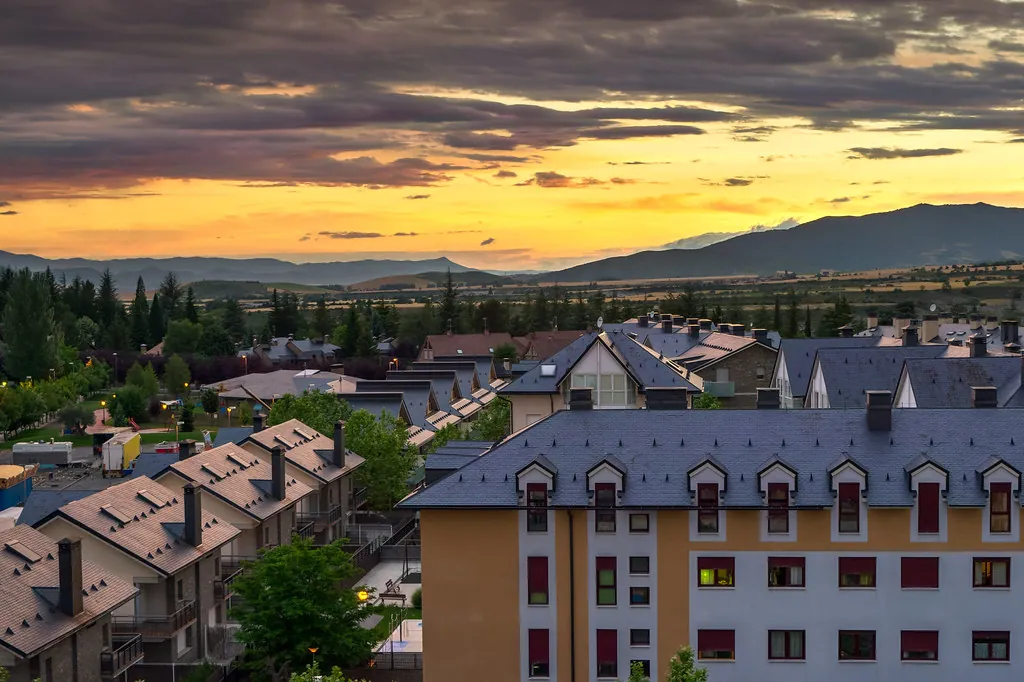
The thermometer reads eight degrees at eleven o'clock on an August morning. Swallows wheel below the church tower, not above it, and every stone house in Bronchales has its chimney smoking. This is Spain's ceiling—1,569 m up in the Sierra de Albarracín—where the air thins and the pine forest presses in so thickly that even July nights demand a proper jacket.
Four hundred and thirty-five people live here year-round, enough to keep the bakery open and the bar quarrelling over the domino scores, but few enough that strangers are clocked before they've closed the car door. The village clings to a saddle between two crests of quartzite; streets tilt at angles that would trouble a San Francisco tram, and the stone houses grow straight out of the rock, their timber balconies painted the same ox-blood red they've used since the 1800s.
Forests Older Than the Houses
Walk fifty metres past the last cottage and you are inside one of Europe's largest continuous pinewoods. The trees are maritime pine and Scots pine, some well over a century old, planted after the cork-oak forests were stripped for charcoal during Spain's early iron industry. Now they tower thirty metres, filtering the light into a green-gold haze that smells of resin and wet earth. Marked paths leave from the top of Calle de la Iglesia; the shortest, the Ruta de las Fuentes, is an easy 4 km loop that passes five stone springs still used by locals for drinking water. Serious walkers can continue north-east along the PR-TE 58 to the summit of Balsa Mora (1,950 m), a stiff three-hour pull that ends on bare rock with views across two provinces.
Autumn is when the forest earns its keep. From mid-October, depending on rainfall, the undergrowth erupts with mushrooms: níscalos (saffron milk-caps), rebozuelos (golden chanterelles) and the prized boletus edulis. Spanish legislation is strict: you need a free day permit from the town hall, a maximum haul of 3 kg, and enough Spanish to argue over species with the forest guard who patrols with a wooden walking stick and an encyclopaedic knowledge of fungi. Even if you never stoop to pick, the market stalls set up on Plaza Mayor weekends sell porcini the size of side plates for €16 a kilo—half the Madrid price.
What to Eat When the Fire's Lit
Mountain cooking here is built around what keeps when the snow drifts against the door. Breakfast might be migas—breadcrumbs fried in olive oil with garlic and bits of chorizo—served with a glass of local red that costs €2 and tastes like Ribena mixed with pepper. Lunch is conejo al ajo arriero, rabbit pounded with garlic and dried pepper until it collapses into a brick-red stew thick enough to stand a spoon in. Evening brings trucha a la serrana, brown trout caught the same dawn in the Guadalaviar twenty kilometres north, pan-fried with jamón fat and a squeeze of lemon. Vegetarians survive on setas a la plancha, whatever mushrooms the chef's cousin found that morning, and the excellent queso de oveja, a semi-cured ewe's milk cheese with the faint tang of thyme.
There are two proper restaurants and one bar that serves food. Casa Santiago opens only at weekends outside July–August; booking means ringing the owner's mobile and hoping he answers. Asador El Pinarejo has a fixed daily menu at €14 including wine—arrive before two o'clock or the guisote (a hefty potato and pork stew) runs out. Portions are calibrated for men who have spent the morning chopping pine; half-portions (media ración) are acceptable to order and still feed two.
Winter Comes Early and Stays Late
The first snow usually falls in late October and can reappear as late as May. When it does, the TE-V-9013—the only road in—gets the blade of a 1970s tractor pushed by the village mayor because the council can't afford a gritter. Chains or winter tyres are non-negotiable; the final 12 km rise 600 m with hairpins tight enough to make a Welsh pass feel generous. In compensation, the village turns into a low-budget alpine set: drifts banked against stone, wood-smoke ribboning upwards, and absolute silence broken only by the church bell striking the quarter. Night temperatures of –15 °C are routine; the small casa rural owners leave hot-water bottles on the beds and still charge only €55 for a double.
Summer, by contrast, is almost mild. Daytime peaks hover around 24 °C, nights drop to 12 °C, and the forest provides instant shade. Spanish families from Valencia and Madrid migrate here in August, so book accommodation early and expect the lone supermarket to run out of milk by Sunday evening. Mid-week visitors in June or September get the place to themselves, plus wildflowers that turn the high meadows into a Pointillist canvas of purple centaurea and yellow hippocrepis.
Beyond the Village: Albarracín and the Bronze Age
Twenty-five minutes down the pine-flanked road lies Albarracín, a fortified town stacked on a cliff above the Guadalaviar and routinely hyped as Spain's most beautiful settlement. The description is almost accurate: pink-medieval walls, cobbled lanes barely wider than a donkey, and a cathedral whose tower you can climb for €5 to see why every photography tutor includes it in workshop brochures. Go early; by eleven the tour buses arrive and the narrow streets become a slow-moving conveyor belt of selfie sticks.
Between Bronchales and Albarracín, detour to the Pinturas Rupestres de Albarracín, a UNESCO-listed cluster of Bronze Age rock art reached by a 2 km forest track passable in an ordinary car. The paintings—hunting scenes, goats, an archer who looks suspiciously like a traffic policeman—are protected behind iron grills, but the custodian will unlock them if you ring the number posted on the gate and promise to shut it properly afterwards. Entry is free; tip him a couple of euros and he'll point out the pigment that still glows ochre after 4,000 winters.
How to Get Here (and Why You Might Turn Back)
The practical bit: fly to Valencia or Zaragoza, hire a car, and drive. From Valencia it's 185 km, last stretch on the A-23 then the TE-V-9013; allow three hours because the sat-nav lies about mountain speeds. There is no petrol station in Bronchales, no cash machine, and no mobile signal on large stretches of the approach—download offline maps before you leave the autopista. Buses run from Teruel to Albarracín twice daily but terminate there; reaching Bronchales without wheels would involve hitch-hiking with mushroom pickers, legal only if you carry a permit.
Accommodation is limited to a handful of casas rurales, two self-catering flats above the bakery, and the improbably located Camping Las Corralizas at 1,620 m—reportedly Spain's highest campsite, open May–October, €18 a night for a pitch with hot showers that actually work. Book ahead for October weekends when mycological societies descend; otherwise you may end up sleeping in the car park where the temperature free-falls to 3 °C by dawn.
Bronchales will never tick the boxes of a conventional holiday. There are no souvenir shops, no cocktail bars, and the nearest beach is a two-hour dash to the Med. What it offers instead is altitude-induced clarity: the realisation that Spain can be cold, quiet, and scented with pine rather than orange blossom. Pack walking boots, a thick jumper, and expectations set to "slow". The village will handle the rest.