Full Article
about Buena
Ocultar artículo Leer artículo completo
At 1,200 m above sea level, even the air feels different. Step out of the car on Buena’s single street and the first thing that hits you is the temperature—five degrees cooler than Zaragoza, ten degrees below Valencia, whatever the season. The second thing is the stillness: no café music, no motorway hum, just wind across cereal fields and the occasional clank of a farmer’s gate.
Stone, Adobe and the Business of Survival
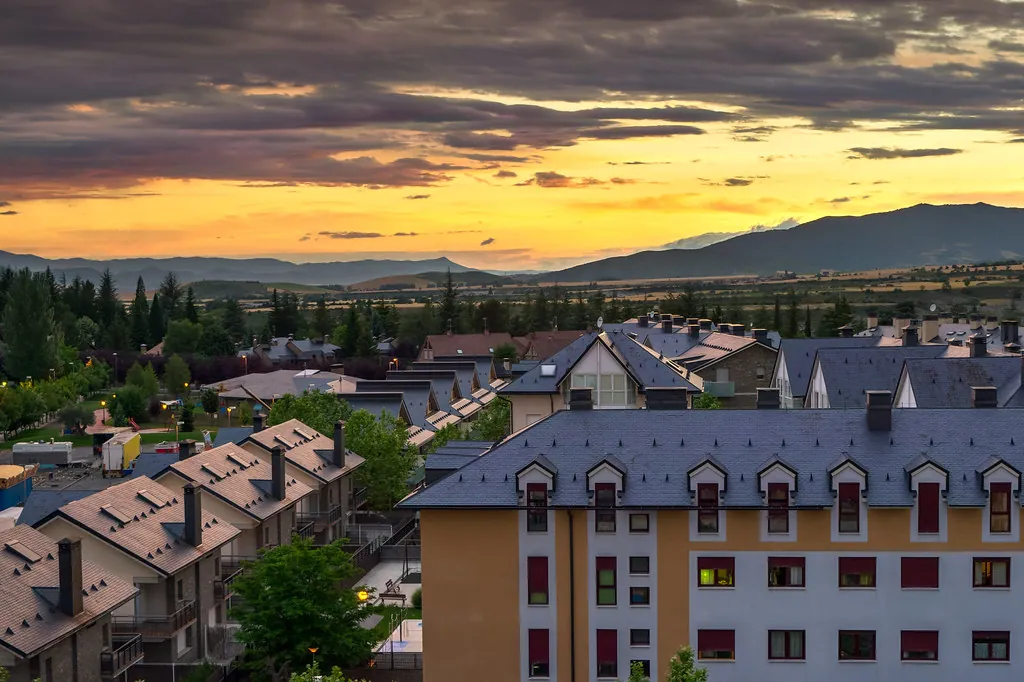
Buena is not here to seduce. Forty-odd houses, a church, a bar that opens when it feels like it, and a population that slips below fifty once the school holidays end. The buildings are squared-off and practical: local stone below, adobe brick above, roofs of curved Arab tile weighted with rocks so they stay put in winter gales. Paint is optional; insulation is not. If you expect geraniums round every door, drive to Albarracín instead. If you want to see how Spain’s interior keeps ticking long after headlines declare the villages dead, stay.
Start in the square. The Iglesia de San Pedro apse forms one side, its walls two metres thick, its bell tower more lookout than ornament. The other three sides are a mix of dwellings, a former grain store now used as the ayuntamiento, and Bar La Plaza—wood-burning stove, hand-written menu, opening hours that shrink after the weekend. Inside the church you’ll find a single-nave box of masonry designed for blizzards, not baroque tourism. The altarpiece is nineteenth-century pine, gesso flaking like old emulsion; the Stations of the Cross are painted directly onto plaster, the colours muted by a century of incense and Teruel dust.
Wander uphill along Calle de la Ermita and the village reveals its working parts: stone-paved corrals where sheep once queued for milking, timber-beamed haylofts propped on mushroom-shaped stones to keep rats out, communal ovens built into party walls. Everything is on a human scale because it had to be built by humans—no cranes up here until recently. Peer over the western escarpment and the Jiloca valley unrolls in a patchwork of ochre and sage, stitched together by dry-stone walls that predate the Civil War.
Walking Without Waymarks
Buena has no ticket office, no audio guide, no gift shop. What it does have is a lattice of farm tracks that link to the next village, and the next, sometimes signed, sometimes guessable only by tyre ruts. The most straightforward circuit heads south-east to Villarroya del Campo (population 120, water fountain, closed bakery). It’s 6 km out and back, 200 m of gentle ascent, and you’ll meet more wheat stubble than people. Spring brings red poppies among the barley; October turns the broom bright yellow and releases a smell like dried hay. Keep an eye out for booted eagles riding the thermals above the ravine—this is migration corridor territory.
If you want something longer, follow the GR 84 long-distance footpath as it skirts the village. Westwards the route drops into the Riachuelo valley, climbs through juniper and rosemary, then delivers you to Monreal del Campo in just under three hours. The return can be made on the paved road—quiet enough that a tractor is front-page news—or by doubling back. Summer walkers should carry at least a litre of water per person; shade exists, but only where a cliff faces north. In winter the same path can be under powder snow within an hour of a storm: micro-spikes or lightweight crampons live in local car boots for a reason.
Night-time at 40° North
Light pollution maps show a bruise of blackness over north-west Teruel, and Buena sits in the middle of it. Walk fifty metres beyond the last streetlamp and the Milky Way becomes a credible white smear rather than a screensaver. Photographers set up on the football pitch—an unstocked, unlined rectangle whose goals have no nets. Exposures longer than twenty seconds capture Andromeda without trailing; during August you can log Perseids at one a minute, wrapped in a jacket because the thermometer is already heading for single figures. The village installed downward-facing LED lamps a few years ago, so you won’t be blinded on the way home.
Eating, Sleeping and the Art of Lowering Expectations
There is no hotel, no casa rural with a booking.com widget, no supermarket. The bar serves coffee from 08:00 if the owner is awake, draught beer from the same nozzle that dispenses lemonade, and a daily plate that might be migas with grapes, or lentils with chorizo, always under €9. Payment is cash; the card machine “only works when it feels like it.” If you need to stay overnight, the nearest beds are in Monreal del Campo (20 min drive): Hostal El Molino has doubles from €45, heating that works, and a restaurant that understands vegetarian means no jamón garnish. Calamocha, fifteen minutes further, adds a Thursday market and a petrol station that closes at 21:00.
Bring supplies if you have dietary requirements; the village shop closed in 2011 and the mobile grocer in a white van swings by on Tuesdays—locals hear the horn and sprint. Tap water is potable but tastes of iron; if that bothers you, fill up at the fuente on the road out, where limestone sweetens it.
When to Come, When to Stay Away
April–May and mid-September to early November are the sweet spots. Daytime highs hover around 18 °C, nights are crisp but not freezing, and the track to the ruined ermita of San Cristóbal is firm underfoot. July and August deliver cloudless skies perfect for astrophotography, but 30 °C by 11:00 and not a sliver of shade on the walks. The bar extends its hours because the village doubles in size with returning grandchildren; conversations happen at 02:00 outside the church, and nobody apologises for the noise.
December through March is another country. Roads can be clear at noon and impassable by teatime when the wind drifts snow across the plateau. Chains are not optional. On the other hand, you get the stone walls etched white, lamplit interiors that smell of oak smoke, and a silence so complete you’ll hear your own pulse. If that appeals, book a four-wheel-drive and pack a Thermos of coffee—there is no roadside assistance within an hour.
Fiesta, or How to be Adopted for 48 Hours
The main fiestas honour the Virgen de la Blanca around 15 August. The programme is printed on a single A4 sheet taped to the church door and changes daily. Expect a folk mass with brass band, a procession that stops at three house-shrines for tumblers of wine, an afternoon foam fight improvised with a fire engine, and a dinner of roast lamb in the square at long tables you didn’t reserve but are welcome to join. Bring tissues—the smoke from the grape-vine barbecue will make your eyes stream—and offer to buy your neighbour a jar of beer; acceptance is instant and you’ll leave with more phone numbers than you acquired at university.
Getting There, Getting Out
Buena sits 75 km north-west of Teruel city. From Zaragoza take the A-23 towards Sagunto, exit at Calamocha, then follow the TE-61 and TE-V-3021 through twisting cereal country. The final 12 km are single-lane with occasional passing bays; the surface is good but wandering sheep have right of way. Total driving time from central Zaragoza is 1 hr 45 min, from Valencia 2 hr 30 min. There is no bus, no train, no Uber, no Cabify. If you fly into Madrid, budget three hours on the road via the A-2 and the same A-23 turn-off.
Fill the tank before you leave the motorway; the village has no fuel, and the nearest 24-hour station is back in Calamocha. Phone coverage is patchy—Movistar works on the north side of the square, Vodafone requires a walk to the cemetery ridge. Download offline maps and tell someone where you’re going.
Worth It?
Buena will not change your life. It offers no souvenir beyond the echo of your own footsteps between high walls and perhaps a jar of local honey sold on trust from a windowsill. What it does give is a calibration point: a place where the altitude, the emptiness and the pace reset urban expectations. Arrive with a full water bottle, an open afternoon and no fixed idea of what constitutes an attraction, and the village meets you halfway. Leave before you start thinking 1,200 m is normal, or you may find city streets intolerably loud on the return.