Full Article
about Camporrells
Ocultar artículo Leer artículo completo
The road peels off the N-123 just after Graus, climbs through olive terraces, then corkscrews into proper mountains. Six kilometres later the tarmac narrows to a single strip, the phone signal dies, and Camporrells appears: forty-odd stone houses clamped to a ridge at 665 m, looking south across a fold of oak and pine that runs all the way to the Ebro basin. No souvenir stalls, no coach park, not even a bar—just the sound of wind in the pines and the occasional clank of a sheep bell.
A village that forgot to grow
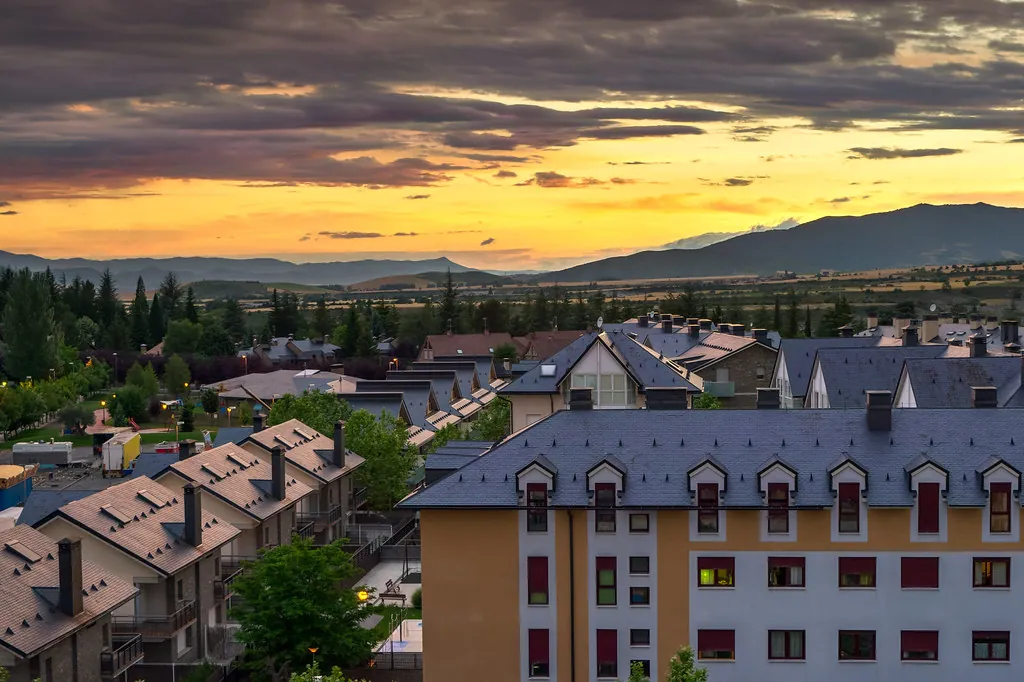
Most maps spell it Camporrélls; locals drop the accent and sometimes the final “s”. Either way, it is tiny. The 2023 census lists 47 permanent residents, though that swells to perhaps 80 when weekend owners from Barcelona or Zaragoza drive up. Houses are built from honey-coloured limestone quarried on the spot, roofed with thick slate slabs held down by hand-cut wedges. Narrow lanes angle between them just wide enough for a tractor; drainage channels carved during Franco’s era still work after heavy storms. There is no square in the Spanish sense, only a widening of lane where the church door and the old school face one another. The church bell strikes the hour, and the echo answers from the opposite slope a second later.
Inside, the single-aisle chapel is pure Aragonese sobriety: whitewashed walls, a pine pulpit painted ox-blood red, and a 17th-century retablo whose gold leaf has faded to the colour of autumn wheat. Mass is held twice a month; on other Sundays the priest continues up the mountain to the even smaller hamlet of Nasiet. Visitors are welcome, but the building is kept locked outside service times—collect the key from the house opposite the bread oven, return it before nightfall.
Walking without way-markers
Footpaths start literally at the doorstep. A five-minute stroll north-east drops you into the Barranco de Camporrells, a shallow gorge shaded by Scots pine and kermes oak. The track is an old muleteers’ route that once carried salt from the Ebro valley up into the high Pyrenees; stone retaining walls still stand after two centuries. Gradient is gentle, so trainers suffice, but carry water—there are no fountains above the village and summer temperatures sit in the low thirties.
For something more committing, continue for 90 minutes to the abandoned settlement of La Masieta. Roofs have collapsed but dry-stone walls remain, together with a stone basin where snow was once compacted for refrigeration. Griffon vultures nest on the crags above; watch for their six-foot wingspan riding thermals at eye level. Return via the forest service track that contours back to Camporrells, making a three-hour loop with 250 m of ascent. Ice can linger here until late March; if you’re visiting between December and February, carry micro-crampons and expect the final road to the village to be salted by the local council only after 10 a.m.
Supplies, or the lack of them
There is no shop, no filling station, and—crucially—no bar. The last commercial enterprise, a grocery run by the Vives family, closed in 1998 when the elder Señor Vives retired. Plan accordingly. Graus, 18 km and 20 minutes down the hill, has two well-stocked supermarkets, a Saturday market with local cheese and honey, and an ATM that still dispenses €50 notes if you ask nicely. Most self-catering houses leave a two-page list in Spanish and English of what to buy before you drive up; heed it, because once the sun sets you will not want to negotiate the switchbacks again.
Accommodation options are limited to three restored village houses, all bookable through the same cooperative website. Casa Cardelina sleeps six and has under-floor heating powered by an air-source heat pump—welcome after a January day when the mercury never crawls above 4 °C. Casa Nasiet is smaller (two bedrooms, one shower) but opens onto a walled garden with a stone barbecue and unobstructed views of the Moncayo massif 60 km west. Nights are dark enough to read by starlight; bring a red torch if you want to preserve night vision for meteor spotting.
Eating in the stone kitchen
Local cuisine is built around what the land gives in any given week. In late April that means calçot-style onions grilled over vine prunings and dipped in almond-thickened romesco; by mid-October it is a wood-pigeon stew scented with mountain rosemary. The nearest restaurant is in La Puebla de Castro, a 25-minute drive on a road that would make a rally driver grin. Their menu del día runs to three courses plus wine for €16—order the ternasco (milk-fed lamb) if it appears, but be aware portions are sized for people who have spent the morning hoeing almonds.
Back in the village, kitchens come equipped with paella pans and sharp knives. Graus deli sells Somontano wine from the bodegas of Barbastro: try a bottle of Pirineos “Glárima” blanco, a crisp macabeo that costs €6 and pairs surprisingly well with tinned sardines eaten on the terrace while the sun drops behind the ridge. If you arrive during the third weekend of November you may catch the matanza communal; nowadays the actual pig slaughter happens in an abattoir for hygiene reasons, but neighbours still gather to make longaniza sausages and share a stew of liver and saffron rice. Tourists are welcome to watch, not to Instagram.
Seasons of silence
Spring brings the sound of bees and the smell of broom. Daytime highs hover around 18 °C, ideal for walking, though nights stay cool enough for a jumper. Wild asparagus sprouts along path edges; locals carry a knife and a plastic bag for impromptu harvesting. By June the thermometer pushes past 30 °C; activity shifts to dawn and dusk, and the only shade is what you find under a pine. August is hot, dry, and surprisingly noisy—cicadas in the valley, weekend motorbikes on the distant road to Benabarre. Book early if you must come then; British school holidays overlap with Spanish ones, and the three houses fill fast.
Autumn is the sweet spot. Almonds ripen in September, turning the lower slopes silver-grey; by mid-October the oak canopy flashes copper and gold. Rain is possible but usually gentle, arriving in afternoon bursts that leave the air scrubbed clean. Winter is not for everyone. The village sits just high enough for snow several times a year; when it comes, the access road is ploughed once daily, at lunchtime. Bring chains, or better yet, a set of winter tyres. Inside the houses log-burners keep things toasty, but you will spend long evenings indoors—download books before you leave civilisation.
Leaving without a souvenir
There is nothing to buy except silence and wide sky. That, for most British visitors, is the point. The nearest airport is Zaragoza, two and a half hours by hire car on mainly empty motorways; Barcelona adds an extra hour but offers more flight choice. Either way, the final six kilometres remind you that maps are only approximate, and that “rural Spain” still exists in its unvarnished form. Pack a pair of decent shoes, a bottle of olive oil from Graus, and the expectation that nobody will ask where you’re from or where you’re going. Camporrells does not do narratives; it simply is. Turn up, walk the ridge, and be gone before the church bell strikes twelve—unless the silence persuades you to stay another day, in which case the village will not mind at all.