Full Article
about Cucalon
Ocultar artículo Leer artículo completo
The church bell strikes noon, yet only a single tractor answers back. At 1,030 metres above sea level, Cucalón’s silence is so complete that the metallic echo seems to bounce off empty sky rather than stone. Seventy-eight residents, one grocery van twice a week, and a bar that closed in 1998: this is the arithmetic that governs life on the wind-scoured ridge between Teruel and Zaragoza.
A Village that Fits in One Glance
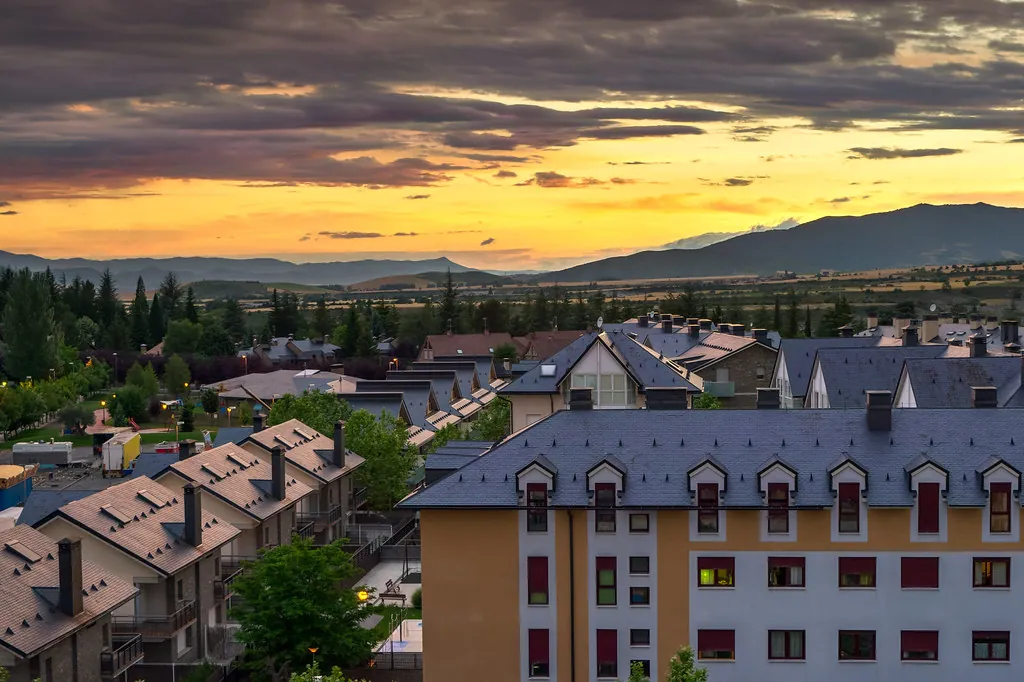
British visitors expecting a plaza humming with cafés will need to recalibrate. The entire urban core is three parallel lanes no longer than a cricket pitch, stitched together by cobbled alleys just wide enough for a donkey and cart. Houses grow straight from the bedrock: lower walls of honey-coloured limestone, upper floors of adobe the colour of digestive biscuits, roofs weighted with Roman tiles that sing in a gale. Many façades still carry painted numbers from the 1950s agricultural census, ghostly white digits that once helped officials locate grain stores. Look closer and you’ll spot bread ovens bulging like external hearths, wine cellars dug into the hill’s south face, and stable doors hinged with iron strappings forged in a nearby forge that went cold in 1973.
The only public building of any scale is the medieval church of San Miguel. It is kept locked unless the mayor’s cousin, Pilar, is awake; ask at the town hall (open Tuesdays only, 09:00-11:00) and she’ll appear with a key the size of a shepherd’s crook. Inside, a single nave, whitewashed every spring, holds a Baroque retablo blackened by centuries of tallow. Sunlight through the rose window lands on the nineteenth-century organ, its pipes still playable if someone remembers to pump the bellows. Donation box proceeds fund the annual fiesta; last year the harvest raised €137 and six bottles of homemade anisette.
Walking into Empty Countryside
Cucalón sits on the lip of the Jiloca basin, a high steppe that feels more Castilian than Aragonese. From the last streetlamp—solar-powered, installed 2019—a web of livestock trails unrolls across wheat stubble and thyme-scented scrub. Within ten minutes the village shrinks to a grey smudge, and the only soundtrack is the rasp of corn buntings and, overhead, the occasional griffon vulture riding thermals like grey kites.
A straightforward circuit heads south-east to the abandoned hamlet of Las Alcubillas (3.8 km, 120 m ascent). Stone terraces there still support almond trees that nobody harvests; in late August you can fill a carrier bag for the price of a scratched forearm. Continue another hour and you reach the ridge of the Sierra de Santa Cruz, where the plain drops away so suddenly that the Mediterranean appears as a silver stripe on the horizon—though that may be heat haze or wishful thinking. Mobile reception dies halfway up, so download your map before leaving the last British-owned rental cottage at the edge of the village.
Winter walkers should note the altitude: snow can arrive overnight in January, and the TE-V-7041 becomes an ice luge before ten o’clock. The council grits sporadically, using a 1987 Lada converted with a salt hopper. Spring is kinder; by late April the fields shimmer with crimson poppies and the night temperature no longer threatens your water pipes.
What You Won’t Find (and Might Miss)
There is no shop, no ATM, no petrol station. The nearest coffee is twelve kilometres away in Monreal del Campo, where the bar opens at 06:30 for truckers on the A-23. Wi-Fi exists in Cucalón only inside the tiny cultural centre, password “cucalon2021”, signal strength enough to send one WhatsApp message every three minutes. Bring cash, a flask, and a spare tyre; the village pharmacist is a cardboard box in the ayuntamiento lobby containing sticking plasters and out-of-date aspirin.
British motorists should fill up in Calamocha before turning onto the local road. The last fuel pump on the mountain route accepts Spanish cards only—your Monzo will be rejected with theatrical disdain. Sat-nav tends to underestimate travel time: the final 19 km average 35 km/h unless you fancy explaining to the Guardia Civil why your rental Seat is upside-down in a ravine.
Eating (or Not)
Restaurants are theoretical. Accommodation providers leave a welcome pack: half a loaf, a lump of chorizo, and instructions to drive to Monreal for anything greener than an olive. Self-catering is mandatory, so stock up in Tesco-sized supermarkets in Teruel before you leave the autopista. If you are invited into a private home—the highest honour the village bestows—expect lamb shoulder slow-roasted with garlic and bay, followed by migas fried in the fat. Vegetarians should declare themselves early; the concept is still regarded as a suspicious foreign fad akin to nudism.
The village’s one commercial output is honey. Buy it from José-María, third house on the left after the church, €7 a jar. He labels jars with a typewriter older than the Spanish constitution and will insist on showing you the workshop, where 47 hives hum behind mosquito netting. The flavour is sharp with thyme; spread on toasted farmhouse bread it turns a Spartan breakfast into something approaching revelation.
Timing the Silence
Visit in late September for the fiestas of San Miguel and the population quadruples overnight. Former emigrants return from Zaragoza, Barcelona, even Birmingham, erecting marquees in the single square and dancing until the amplifier blows the village fuse. Accommodation is impossible unless you have a cousin, or a Birmingham accent strong enough to pass for distant kin. Any other month you’ll share the streets with more sheep than people.
Autumn also brings the cereal harvest, when combine harvesters work floodlit into the night, their headlights carving golden tunnels through the grain. In contrast, February feels post-apocalyptic: mist pools between empty houses, and the cold drives even the dogs indoors. Photographers love it; everyone else books a week in the Canaries.
The Honest Verdict
Cucalón will not entertain you. It will not feed you, direct you, or sell you a souvenir fridge magnet. What it offers instead is a yardstick against which to measure the noise of British life: no adverts, no engines, no algorithm suggesting what to watch next. Stand on the rampart of wheat fields at dusk and the silence is so absolute you can hear your own pulse—a sound as rare, and as unsettling, as snow in June. Bring supplies, humility, and a willingness to be irrelevant for a day or two. If that sounds like hardship, stay on the coast. If it sounds like relief, the mountain is waiting.