Full Article
about El Castellar
Ocultar artículo Leer artículo completo
The church bell strikes eleven, yet only the wind answers back. From the single bench in El Castellar's minuscule plaza you can count every roof in sight—thirty-seven slabs of weather-beaten slate—and still have time to finish a coffee before the echo dies. At 1,275 m the air is thin and startlingly clean; phone reception flickers, then gives up. Most visitors arrive by accident, detour five minutes off the A-23 for petrol that doesn't exist, and stay just long enough to realise they have stumbled onto something increasingly scarce: a Spanish village that has not rearranged itself for the tourist pound.
Stone, Slate and the Art of Not Missing Much
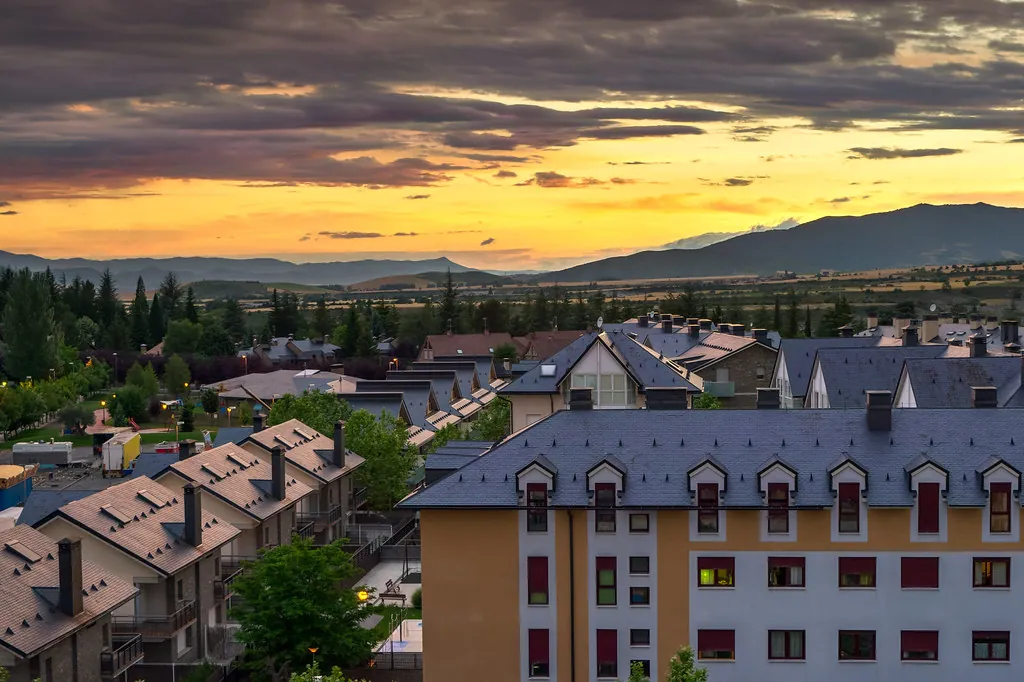
No one comes here for monuments. The parish church of San Pedro is modest, locked on weekdays, its bell turret more useful as a landmark than as architecture. The fascination lies in the houses themselves—granite cubes wedged into the hillside, timber balconies blackened by centuries of sun and snow. Rooflines sag like old mattresses; a single streetlamp leans so far it seems to eavesdrop on the neighbour's washing line. These dwellings were built for winter storms, not for photographs, which is precisely why they hold the eye.
Because the settlement is tiny, you can walk every lane in fifteen minutes, but take longer. Peer over the low wall where geraniums survive on nothing but rain and altitude. Note the date 1789 carved beside a door that still closes with a wooden latch. Above one cellar window someone has chalked "Leña seca 4 €"—dry firewood for sale—though the owner is nowhere to be found. In El Castellar commerce is casual; trust is assumed.
Outside the stone collar the Sierra de Gúdar rolls towards Valencia in one direction, towards Teruel in the other. Early mornings bring a soft violet light that photographers call "the blue hour" but locals simply term el frío. The plain below can be 8 °C warmer; clouds often sit just under the village like a withheld decision. If you walk the sheep track south-east you will reach the abandoned hamlet of Valbona in forty minutes—roofs gone, walnut trees still fruiting among the ruins—then drop into a narrow gorge where griffon vultures turn overhead without flapping.
Walking, Pedalling, Star-Gazing
Maps at 1:25,000 show a spider's web of paths linking El Castellar to Moscardón, Sarrión and the higher ski station of Javalambre. None are difficult, all demand stout footwear; signage is sporadic but the waymarks—stone cairns, a splash of yellow paint on a pine—are usually enough. The most popular circuit climbs to the Puerto de Sarrión (7 km, 350 m ascent) then descends on a forestry track, giving views back across the wave-patterned ridges. Mountain bikers use the same web; expect loose shale and the occasional cattle guard. Road cyclists arrive in summer for the climb from Mora de Rubielos: 19 km averaging 4 %, rising through almond terraces that smell of honey in February.
After dark the village switches off. No streetlights burn all night; the council turns them off at 01:00 to save money. The upside is sky quality: the Milky Way appears not as a poetic reference but as a broad, silvery stripe complete with shadow-casting brightness. Bring binoculars and a red-filter torch; in August you can clock forty shooting stars without leaving the bench.
What You'll Eat and Where You'll Sleep
The only public kitchen belongs to Bar-Restaurante El Castellar, open Thursday to Monday, closed Tuesday and Wednesday outside July–August. Miguel, the owner, doubles as mayor and mechanic; if he likes you he will bring out jamón de Teruel sliced see-through thin, followed by migas—fried breadcrumbs studded with pancetta and grapes. A plate costs €9 and feeds two if you order bread on the side. Vegetarians get tortilla de setas, mushrooms foraged the same morning. Pudding might be paparajotes: lemon leaves dipped in cinnamon batter, edible once you peel away the leaf. House wine arrives in a plain glass bottle; ask for the cosechero red—light, almost chilled, perfect at altitude.
There is no hotel inside the village. The smartest stay is the three-room rural house Casa Palomar (doubles €75, including firewood but not breakfast). Book by WhatsApp and collect the key from number 12 across the lane. Cheaper beds lie 20 km south in Moscardón, but verify the address: booking sites list both places as "Hotel El Castellar" and British drivers have been known to reverse 40 minutes of hair-pin road after realising their mistake. Wild camping is tolerated above the tree-line; keep fires small, pack out tins, expect wild boar after dusk.
Getting Here, Leaving, Returning
From Valencia follow the A-23 north-west past Sagunto's refineries; after 90 minutes take exit 42 for N-234, then county road TE-V-9031. The final 7 km twist through pine and abandoned terraces; meet oncoming hay tractors by reversing into a farmer's gateway—courtesy is the only traffic code that functions here. Petrol pumps sit 20 km away in both Teruel and Mora de Rubielos; fill up, then fill up again in case weekend plans change. In winter carry chains from December onward; the road is gritted but shade keeps ice until noon.
Buses exist on Tuesdays and Fridays only: the Sarrión–Teruel line will drop you at the junction, 4 km below the village. Hitch-hiking the remaining climb is accepted practice; someone usually stops within three cars, often the same person you bought wine from the night before.
The Quiet Trade-Off
El Castellar's chief luxury is silence, but silence has a flip side. If the bar is shut you will eat crisps for dinner. If clouds settle, views vanish and mobile data never returns. Children may find the absence of playgrounds, pools and Wi-Fi a form of medieval punishment. Even in May the wind can knife through a fleece; in July the sun at midday is merciless and shade is rationed. Come prepared, or the village's indifference will feel less like authenticity and more like neglect.
Yet for travellers who have tired of souvenir lanes and Instagram queues, the payoff is real. Sit on the bench at dusk, watch stone turn rose then bruise-grey, listen to a single dog bark somewhere below the crags. You will realise that "nothing to do" can translate, with surprisingly little effort, into "nothing needed." Drive away next morning and the mirror shows empty road, a receding cluster of roofs, and a sky still bigger than the schedule you left behind.