Full Article
about Laluenga
Ocultar artículo Leer artículo completo
The combine harvester appears first as a speck against the wheat, then grows larger until its rumble fills the narrow street. This is how mornings begin in Laluenga—not with church bells, though those follow, but with the sound of machinery bringing in the crop that has sustained this Aragonese village for longer than anyone can remember.
At 479 metres above sea level, Laluenga sits high enough to catch the breeze that sweeps across Somontano's cereal belt, yet low enough to feel the full force of summer's heat. The difference becomes apparent within minutes of leaving Barbastro, 20 kilometres to the south. Where the city simmers in trapped warmth, the village enjoys air that moves, carrying the scent of dry earth and ripening grain.
Stone and Adobe Against the Sky
The village's 202 inhabitants live in houses that demonstrate practical wisdom rather than architectural ambition. Local stone forms the lower walls, supporting adobe upper sections coated with lime wash that glows white against the brown fields. Narrow windows face southeast, away from the cierzo wind that can roar down from the Pyrenees at 80 kilometres per hour. Flat roofs of Arabic tile weigh down the structures, preventing uplift during winter storms.
These details matter because Laluenga offers little in the way of conventional attractions. The parish church of San Salvador dominates the skyline from its position at the village's highest point, but its plain façade reveals nothing of the elaborate baroque interiors found in nearby towns. Instead, the pleasure lies in noticing how each house adapts to its neighbours, creating passages just wide enough for a loaded donkey yet wide enough to channel cooling breezes.
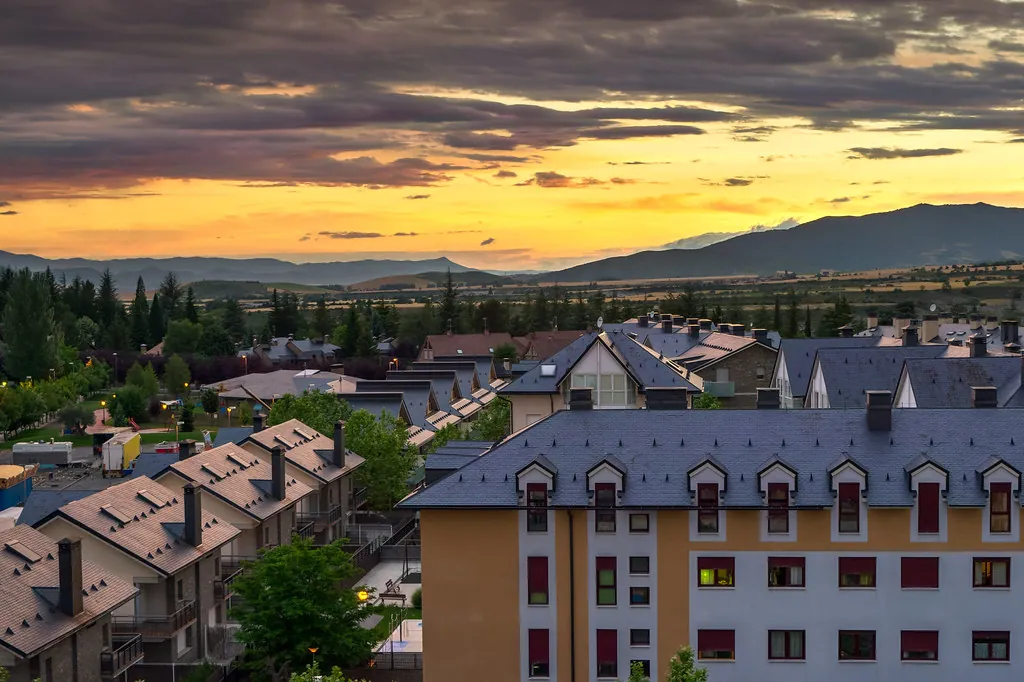
Walk the streets at dusk and you'll see why photographers make the journey. The horizontal light transforms the wheat stubble into fields of gold, while shadows pool in the doorways of houses built before Britain had its Civil War. Spring brings almond blossom that turns entire slopes white and pink, though the display lasts barely three weeks—timing is everything.
Following the Harvest Routes
The tracks leading from Laluenga were created by tractors and centuries of ox-carts, not by tourism boards. They serve walkers well enough, forming loops of five to fifteen kilometres through country where the horizon seems to retreat as you approach it. Marked routes exist, though the signage assumes you can read Spanish and understand that a red arrow means "keep going" while yellow suggests "perhaps reconsider."
One path heads north towards Alberuela de Laliena, passing through stands of Aleppo pine that provide the only shade for miles. Another follows the ridge east towards Castillazuelo, with views across the Ebro valley that stretch clear to the mountains of La Rioja on clear days. Neither requires technical skills, though the summer sun demands respect—carry more water than you think necessary, as the nearest shop closes for siesta between 2 pm and 5 pm.
The serious hiking lies further north in the Sierra de Guara, a forty-minute drive away. Laluenga works better as a place to return to after challenging walks, somewhere to sit outside the single bar and watch shadows lengthen across the grain fields while nursing a caña that costs €1.20.
What Grows in Dry Earth
The village bar doubles as the grocery store, opening at 7 am to serve farmers their morning coffee and maintaining hours that follow agricultural rather than tourist rhythms. Inside, you'll find the products that define local cooking: chickpeas dried to the point where they require overnight soaking, olive oil from cooperative presses near Barbastro, and blood sausages that reflect the autumn slaughter of family pigs.
Meals centre on what the land provides, served in quantities that reflect days spent working it. A typical menu del dia at the weekend might feature migas—fried breadcrumbs with garlic and grapes—followed by lamb raised on the surrounding hillsides. The wine comes from Somontano's modern bodegas, where international varieties like Cabernet Sauvignon grow alongside the local Moristel. A bottle of reasonable red costs €8-12 in the village, half what you'd pay in Huesca's restaurants.
For self-caterers, the Thursday market in Barbastro offers everything from local cheese to vegetables that still carry field dust. The 25-kilometre drive takes 35 minutes on roads that narrow alarmingly after the junction at Somontano-Cinca, where trucks loaded with grain compete for space with cars heading to the city.
Seasons of Silence and Celebration
August transforms Laluenga. The population swells as families return for the fiestas patronales, creating a temporary community of 500 or more. Suddenly the bar runs out of tables, children play football in streets that are usually empty, and the night air fills with music from a temporary stage erected in the plaza. The celebrations honour the Virgin of the Assumption with processions that weave between stone houses, though the real action happens in private courtyards where whole lambs turn on spits over wood fires.
January brings San Antón, when residents bring animals—everything from hunting dogs to pet rabbits—for blessing outside the church. The ritual feels ancient because it is, predating Christianity's arrival in these parts. Winter visitors find a different village: shutters closed against cold that can drop to -5°C, smoke rising from fireplaces that burn pruned almond wood, and a silence broken only by the church bell marking hours that seem longer than they do in summer.
Spring and autumn provide the sweet spots for visiting. April sees the fields turn green with new wheat, while October brings the harvest that fills the air with dust and diesel fumes from working machinery. Temperatures range from 12-22°C, perfect for walking, and the light possesses that quality photographers describe as "golden" despite the cliché. Rain falls mainly in April and May—check weather forecasts because the village's streets become rivers of mud during heavy storms.
The Practical Reality
Getting here requires commitment. The nearest railway station lies in Huesca, 55 minutes away by car on the A-22 motorway. Car hire becomes essential—public transport involves a bus to Barbastro that runs twice daily, followed by nothing that climbs the final kilometres to Laluenga. The last section follows a road so narrow that meeting an oncoming grain lorry requires one vehicle to reverse to the nearest passing place.
Accommodation options remain limited. The village offers three self-catering houses restored by locals who've moved to Zaragoza but return for holidays. Expect to pay €60-80 per night for somewhere that sleeps four, with thick stone walls that maintain 18°C temperatures regardless of outside conditions. Book well ahead for August and the Easter weekend, when Spanish families claim properties months in advance.
Mobile phone coverage works on the higher streets but disappears inside ground-floor rooms. The village has no petrol station, no cash machine, and no restaurant in the conventional sense—just the bar that serves food when the owner's mother feels like cooking. This is not a place for ticking off bucket lists or collecting Instagram moments.
Laluenga rewards those who value space over spectacle, who can appreciate how human settlement adapts to harsh beauty over centuries. As the sun sets and the harvest machinery falls silent, the village returns to what it has always been: a small community living at the edge of possibility, where the next crop and the next season matter more than the next visitor.