Full Article
about Lituenigo
Ocultar artículo Leer artículo completo
The church bell strikes seven and the only other sound is wheat rustling in the breeze. From the village edge, fields roll eastwards like a golden ocean until the land suddenly rears up into the forested wall of Moncayo. Lituénigo perches at 756 m on that seam between plain and mountain, a place where tractors outnumber tourists and the evening news is still read out loud in the bar.
Stone, Slate and Silence
A single lane curls into the settlement, barely wide enough for two small cars to pass. Houses shoulder together, built from the same honey-coloured stone that lies under the surrounding soil. Slate roofs overhang thick walls; balconies are forged from iron that has weathered to graphite grey. Nothing is pristine—paint flakes, timber warps—yet the overall effect is honest rather than neglected. One front door still bears the brass letter-slot installed when the postman arrived on mule-back.
The core is the parish church, rebuilt piecemeal since the sixteenth century. Step inside and the air smells of candle wax and dusty brocade; fresco fragments cling to the apse, their blues muted by centuries of incense. The squat tower serves as the village compass: lose your bearings on the web of footpaths and a glance upwards realigns you.
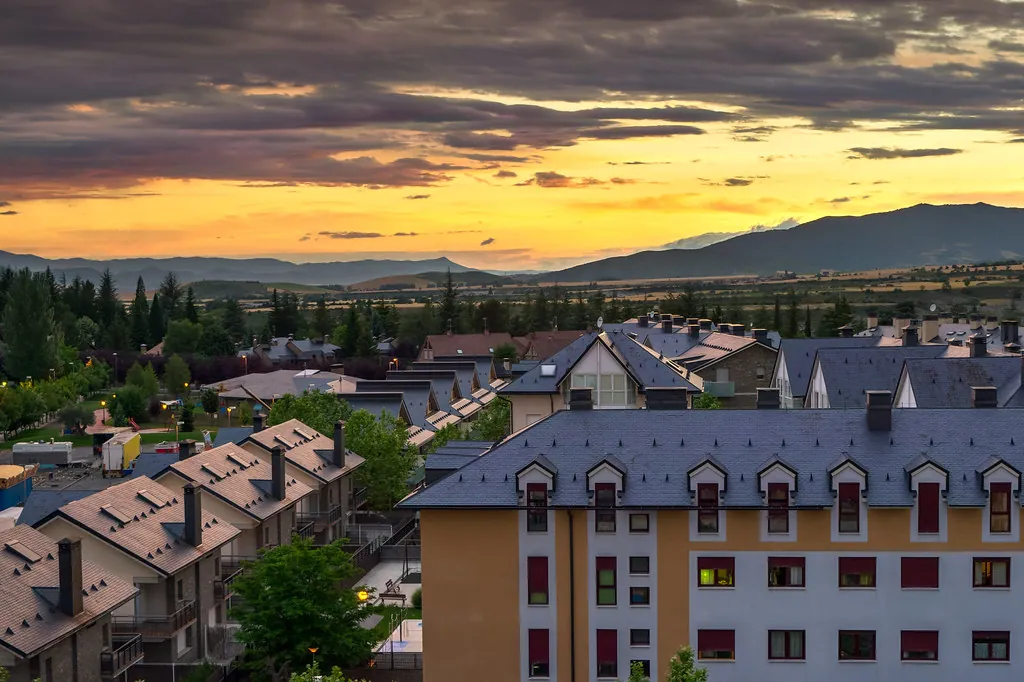
Outside, alleys climb and drop with no concession to wheeled traffic. Wear shoes that grip; after rain the granite setts turn slick as ice. The reward is a roof-top view west: cereal strips alternate with olive groves, the colours shifting from sage to straw depending on the month. Photographers arrive for the half-hour after sunset when the Moncayo ridge turns bruise-purple against an orange sky; then the light dies fast and the scene is gone.
A Walk That Unfolds the Countryside
There are no signed trails, only farm tracks that the villagers still use. Follow the one past the last house and within five minutes the wheat closes overhead, ears brushing your sleeves. The path skirts a threshing circle where stone walls once broke the wind for horses. Beyond, the land lifts gently to a low crest; from the top you can see the Ebro valley haze and, on very clear days, the pyramidal shadow of Moncayo’s highest summit, San Miguel.
Allow ninety minutes for the loop that drops into the little rambla of Los Molinos, where an irrigation channel still feeds a ruined waterwheel. Boot soles are sufficient; the steepest gradient is a farm ramp rather than a scramble. Spring brings calandra larks and the odd hoopoe; autumn resounds with gunshot as local hunters pursue partridge—walkers should stick to the obvious track and wear something visible.
Back in the village, silence returns the moment you leave the fields. The only background hum is a generator at the olive press; otherwise you hear your own footsteps echoing off stone.
What You’ll Eat—and When
Lituénigo itself has no restaurant, merely the Teleclub, a social bar where men play dominoes at 11 a.m. sharp. The owner, Mari-Carmen, will grill a pork chop, fry peppers and tip a mound of homemade chips onto a stainless-steel plate. Ask for the plato combinado; it costs €9 and arrives with a basket of bread still warm from the baker in Tarazona. Vegetarians get eggs and chips—no fuss, no apology.
If you want more, phone ahead. Pili, who rents the three-bedroom house La Carrasca, offers evening meals to guests: roast kid with bay leaves, or migas—fried breadcrumbs laced with garlic and grapes—served on her roof terrace while the sun slips behind the ridge. The local red carries the Campo de Borja label, softer than Rioja and better value at €2.50 a glass.
Churros appear once a year, on the fiesta Sunday midway through August. The village quadruples in size as grandchildren return; a brass band plays pasodobles in the square until the small hours. Book accommodation early or you’ll sleep in the car.
Getting There, Staying Warm
Public transport stops at Tarazona, 22 km away. From London, the smoothest route is Ryanair’s twice-weekly Stansted–Zaragoza flight; collect a hire car and head northwest on the A-68, then the N-122 towards Pamplona. Turn off at the sign for Lituénigo and climb 6 km of switchbacks where sheep have right of way. Petrol up beforehand—there is no garage, and the village shop opens when its proprietor feels like it.
Accommodation is limited to three rural houses and a handful of rooms above the olive mill. La Carrasca is the pick: thick stone walls mean Wi-Fi reaches the kitchen but not the bedrooms, forcing you onto the roof where swifts screech overhead. Nights are cool even in July; pack a fleece. Winter visitors should expect frost on the inside of the windows and the possibility of snow blocking the access road for a day or two. The upside is razor-sharp air and Moncayo dressed in white from summit to tree line.
Why Bother?
Lituénigo will never feature on a glossy “Top Ten” list. There are no souvenir stalls, no boutique hotels, no swimming pool with a view. What you get instead is a functioning agricultural hamlet that happens to be astoundingly pretty at dawn and dusk. Conversations start without preamble—an old man will point out the plot his grandfather ploughed with mules; a woman hanging washing will explain why the church clock strikes thirteen at noon (a tribute to a long-dead priest born on the thirteenth).
Stay one night and you may leave before breakfast, satisfied you ticked off “authentic Spain”. Stay two and you’ll notice the rhythm: work in the fields until two, siesta, return at five when the light turns buttery, then the bar fills with chatter about rainfall and olive prices. By the third evening you stop checking your phone—there is nothing to check—and instead listen to swallows gathering on the wire.
Leave early, drive back down the twisting road, and the plateau opens again. In the rear-view mirror Lituénigo shrinks to a single terracotta smudge against green and gold. The silence you carried away lasts until the motorway toll booth, then the real world rushes back in.