Full Article
about Mezquita de Jarque
Ocultar artículo Leer artículo completo
The church bell strikes seven and the sound carries further than you'd expect. At 1,251 metres above sea level, Mezquita de Jarque's single toll has fewer obstacles to contend with. Below, the village's 84 permanent residents step onto stone doorways that have been worn smooth by centuries of similar mornings. The air carries a mineral tang, a reminder that this quiet corner of Aragon's Cuencas Mineras once pulsed with extraction industries that shaped both landscape and livelihood.
Stone, Silence and Second Glances
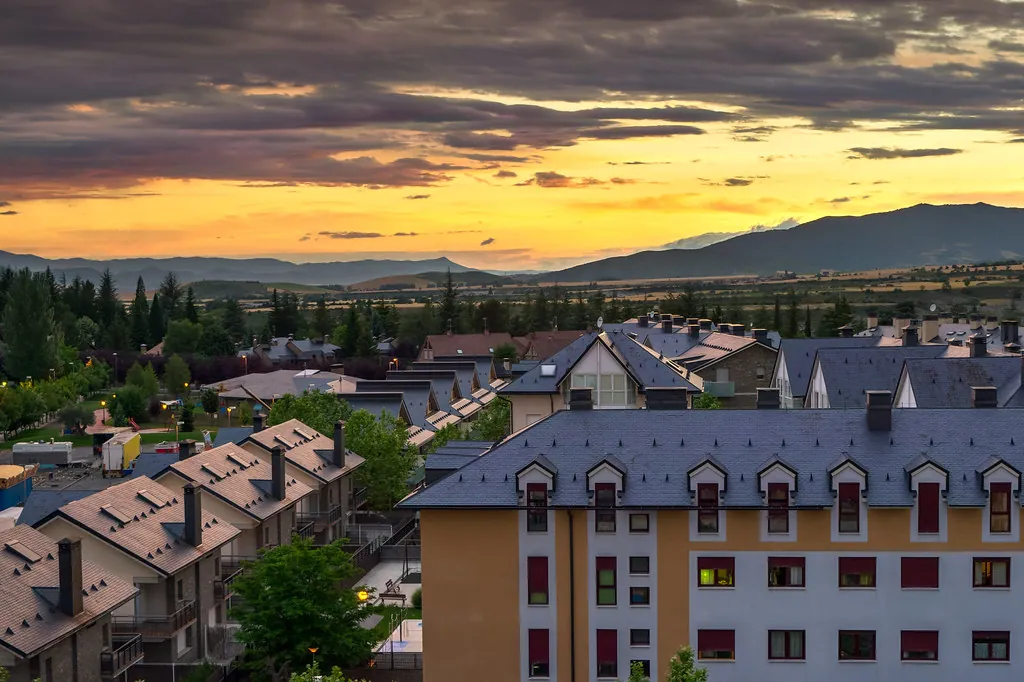
The village's name raises eyebrows among Spanish speakers, though there's no mosque to be found. The origins lie buried in local dialect, possibly corrupted from Arabic during the region's medieval past. What exists instead is a masterclass in mountain vernacular architecture: stone houses that climb the hillside like grey lichen, their wooden balconies jutting at angles that follow the slope rather than any planner's grid. Walls here aren't straight because the terrain never allowed for it.
The Iglesia de la Natividad de Nuestra Señora squats at the village's highest point, its robust stone construction more fortress than sanctuary. Inside, the decoration is spare but deliberate – carved capitals that reward patient observation, a retablo whose gold leaf catches the mountain light differently throughout the day. The building serves as both spiritual centre and social thermometer; when its doors open for September's fiesta, the population swells fivefold as former residents return from Zaragoza, Valencia, even London.
Walking the streets demands attention. Cobbles are uneven, drainage channels cut diagonal paths across the stone, and sudden steps appear without warning. This isn't negligence but adaptation to a landscape that refuses to be tamed. Houses grow from bedrock, their lower floors often carved directly into the hillside. Modern additions – satellite dishes, PVC windows – sit uncomfortably alongside weathered timber and hand-forged ironwork, creating a visual conversation between necessity and tradition.
The Empty Quarter's Echo
The mining heritage lies mostly in absence. Follow the rough track south-east for three kilometres and you'll reach the remains of Mina María, where tungsten extraction continued until the 1980s. Now it's a scar of rust-coloured spoil heaps and concrete foundations being slowly dismantled by frost and thyme. Information boards promised by the regional government never materialised, leaving visitors to piece together significance from scattered industrial archaeology.
The landscape compensates through scale. Mountain ridges roll away towards the Jiloca valley, their slopes patched with Scots pine and regenerating oak. Between them, barrancos cut deep gashes where griffon vultures ride thermals with military precision. Dawn and dusk transform these valleys into acoustic amphitheatres – cowbells from unseen herds, the distant bark of mastiffs guarding isolated farms, occasionally the rasp of a wild boar overturning stones in search of roots.
Spring arrives late at this altitude. May sees the slopes explode with colour: purple thyme, yellow cytinus, white asphodels that locals call "espadanas" and pick for wound treatment. The air fills with resin and wild rosemary, used here to flavour lamb rather than the more common herbs of lower Aragon. By July, everything's bleached to bronze except where irrigation channels support small vegetable plots – tight rows of beans, peppers and tomatoes that would struggle in the thin mountain soil without human intervention.
Walking Through Absence
The GR-24 long-distance path skirts the village, connecting Mezquita de Jarque with neighbouring settlements through ancient drove roads. These routes predate the mines, following watersheds that shepherds have used for at least eight centuries. The going is tough – ascents of 400 metres are common, paths disappear into limestone scree, and waymarking assumes local knowledge. But the rewards match the effort: views across three provinces, fossil-rich outcrops where ammonites the size of dinner plates lie embedded in marine limestone, complete silence broken only by boot soles on schist.
Shorter circuits exist for the less committed. A ninety-minute loop north of the village climbs through abandoned almond terraces to reach the Ermita de San Juan, a ruined chapel whose bell arch frames Mezquita de Jarque perfectly below. The descent passes through pine forest where collecting resin scars still bleed amber on mature trees – a practice that continued here into the 1960s, providing turpentine for the mining operations.
Winter transforms everything. Snow arrives early, often in October, and can linger until April on north-facing slopes. The access road from Teruel – 50 kilometres of switchbacks and sudden gradients – becomes treacherous without chains. Those who make the journey find a village reduced to essentials: smoke from chimneys, the single bar open only at weekends, a landscape scrubbed clean by altitude and isolation. It's beautiful but brutal, and several houses stand empty precisely because owners couldn't face another winter of hauling firewood up ice-coated streets.
What Passes for Civilisation
Food here follows function rather than fashion. The village's only restaurant, Casa Ramón, opens when Ramón feels like it – usually weekends, occasionally weekday lunchtimes if his daughter's visiting from Zaragoza. The menu never changes: migas cooked in an iron pan until the breadcrumbs achieve the consistency of wet sand, then lifted with grapes that Ramón dries himself. Lamb comes from animals that grazed within sight of the village, their flavour intensified by mountain herbs. Wine arrives in unlabelled bottles from a cooperative in Calamocha, robust enough to cut through the region's aggressive sausages but subtle as a sledgehammer.
Accommodation options reflect the demographic reality. One casa rural occupies a renovated farmhouse at the village edge – thick walls, wood-burning stove, views that make mobile phone reception irrelevant. At €60 per night it represents reasonable value, though hot water depends on solar panels that struggle through December fog. Alternative options exist in nearby Escucha, twelve kilometres down the mountain, where a small hotel caters to engineers visiting the remaining active mines.
The nearest cash machine stands twenty-three kilometres away in Montalbán. Card payments in Mezquita de Jarque remain theoretical, though the village shop – open Tuesday and Friday mornings – will extend credit to regular visitors. Stock up in Teruel before ascending: the mountain air creates surprising thirst, and local supplies extend mainly to tinned tuna, cured meats and wine that could remove paint.
The Mathematics of Departure
Leaving requires calculation. The morning bus to Teruel departs at 6:45, driven by Paco who's been making this run for twenty-seven years. He knows every pothole, every bend where wild boar cross, every house where widows wait with shopping bags for the weekly trip to civilisation. The service doesn't run Sundays or fiesta days, and winter weather cancels it without notice. Those with cars face the same mathematics: every descent saves fuel but gains brake wear, every ascent tests cooling systems and clutch plates.
Yet people return. Not the tourists – they pass through, ticking boxes on mental lists of "authentic Spain" – but those who left for education, work, love. September's fiesta sees them flood back, filling houses that stand dark eleven months a year. They drink in streets where they learned to ride bicycles, attend mass in the church where they were baptised, marry and bury in rituals that connect across continents. By October's end, silence reclaims the streets. The stone houses settle back into winter vigil, waiting for next year's temporary resurrection.
Mezquita de Jarque offers no souvenirs beyond memory. No craft shops, no branded fridge magnets, no interpretive centre explaining the mining heritage. Just altitude, stone, and the slow processes of mountain time that make British notions of "remote" seem positively suburban. Come prepared for that reality, or don't come at all.