Full Article
about Monegrillo
Ocultar artículo Leer artículo completo
The thermometer outside the baker’s already reads 32 °C at nine-thirty, yet the only sound on Calle Mayor is the click of a single petrol-blue Ford Fiesta pulling up to the village shop. Inside, the proprietor is slicing warm tostadas and spreading them with tomato pulp, olive oil and a pinch of salt—the breakfast she’ll wrap in foil for the two walkers who phoned ahead. This is Monegrillo, population 393, administrative capital of nothing in particular, and the first place on the road where the Ebro Valley admits it has run out of water and become desert.
Adobe, alfalfa and horizon
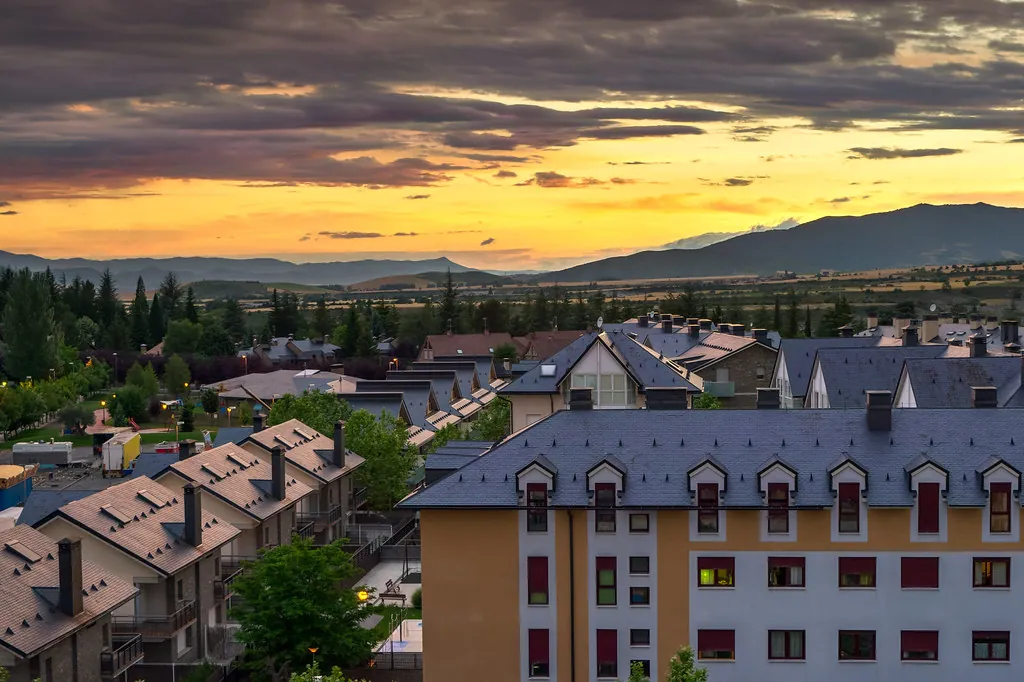
Most British maps label the surrounding country simply as “Monegros”, a word that translates roughly as “dry hills”. The landscape obeys the rule: wheat stubble gives way to grey thistle, then to a bruised-sienna plain that looks like a film location until you realise the nearest catering truck is 50 km away. Monegrillo sits on a low rise at 437 m, high enough for the evening air to cool but not high enough for pine trees. Houses are built of adobe brick the colour of digestive biscuits, roofed with curved Arabic tiles that turn almost black after the handful of autumn storms. The effect is more North-African than Iberian, and the illusion strengthens when the afternoon wind lifts dust off the surrounding fields and the sky turns the colour of weak tea.
There is no picturesque plaza mayor lined with cafés; instead the village spreads along two parallel streets that meet a small church square. The 16th-century parish tower, square and unadorned, serves as both clock and landmark—climb the outside steps at dusk and you can watch irrigation sprinklers draw slow silver circles on the alfalfa plots while the sun drops behind the Sierra de Alcubierre.
Walking without shade
Trailheads begin at the last streetlamp on the south side of town. A gravel track, formerly a drovers’ road, strikes out across public farmland for 12 km to the ruined farm of Las Cuerlas; the gradient is negligible but the surface is stony, so trainers suffice only if you’re happy to feel every pebble. Markers are intermittent: a cairn, a paint splash on a fence post, sometimes nothing at all for 2 km. Download the free IGN Spain 1:25,000 sheet before you leave Zaragoza; phone signal flickers in and out, and Google’s car-shaped icon will confidently position you in the middle of an untilled field.
What you get in return is space. Lark song, the squeak of a short-toed eagle overhead, and the occasional clank of a distant tractor are the only interruptions. In April the plain is patched green with young barley; by late June the same fields bleach to the colour of straw hats. Photographers should bring a polariser—midday light is brutal, but the horizon glows ochre and violet for twenty minutes after sunset, and the Milky Way is bright enough to cast a shadow once the moon has set.
Carry more water than you think civilised: 1.5 litres per person for a three-hour circuit. There is no pub, no kiosk, no benevolent farmer with a hosepipe. Summer temperatures reach 40 °C most afternoons; if you must walk then, start at dawn and finish by eleven, or risk the indignity of being rescued by a Guardia Civil quad-bike whose driver will assume you are lost, not merely British.
Lamb, crumbs and the absence of ATMs
Monegrillo keeps one grocery, one bakery and one bar. The shop opens 09:00-13:00, 17:00-20:00, closed Tuesday afternoon and all day Sunday; the baker knocks off at 13:30 sharp. There is no cash machine—plastic is useless, so bring notes. Evening meals happen in the bar, which cooks whatever the owner’s mother prepared that morning. Expect ternera estofada (beef stew) or cordero al horno, local lamb roasted until it flakes like slow-cooked shoulder. Aragonese migas—fried breadcrumbs with strips of bacon and mild red pepper—taste like Christmas stuffing without the sage and pair well with a £2.20 glass of Cariñena tempranillo. Vegetarians can usually negotiate a plate of roasted peppers and tomatoes; vegans should stock up in Zaragoza.
If you need a menu translated you are already unusual. English is confined to the school textbook and the occasional German shepherd owner who moved here for the inexpensive stone cottages. Learn five phrases—buenos días, agua, gracias, cuenta, ¿a qué hora cierra?—and service becomes friendly rather than politely baffled.
When to come, where to sleep
Spring (mid-April to late-May) and autumn (mid-September to late-October) give daytime highs of 22 °C and nights cool enough for a jumper. Winter is quiet but viable: frost whitens the fields at dawn, the air smells of wood smoke, and you can walk for two hours without meeting anyone. Accommodation is limited to four self-catering apartments above the baker’s (Amanece Monegrillo, €55 per night, two-night minimum) and two village houses let by the council (€40, book at the town hall). All have ceiling fans rather than air-conditioning; in July and August you will still sleep with the windows open and a bottle of frozen water in the bed.
The fiestas in mid-August fill every room and bring the only traffic jam of the year: a procession of tractors decked with coloured paper, a foam machine in the square, and a public paella for 600 people that starts at 15:00 and runs out by 15:45. Book accommodation a month ahead or stay in Zaragoza and drive up for the day.
Getting here, getting out
Zaragoza airport, served by Ryanair from Stansted and Manchester, is 58 km west. Hire cars live in a cabin opposite arrivals; allow €90 for three days. Take the A-2 towards Barcelona, exit at kilometre 311 for the N-II, then follow signs to Monegrillo via Alcubierre. The final 22 km cross flat desert where fuel stations are absent and mirages pretend to be lakes—leave the airport with a full tank. A single Alsa bus leaves Zaragoza-Delicias at 17:45 on weekdays, returning at 07:00 next morning; journey time is 90 minutes and a ticket costs €6, but you will still need a car or bicycle to reach the trailheads.
Leave time for the drive back. The same empty horizon that feels liberating on arrival can look desolate when you are hunting for the hire-car drop-off and your flight is in two hours. Factor in a coffee stop at the service area outside Zaragoza, where the cashier will ask where you’ve been. Tell her “Monegrillo” and she will nod, half-impressed, half-puzzled, as if you have just confessed to spending the night in a motorway lay-by for fun.
The village offers no souvenir shop, no fridge magnets, no framed watercolours of the church. What you take away is lighter: the memory of a place where Spain pauses, where the loudest noise at midday is a lark too high to see, and where the desert begins so gently that you can walk straight into it from the bakery door.