Full Article
about Monesma y Cajigar
Ocultar artículo Leer artículo completo
The church bell strikes noon, yet barely a soul appears. A farmer loads hay onto a trailer. His dog watches, motionless. At this altitude, even sound travels differently—thinner, sharper, as if the mountain air itself has stripped away the unnecessary. This is Monesma y Cajigar, a scatter of stone hamlets stretched across a high ridge in western Ribagorza, where 66 permanent residents share 40 square kilometres of oak forest, pasture and sky.
The Ridge That Time Misplaced
Most visitors race past on the A-22 below, bound for the postcard Pyrenees further north. They miss the turning entirely. Good. The climb from the N-123 at Graus is 26 kilometres of switchbacks, narrow enough to make passing a tractor an exercise in breath-holding. Fog rolls in without warning; in winter the asphalt ices early and the council sometimes forgets to grit. Sat-nav loves to die here—phone reception is a rumour—so print the map before leaving Huesca.
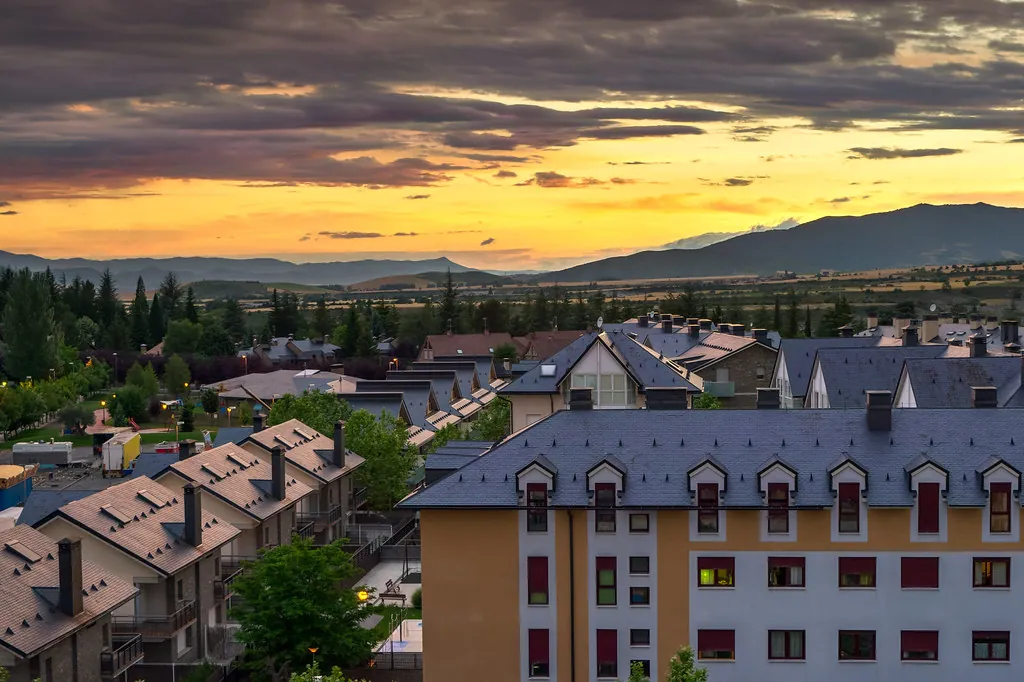
What waits at the top is not a village in the British sense—no obvious centre, no tea shop, no village green. Instead, a string of tiny settlements: Monesma itself, Cajigar, the almost-abandoned Masadas. Houses are built from the mountain’s own limestone, roofs steep to shed snow, walls a metre thick to blunt the cierzo, the wind that barrels up the Ebro Valley and slaps the ridge at 80 kph. Temperature swings are brutal: 30 °C in July can flip to frost by dawn; January mean is –2 °C, and the access road closes for days after heavy snow. Spring comes three weeks later than in Huesca city, autumn two weeks earlier. Pack layers, always.
Walking Without Waymarks
There are no glossy trailheads, no wooden signposts promising Instagram moments. What exists is a lattice of old mule tracks, some still used by farmers on quad bikes. Head east from the church and a barely visible path drops into the Barranco de Monesma, a shallow gorge where robin song replaces phone notifications. After forty minutes the valley opens onto a natural balcony at 1,200 metres; the view is not of jagged peaks but of endless folded hills fading to ochre, the Ebro a silver thread 800 metres below. Bring water—there are no cafés, no fountains, and the nearest shop is 18 kilometres away in Beranuy.
More ambitious walkers can link a figure-of-eight circuit that climbs to the Collado de Lier, 1,520 metres, then descends through beech woods to the abandoned hamlet of Otín, roofs long gone but stone walls still shoulder-high. The round trip is 14 kilometres and 600 metres of ascent; allow five hours, longer if you stop to photograph the wild crocuses that appear in late April. In May the hillsides turn improbably green, the colour so saturated it feels like someone has slid the saturation filter to maximum.
Food That Doesn’t Need a Menu
There is no restaurant in the municipality. What passes for hospitality is the occasional weekend barbecue mounted by the village association: half a lamb, a crate of beer, music from a single speaker. Visitors are welcome, though you’ll be asked where you’re staying and how you heard about the place. The local matanza happens in early December; if you’re invited, expect to leave with a paper parcel of morcilla and the realisation that British supermarkets have sanitised pork entirely.
Self-caterers should stock up in Graus: the Eroski there sells proper Manchego at €14 a kilo, and the bakery opens at 6 a.m. for still-warm pan de pueblo. In the village, the only commerce is a honesty shelf outside one house: homemade honey, €6 a jar, leave coins in the tobacco tin. The honey is dark, almost treacly, from rosemary and thyme that grow wild on the southern slopes. Pair it with local goat cheese, bought directly from the farm at Cajigar—knock loudly, the dogs bark first, the farmer second.
When the Silence Breaks
August fiestas last three days. The population quadruples as descendants return from Zaragoza and Barcelona. A sound system appears in the church square, volume set to “penetrating”; someone wheels out a plastic paddling pool for toddlers; dinner is paella for 200 cooked over vine prunings. If you crave sleep, book accommodation elsewhere that weekend. The rest of the year belongs to the wind, the tractors and the occasional British hiker who thought “undiscovered” sounded romantic and is now wondering how to kill 48 hours without Wi-Fi.
Accommodation is limited to three rural houses, two of them converted barns. Casa Pardina sleeps six, has underfloor heating and charges €140 a night minimum two nights. The owner, Francisco, will email GPS coordinates because the postcode covers three kilometres. Mobile signal reaches the terrace if you stand on the picnic table and lean north-east. He’ll also warn you that the boiler runs on butane: long showers are a London memory.
Leaving Without a Fridge Magnet
The ridge teaches restraint. There is nothing to buy, nothing to queue for, no guide to murmur facts. What you remember instead is the smell of sun-hit rosemary, the way the valley fills with cloud until only the church tower protrudes like a ship’s prow, the realisation that 66 people choose to live here year-round, keeping the lights on against geography itself. Drive down next morning; the road drops through layers of temperature—cool, warm, cool again—until the motorway appears and the phone buzzes back to life. The silence stays in the car with you, all the way to Zaragoza.