Full Article
about Montanuy
Ocultar artículo Leer artículo completo
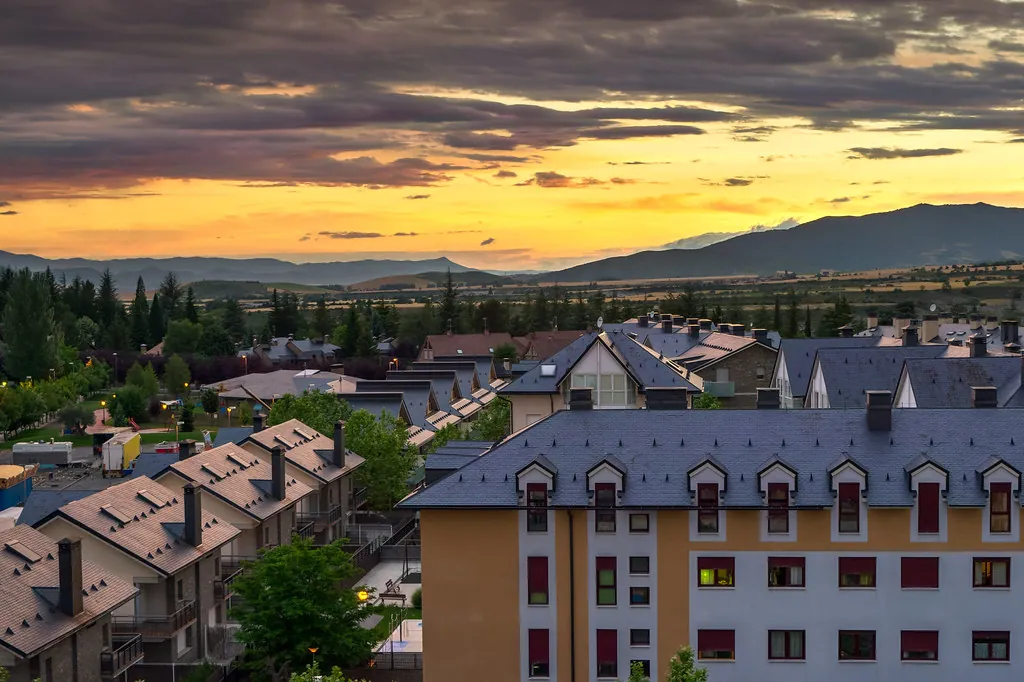
The first thing you notice is the silence. Not the hushed, reverent quiet of a cathedral, but a proper, mountain silence broken only by cowbells and the occasional tractor grinding up a gradient that would make a Land Rover blush. Montanuy sits at 1,200 metres in the Ribagorza comarca of Aragón, closer to the French border than to any Spanish city you've actually heard of, and it feels it. The stone houses don't so much line the lanes as cling to them; roofs are slate, not terracotta, and the chimneys puff wood-smoke even in late May.
A village that refuses to perform
Forget the choreographed "Spanish village" routine of geraniums and guitar music. Montanuy has no souvenir stalls, no guided tastings, no bloke in a straw hat charging two euros for a photo. What it does have is neighbours who still keep sheep, a tiny Pyrénées supermarket that shuts for lunch, and a bar that doubles as the social security office on Thursday mornings. The place works for a living: hay bales in the meadows, a communal washing trough still fed by a mountain spring, and a tractor parked where another town might put a fountain.
The architecture is Pyrenean rather than Castilian—thick stone walls the colour of weathered pewter, wooden balconies wide enough to dry a year's worth of hay, and barn doors big enough to drive a Citroën through (someone actually does). The Romanesque church of San Martín squats at the top of the hill, its bell tower more functional than pretty, rather like the village itself. Step inside and you'll find a single nave, cool even at midday, with a 16th-century font that still gets used because, well, babies keep arriving.
Walking without the circus
Trails start at the edge of the village, signed just enough to reassure, not enough to domesticate. A fifteen-minute stroll up the old mule track brings you onto meadows where horses graze untethered; keep climbing and you reach the tree line at about 1,800 m, where beech gives way to Scots pine and the views open south-west towards the Posets-Maladeta massif. On a clear morning you can pick out Aneto, the Pyrenees' highest summit, still wearing last winter's stripe of snow.
Maps are useful: the GR-15 long-distance path skirts the village, but local shepherd paths sometimes fork and fade. A straightforward half-day loop runs east to the abandoned hamlet of Bestué, roofless stone houses slowly being swallowed by brambles, then drops back to the river Ésera via an old packbridge wide enough for one cautious cow. Total distance: 11 km, 450 m of ascent, zero entrance fees and—on a weekday in June—zero other walkers.
If you want something bigger, the track behind the cemetery becomes a dirt road that climbs to the Collado de Llaguerri (1,950 m). From there a faint path continues to the Besurta refuge, gateway to the Maladeta glaciers. It's a serious day—20 km return, 1,400 m of up—but you'll share the summit ridge only with the occasional sarrio, the Pyrenean chamois that stares, then evaporates into the rocks.
Weather that keeps you honest
Even in July nights drop to 12 °C; by late afternoon the wind can knife through a cotton shirt. Autumn brings a riot of beech gold and rowan red, but also cloud that can swallow a ridge in minutes. Winter is properly snowy—roads close, the bakery van stops arriving, and the handful of permanent residents dig in. Spring is the sweet spot: green meadows, wild narcissus along the tracks, and daytime temperatures in the low twenties. Just remember that the phrase "changeable conditions" was invented here; pack a fleece and a rain shell even if the sky looks innocent.
Food that tastes of altitude
The local menu is mountain, not Mediterranean. Lamb grazed on meadow herbs becomes "cordero al chilindrón", a slow braise with peppers and tomatoes that arrives in an iron pan big enough to bathe a toddler. Wild-boar stew ("civet de jabalí") tastes like a British casserole that has spent a winter in Spain—dark, winey, faintly smoky. Trout from the Ésera turns up grilled with a single slice of serrano ham, the fat basting the fish as it cooks. Vegetarians get migas—fried breadcrumbs with garlic and grapes—plus the best tortilla this side of Zaragoza, still runny in the middle.
Cheese is sheep and goat, milder than Manchego, sold in vacuum-packed wedges at the Pyrénées shop. The house red comes from Somontano, an hour south, and costs about fourteen euros a bottle in the bar—roughly what you'd pay for a glass in London. Pudding is usually "leche frita", squares of set custard fried in cinnamon batter, because calories don't count at altitude.
Getting there (and away)
The nearest airport is Zaragoza, two hours south on mostly empty motorway. Barcelona works too, but the drive stretches to three and a half once you leave the AP-2 and start threading the Cinca valley. Either way, hire a car: public transport is two buses a week from El Pont de Suert, and they don't run if the driver's mother is sick. Fill up with petrol and cash in Ainsa—after that the card machine becomes a mythical beast.
The final 30 km from El Pont de Suert to Montanuy is the sort of road Top Gear used to fetishise: tunnels carved through conglomerate, single-track sections with passing places, and a 1,500 m pass where the temperature gauge drops five degrees in as many minutes. It's entirely passable in a normal hatchback, but you'll meet logging lorries around blind bends and develop a new respect for Spanish lorry drivers.
Where to sleep (and why you might not want to leave)
Accommodation is limited to a handful of casas rurales, stone houses restored with under-floor heating and Wi-Fi that flickers whenever it rains. Casa Rural Quintana has beams you could build a ship from, a wood-burner stacked with oak, and a balcony that catches the morning sun over the Ésera valley. Expect to pay about €90 a night for two, including breakfast delivered in a wicker basket—fresh milk still warm from the neighbouring farm, bread that tastes of wheat rather than additives, and homemade jam that changes with whatever grew last summer.
The honest verdict
Montanuy won't suit everyone. If you need nightlife, taxis, or a choice of three restaurants, stay on the coast. If you want postcard Spain, look elsewhere. But if you're after a place where the nights are star-saturated, the walking starts at your front door, and the barman remembers your name after one coffee, this village delivers. Turn up in late May or early October, pack decent boots and a sense of self-sufficiency, and you'll discover something increasingly rare: a corner of Europe that tourism hasn't rehearsed for you.