Full Article
about Perarrua
Ocultar artículo Leer artículo completo
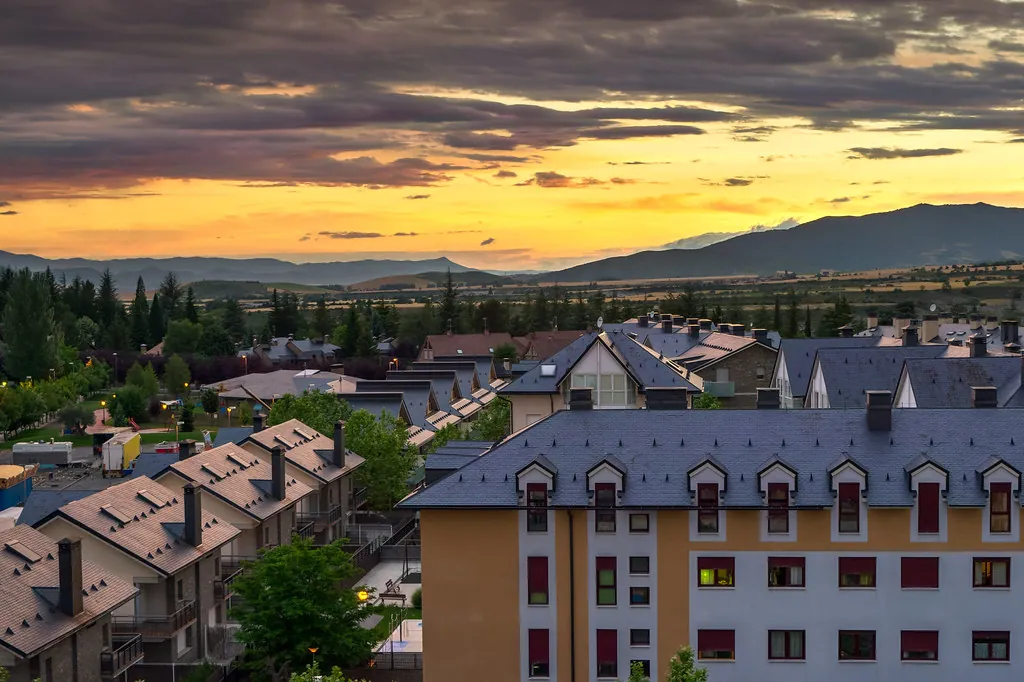
The church bell strikes eleven and the only other sound is a tractor changing gear somewhere below the houses. From the stone bench beside the war memorial you can see the whole of Perarrua: thirty-odd roofs, a patch of allotments, olive terraces dropping to the muddy Ésera, and then nothing but hills until the proper mountains begin. At 517 m it is hardly high, yet after the long climb from Barbastro the air feels rinsed and the Sierra de Sis already snow-dusted on the horizon.
This is the eastern edge of Ribagorza, the buffer zone between the cereal plains of Aragón and the Pyrenean crests. The village has 123 permanent inhabitants, a number that shrinks to double digits once the almond harvest is in. What it offers is interval: a pause between motorway and mountain, between the schedule of northern Europe and the slower cadence of a place whose nearest cash machine is 19 km away.
Stone, sun and silence
Houses are built for the continental swing — walls a metre thick, tiny windows on the north side, balconies punched out to catch the winter sun. Granite quoins, timber painted the colour of paprika, chimney pots that look like black berets: the details accumulate if you walk slowly. Most buildings are nineteenth-century, patched rather than replaced, which gives the streets their irregular roofline and their quiet dignity. Keep an eye out for the lintel dated 1764 on Calle Nueva and for the iron ring where mules once were hitched outside the bakery — now a private garage whose owner will cheerfully show the original wood-fired oven if you ask.
The parish church, dedicated to the Assumption, is locked outside service times but worth a wait. Inside, a single nave ends in a polygonal apse typical of the region; the altar frontal is seventeenth-century pine painted with vegetable dyes that have softened to brick-red and moss-green. Sunday mass is at nine, sung by a congregation rarely larger than fifteen, but the acoustics make the responses ring like a cathedral.
Beyond the last houses a farm track becomes the GR-1 long-distance path. Within twenty minutes the village is reduced to a beige smear on the ridge and you are alone among wheat stubble and almond groves. The loop to neighbouring Torres de Alcanadre takes two hours, gains only 180 m and delivers a picnic-table view of the entire Cinca valley. Mountain boots are overkill; trainers suffice, though you will still need water — the only fountain is in the village square and summer temperatures sit in the mid-thirties well into September.
Eating (and drinking) like there’s no menu
There is no restaurant in Perarrua. What there is, depending on the day, is Conchi’s dining room: ring the bell at number 14 Calle Mayor before ten in the morning, say how many places you’ll need at lunch, and for €14 you will receive soup, a plate of roast ternasco (milk-fed lamb), almond tart and a carafe of Somontano wine. Payment is cash only; cards are met with a polite shrug. If you prefer to cook, the Saturday market in Barbastro (09:00–14:00) sells local charcuterie: try the longaniza de Graus, a thin pork sausage scented with cinnamon and anise. The village shop opens three mornings a week and stocks UHT milk, tinned tomatoes and little else, so arrive stocked up.
The area’s signature drink is a surprise: Moristel rosado, a light red made from an indigenous grape that colours to onion-skin pink. Chilled, it tastes of strawberries and white pepper and disappears quickly on warm evenings. British drinkers who find Rioja too oaky tend to approve.
When the road ends, the day begins
Cyclists use Perarrua as a gateway to the Coll de Faido, a 1,070 m pass that carries only local traffic and offers 22 km of continuous ascent from the village door. The gradient never bites above 7 %, olive terraces giving way to Scots pine and red kite overhead. Descend the far side and you reach the abandoned village of Jánovas, its stone houses gaping open since the 1980s when a hydroelectric project was cancelled mid-demolition. Return via the A-138 for loop of 45 km and 750 m of climbing — manageable on a touring bike and quiet enough for hummingbirds to dart across the tarmac.
Cars have their own diversion: the forest track to the Santuario de la Balma, six kilometres of graded gravel passable to anything except a low-slung coupe. Park at the shrine, a chapel wedged beneath a sandstone overhang where shepherds once wintered, then walk the final kilometre to the Vero canyon rim. Vertical walls drop 300 m to a ribbon of green water; vultures turn at eye level. In March the cliff is sheeted with wild rosemary and the air smells like a Sunday roast.
Seasons, and when not to come
April brings blossom and the first warm afternoons; May can still deliver a week of rain blown in from the Atlantic. June is ideal — daylight until 21:30, night temperatures dropping to 12 °C for sound sleep. July and August are hot, often 38 °C by midday; walkers start at dawn and hide indoors between two and five. September is harvest: almonds rattling onto plastic sheets, the smell of crushed olive leaves, locals too busy to chat. October glows with turning poplars and is favourite with photographers, though the sun is gone by six. Winter is sharp: blue skies, zero degrees at midday, wood smoke drifting across the streets. Snow is occasional rather than guaranteed; when it comes the village looks Christmas-card pretty for forty-eight hours, then turns to slush that no one bothers to clear.
Accommodation shuts down from January to March except for one house that keeps its wood-burner stoked for long-stay writers. If you arrive then, bring slippers — stone floors are cold and central heating is still considered a foreign fad.
Leaving without a souvenir
There are no gift shops. Instead, ask at the bakery in Pueyo de Marguillén (ten minutes by car, open Tuesday and Friday) for a slab of pan de aceite, a flatbread studded with almonds and aniseed that keeps for a fortnight. Wrap it in newspaper, wedge it between walking boots, and the scent will take you back to the village the moment you unwrap it at home. That, and the memory of the bell striking eleven while a tractor changes gear, may be all the reminder you need of a place whose greatest monument is the space between sounds.