Full Article
about Royuela
Ocultar artículo Leer artículo completo
The morning bus from Teruel drops you at the edge of Royuela with a sigh of brakes and a single suitcase. At 1,214 metres, the air carries a blade of cold even in late May; the driver points uphill and says simply, “El pueblo está arriba.” Then he’s gone, leaving only engine tick and the smell of pine drifting down the ravine.
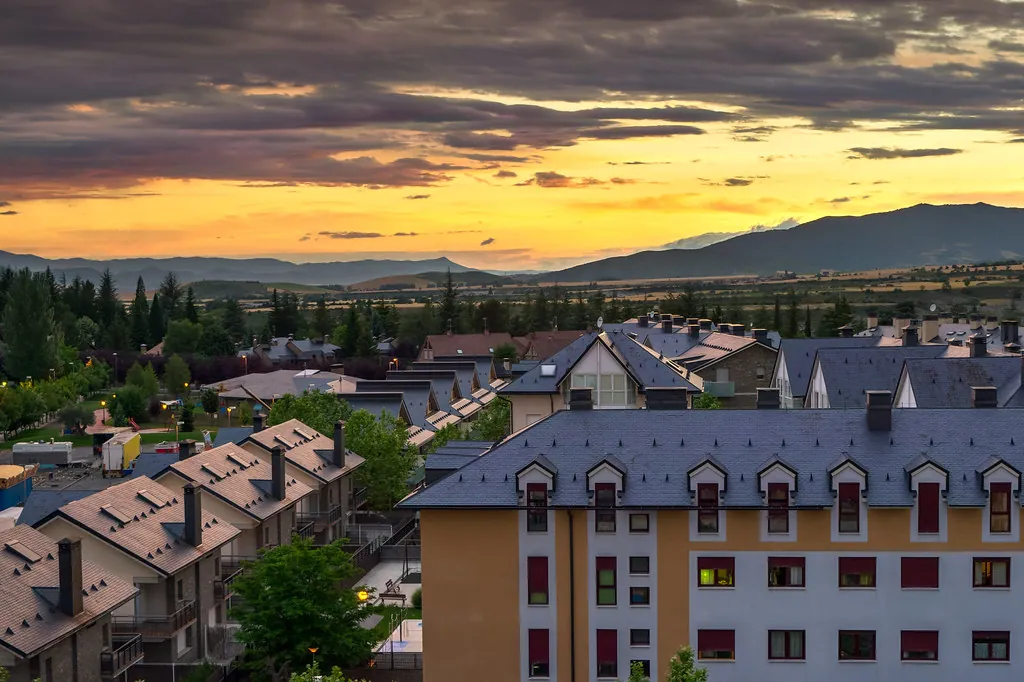
Royuela clings to the southern flank of the Sierra de Albarracín like something grown rather than built. Stone roofs the colour of weathered pewter merge into the slope, and every lane tilts at an angle that reminds calves they are on holiday. Year-round population: 212, plus a handful of returning pensioners who reclaim family houses for July and August. Out of season, silence is the default soundtrack—broken by church bells, a tractor in low gear, or the clatter of walnuts falling onto corrugated iron.
A village that never levelled its gradients
The streets were laid out for mules, not Minis. Alleyways taper into staircases without warning; a wooden balcony at shoulder height lets you peer straight into someone’s kitchen where rabbit stew simmers. Most houses are dressed in the local limestone, their timber galleries painted the deep ox-blood red once produced by village brickworks. A few lie hollow, roofs collapsed, but even these ruins are tidy: firewood stacked inside old bedrooms, rosebay willow-herb poking through empty hearths.
There is no souvenir shop, no interpretive centre, no glass-fronted boutique hotel. The only public building of note is the Iglesia de San Juan Bautista, a 16th-century parish church whose modest tower houses two bells cast in Zaragoza in 1798. Step inside and the temperature drops five degrees; the altar retablo, gilded during a brief flour-boom in the 1940s, gleams like a seam of sudden sunlight. Sunday mass at eleven still draws twenty-odd villagers, men in flat caps parked along the north aisle, women swapping packets of saffron-coloured seeds after the service.
Forests that outnumber the people
Royuela sits inside a pinery of Scots pine and Spanish oak that stretches, almost unbroken, to the watershed of the Guadalaviar. From the top of the village, a dirt track known locally as the Senda de los Neveros climbs 300 metres in forty minutes to a snow-well carved into the rock—farmers once packed winter ice and sold it in Albarracín come July. The path continues eastwards, linking with the GR 10 long-distance trail; map and footwear are essential, because waymarking is sporadic and phone coverage evaporates after the second ridge.
In October the woods become a supermarket. Chestnut, penny bun, parasol and saffron milk-cap all appear within a twenty-minute radius, and villagers guard their cortes (mushroom patches) with the same discretion a Devon farmer reserves for trout pools. Picking is regulated: the regional government issues daily permits online (€5), caps baskets at three kilos, and stations forest rangers at track junctions. Ignorance is no defence—every autumn someone gets a €300 fine for carrying a plastic bag instead of the obligatory open weave.
When to come, what to expect
Spring arrives late. Snow can fall as early as Halloween and linger on north-facing slopes until April; if driving, pack chains even when the forecast claims “light frost.” May and early June bring clear, sharp days perfect for walking—daytime 18 °C, nights dropping to 7 °C—while the village’s handful of almond trees suddenly bloom in neon pink against the grey stone. July turns hot and thundery; by August the place doubles in volume as grandchildren arrive from Zaragoza and Valencia. Accommodation is limited to Hostal Royuela (sixteen rooms, €45–€55 B&B), a no-frills guesthouse above the only bar. Book ahead for fiestas; otherwise you’ll be offered a mattress in someone’s hayloft for €20 and the expectation that you’ll join the family paella.
Fiestas take place around the third weekend of August: procession of San Juan, open-air disco powered by generators that make the lights flicker across the valley, and a Saturday comida popular where long tables appear in the plaza and everyone pays €12 for bottomless sangria and a plate of roast goat. The volume rises, dogs bark till dawn, and for forty-eight hours Royuela forgets it is a quiet mountain village. By Monday the rubbish lorry has hauled away the empty bottles and the last teenager is kicked towards the bus stop; silence reasserts itself like mist in a hollow.
Eating, or not
There is no restaurant. The bar opens at seven for coffee and churros, closes at ten, reopens at seven for beer and tapas—simple things: manchego, tinned mussels, longaniza sausage grilled on the plancha. If you want a full meal, ask the day before; the owner’s sister will cook a three-course dinner (€18) provided you don’t mind eating in the kitchen while her husband watches football. Most visitors self-cater. The nearest supermarket is in Gea de Albarracín, 19 kilometres west, so stock up in Teruel before you leave. Vegetarians should note that even the vegetable stew is likely to have bits of jamón lurking at the bottom; coeliacs will struggle because bread appears with everything and “sin gluten” still translates as “without understanding.”
Getting here, getting out
No railway reaches this corner of Aragon. From the UK, fly to Zaragoza (direct from London-Stansted with Ryanair, three times weekly), hire a car, and count on two hours via the A-23 and the TE-V-7031. The final 35 kilometres from Teruel twist through pine plantations and sudden drops; meeting a timber lorry on a hairpin is memorable. In winter the road is gritted but not salted—if it snows overnight you may be stuck until the snowplough appears at first light. Buses run Monday, Wednesday and Friday, departing Teruel bus station at 14:30, returning at 07:00 next day; the timetable favours locals visiting the doctor, not tourists chasing sunrise pics.
The unspectacular appeal
Royuela will not change your life. It offers no Michelin stars, no selfie-magnet viewpoints, no artisan gin distilled in a fifteenth-century cellar. What it does offer is a place where the night sky is still genuinely dark—Orion so sharp you feel you could thread him like a needle—and where an elderly man will interrupt his wood-chopping to walk you to the pathhead because “el bosque es traidor” when fog rolls in. Come prepared: good boots, a full tank, food for twenty-four hours longer than you think you’ll need. Treat the village as you would a bothy in the Cairngorms: leave nothing but footprints, take nothing but photographs, and remember that the quiet you came for belongs to the people who live here first.