Full Article
about Santa Maria de Dulcis
Ocultar artículo Leer artículo completo
The tractors start at seven. By half past, the narrow lanes of Santa María de Dulcis echo with diesel as the first trailers of garnacha grapes clatter towards the cooperative. From the stone bench outside the village shop—open, today at least—you can watch the whole operation: drivers leaning out to swap yesterday’s yield figures, a dog keeping pace alongside, the morning sun still low enough to throw long shadows across the 522-metre contour line that passes for the village “high street”. It is late September, the only time of year when the population briefly doubles and the place feels busy.
A landscape that changes its shirt three times a year
Spring arrives suddenly. One week the surrounding cereal terraces are stubble-brown; the next, a haze of green pushes through the cracked earth and the first swallows appear under the eaves of the parish church. By late May the vines have outrun the wheat, and the whole basin between the church and the Sierra de la Llena glows an almost luminous green. Summer strips the colour back to gold, the soil powdery underfoot and the air thick with the smell of warm rosemary. Autumn is the money shot: vineyards flame oxblood and copper, tractors block the road, and every garage seems to double as a pop-up tasting room for Somontano wine.
Winter is the quiet quarter. Daytime highs hover around 8 °C, night frosts are common, and the fields revert to a muted khaki. What saves the season is the light: sharp, low-angle sunshine that picks out every stone in the 12th-century church tower and makes the limestone walls of the cottages look butter-yellow at four in the afternoon. Snow is rare at this altitude—unlike the high Pyrenees 40 km north—but the wind that scours across the plateau can slice straight through a Barbour jacket.
Stone, adobe and the smell of fermenting grapes
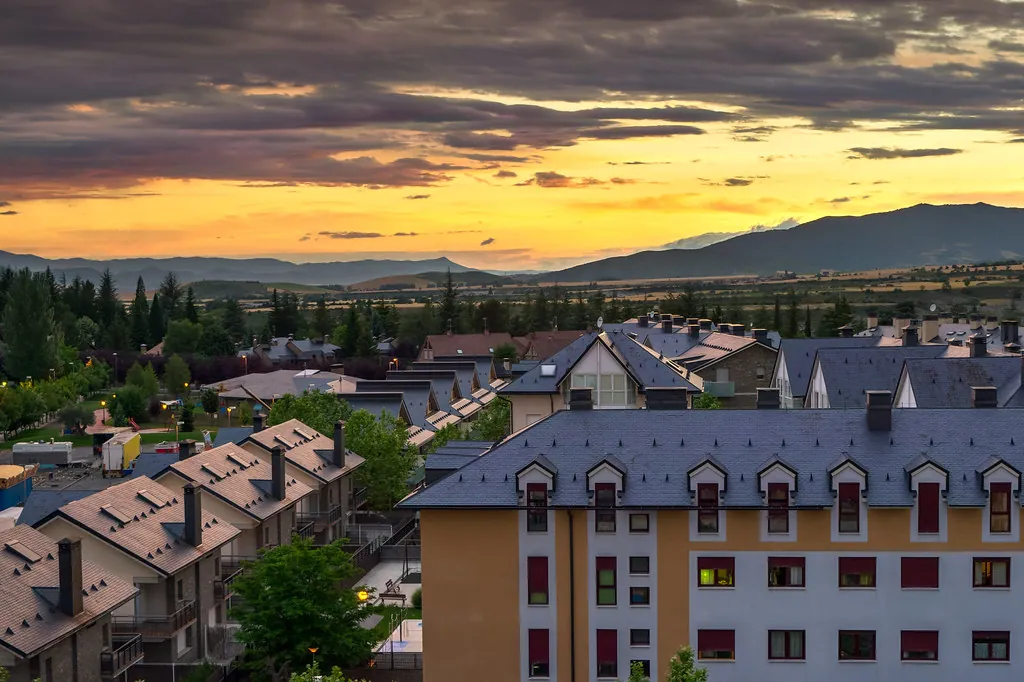
There is no postcard plaza. Instead, the village unfurls along a ridge-top lane barely wide enough for a combine harvester to pass. Houses are built from whatever came out of the ground nearby: lower walls in honey-coloured limestone, upper storeys in sun-dried adobe bricks the size of airline pillows. Timber portals—some still original chestnut—are painted the same ox-oxide red you will see on carts and beehives across Aragon. The overall effect is more functional than pretty, yet the proportions are satisfying: deep-set windows, generous eaves, the occasional carved datestone announcing “1783” or “1926” in serif numerals deep enough to cast their own shadow.
The church of Santa María keeps watch from the highest point. Its bell turret was raised in the 16th century on the bones of an earlier Romanesque nave, and inside you can still make out the ghost of medieval paint on the rib-vaulting—faded oxford-blue stripes and a fragment of gilt stars. Mass is held only twice a week, but the door is normally open and the temperature inside a good ten degrees cooler than outside. Bring change for the box: €1 buys a taper if you want to add your own thin column of wax to the forest left by previous visitors.
Walks that start at the bakery
Santa María is not a base for high-altitude epics; rather, it is the perfect radius for a morning loop that ends in time for lunch. Pick up a still-warm coca—a Catalan-style flatbread topped with anchovy and red pepper—at the horno opposite the fountain, then follow the signed track that leaves the village past the last irrigation tank. Within ten minutes you are between vineyard rows, the soil soft under walking shoes, the vines close enough to reach out and steal a warm garnacha grape. The path climbs a modest 120 m to a low col where the view suddenly widescreens: south across the quilted cereal plains towards Huesca, north to the saw-tooth ridge of the outer Pyrenees.
Turn left along the ridge and you drop into a dry stream bed scented with thyme and the vanilla-like resin of stunted pines. Allow 75 minutes back to the bakery—longer if you stop to photograph the abandoned stone hut whose roof has collapsed into a perfect sunlit jigsaw. The route is way-marked but not way-managed: after heavy rain the gulley turns slick as soap, and in July the shade is non-existent. Carry water; there are no bars en route.
Wine without the theatre
The Somontano DO begins at the village boundary. Unlike Rioja, there are no faux-château driveways or £40 tastings here. Instead, look for the hand-painted “Venta de Vino” sign on a garage door. Knock, and someone’s aunt will appear with a two-litre plastic bottle and a price list chalked on the wall: garnacha rosado €4, full-bodied crianza €6. Bring your own container or buy one on the spot. If you prefer labels, the cooperative bodega on the main road opens weekday mornings and will let you taste three wines for nothing, provided you buy at least one bottle afterwards (around €9 for the house red).
Serious oenophiles head 12 km south to the purpose-built cathedrals of Enate or Viñas del Vero, where stainless-steel vats gleam like space rockets and the tasting notes come in English. Santa María’s advantage is access to the same grapes without the coach parties; the disadvantage is that you will need to speak at least menu-Spanish and carry cash—cards are still regarded with mild suspicion.
Eating: what to expect when you’re expecting dinner
The village contains one restaurant, Posada de Lalola, open Thursday to Sunday for lunch and Friday plus Saturday for dinner. Expect grilled lamb cutlets, chips done in olive oil, and a tomato salad that actually tastes of tomato. Mains run €12–16; house wine is decanted from a jug and costs €2.50 a glass. Kitchens close at 21:30 sharp—arrive at 21:35 and you will be offered a drink while the chef finishes wiping down.
For anything more ambitious you drive 15 minutes to Graus, where Cal Borau serves slow-roasted shoulder of goat and a wine list that dips into Priorat. Stock up beforehand at Graus’s Consum supermarket; the village shop carries only tinned tuna, UHT milk and a rotating selection of seasonal vegetables priced by felt-tip pen.
Beds for ten, or just for two
Accommodation is thin. The smartest option is to rent one of the stone houses aimed at multi-generational families: eight bedrooms, eight bathrooms, a pool that looks onto vineyards and a kitchen island big enough to butcher a whole jamon. Expect €250 a night in May, €420 in August. Smaller parties can try Hostal La Fuente, five rooms above the bar, breakfast of strong coffee and industrial pastries included, €55 double. The hostal is clean, the Wi-Fi patchy, and the owner delighted to practise the English he learned working in a Nottingham warehouse twenty years ago.
When to come, and when to stay away
April–mid-June and mid-September–October are the sweet spots: daytime 22 °C, cool nights, vines either in fresh leaf or full harvest drama. July and August are hot—34 °C is normal—and the village empties after 14:00 while everyone sleeps. Winter is photogenic but monochrome; cafés reduce hours and the only heating in the church is your own breath condensing in front of you.
Avoid the last weekend of August if you dislike brass bands; fiestas patronales mean processions, fireworks and a pop-up bar in the square that stays open until well past the usual curfew. Rooms are booked months ahead by returning families whose grandparents were born here.
Last orders
Santa María de Dulcis will not change your life. It offers no souvenir shops, no Michelin stars, no ancient ruins to tick off. What it does give is a working slice of Aragón where agriculture still sets the clock, where a stranger can taste wine straight from the tank, and where the loudest sound after dark is the church bell counting to eleven. Bring walking shoes, a phrasebook and a pocketful of euro coins. Leave before the tractors start again, or stay long enough to learn their schedule by heart.