Full Article
about Secastilla
Ocultar artículo Leer artículo completo
First Light
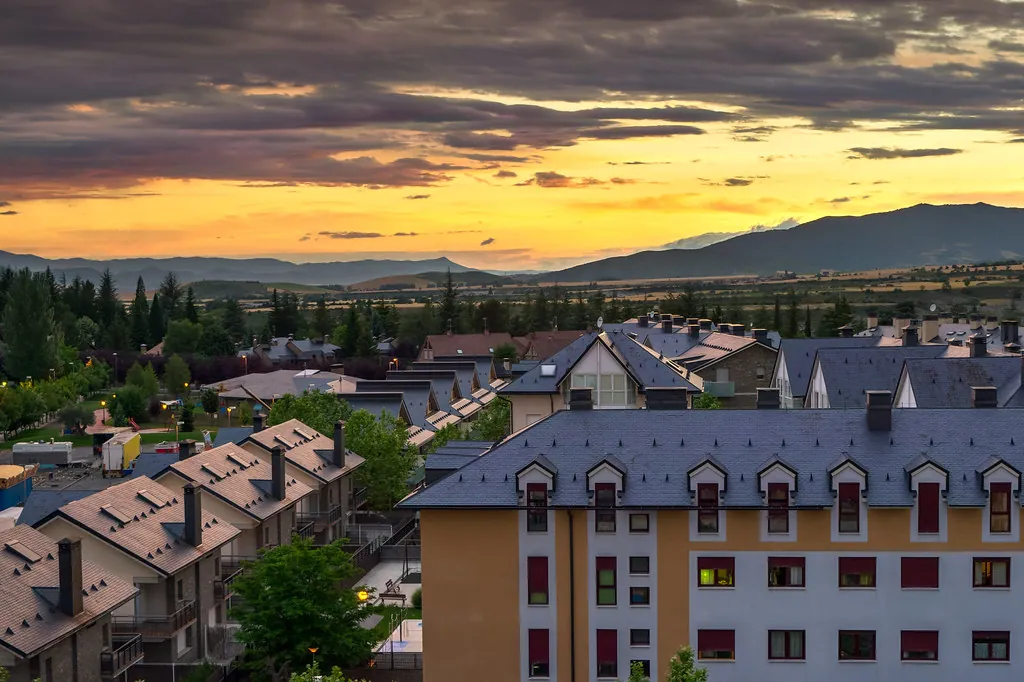
At 07:20 the bells of the Asunción strike once, then stop. No traffic, no milk float, no aircraft trail—just terraced rooftops turning honey-coloured while the Sierra de Chía sharpens behind them. From the upper lane you can watch the sun climb straight out of almond orchards and hit stone that has already survived four centuries of frost and midsummer glare. It is the moment most visitors remember later, usually when they are back on the A-22 wishing they had stayed another night.
A Village that Never Pretended to be a Town
Secastilla keeps its proportions honest: one church, one bar (open when the owner’s cousins are not minding it), a scattering of barns turned into weekend hideouts, and roughly 140 permanent souls. The houses are built from whatever the ground offered—schist, oak beams, the odd Roman brick nicked from the valley road. Nothing is postcard-perfect; render patches dry in different shades, satellite dishes cling to medieval walls, and a 1990s Seat Toledo rusts quietly beside a 17th-century arch. The place feels used rather than polished, which is why walkers looking for “rustic without theme-park” keep turning up.
The altitude, only 612 m, is high enough to shave three degrees off the plain’s summer furnace but low enough for olives and old Grenache vines to survive. Spring comes two weeks earlier than in the high Pyrenees, so you can breakfast on village almonds while watching snow still glued to the distant 2,000 m ridge. In October the same terraces glow amber; by late afternoon the whole slope smells of crushed grapes and woodsmoke, and camera batteries mysteriously drain faster.
Walking Without a Brand Name
No gift shop sells a glossy “Secastilla Circular” map, and that is useful intelligence. The paths that leave the last house are old mule tracks linking fields to threshing floors; they fork, rejoin, and peter out on limestone slabs exactly like the ones farmers have cursed since 1800. A confident walker can string together a two-hour loop south-east to the abandoned hamlet of Pano, add another hour to reach a ruined ice-house, and be back before the sun clears the ridge. Gradient is gentle, stout shoes suffice, and the only ticket office is the occasional chained gate asking you to close it after passing. If you want way-marks every 200 m, drive 45 min to the national park; if you like the idea of choosing left or right because a buzzard is circling that way, stay here.
Serious hikers sometimes sniff at the lack of 1,000 m ascents, yet the lower Sierra de Chía delivers compensations: Griffon vultures at eye level, rock rose that smells warm even in February, and the faint thud of your own pulse when every phone bar has vanished. One ridge north you can look straight down the Esera gorge and count three villages nobody has Instagrammed yet.
What You’ll Eat—and What You Won’t
Forget tasting menus. Evening meals happen in Barbastro (22 km, 25 min drive) unless you booked a cottage with a hob. Breakfast, however, can be magnificent if you shopped sensibly the day before: local honey thick as cold custard, a slab of goat’s cheese that tastes of thyme, and flat peaches that never make it as far as British supermarkets because they bruise if you frown at them. The village bar, when the shutter is up, will fry you migas—breadcrumbs with strips of pancetta—then pour a glass of Somontano Garnacha that costs €2.50 and slips down like Beaujolais with better manners.
Lunch is your picnic on a wall. Supper is whatever you cook, because the nearest restaurant open on a Tuesday is in the valley, and the road back is twisty. Bring a corkscrew; the bodegas at Peralta de Alcofea and Barbastro close at 14:00 sharp, but their €6-€8 crianzas outperform London £18 versions without breaking stride.
The Wine Route Nobody Shouts About
Secastilla sits on the north-eastern fringe of the Somontano D.O., a region Aragonese know but foreigners rarely do. Drive twenty minutes south-west and you reach Bodega Pirineos, where labels are printed in English, tours last 35 min, and someone will explain why the local Garnacha keeps alcohol down to 13.5 %. Back towards the village, tiny Lalanne opens only on weekdays but lets you taste inside a 16th-century stone press big enough to park a Mini. Buy two bottles of their pink “Clarión” and it comes wrapped in yesterday’s Heraldo de Aragón—recycling at its most casual.
None of this is packaged as an “experience”. You will not find a souvenir fridge magnet, and the tasting room may double as the accountant’s office. That, inevitably, is what persuades certain visitors to fill the boot and spend the night in Secastilla itself rather than drive back to a chain hotel on the plain.
Practical Grit
Getting here: Fly Stansted to Zaragoza (Ryanair, 2 h), pick up a hire car, head north-east on the A-22 to Barbastro, then follow the N-123 and A-2305 for the final 22 km. The last 6 km tighten into hairpins, but the tarmac is smooth and passing bays appear just when you need them. Fill the tank and the wallet in Barbastro—Secastilla has no petrol station and no cashpoint, and the nearest supermarket shuts at 14:00 on Saturday for the entire weekend.
Sleeping: Three cottages rent by the night, none with a pool, all with wood-burning stoves you will appreciate in April. Expect around €90 a night for two, towels included, Wi-Fi that fades when the wind is from the north. Book through the village association’s single web page; response time is two days, not two hours.
Weather realism: April and May are glorious and green; September and October stable and golden. July afternoons reach 32 °C—walk early. January hovers round 4 °C, the lanes stay damp all day, and mist can trap you until noon. Snow is rare but possible; carry tyre chains December-March because the council tractor may take its time.
When Not to Come
Turn up during the mid-August fiesta and the population quadruples. The square hosts a decent paella, the church is floodlit, and someone will hand you a plastic cup of cloudy vermouth at 01:00. The silence you drove four hours to find has gone home with the last firework. Equally, rock up on a wet Tuesday in February and you will meet four villagers, two dogs, and a closed bar. Half a day suffices to see stone, photograph mist, and decide civilisation has its merits after all.
Last Call, Quietly
Leave at dawn and you will meet the baker loading loaves into a van older than he is. The church door will be ajar, candles lit for nobody in particular, and the valley below still invisible under a cotton-wool cloud sea. It is the sort of exit that makes you check property prices, then remember the nearest A&E is 45 minutes away. Secastilla does not flatter, sell, or shout; it simply stays there, 612 m up, waiting for the next traveller who thinks good travel sometimes means turning the phone off and admitting the map might be wrong.