Full Article
about Trasmoz
Ocultar artículo Leer artículo completo
The Pope’s parchment still hangs in the village bar. Yellowed, cracked and framed between a ham leg and a football scarf, the 1511 bull Cum sicut nobis declares Trasmoz "damnata et excommunicata" – the only place in Spain that carries its own papal curse as a tourist credential. Locals treat the document with the same mock reverence they reserve for the weather: shrug, grin, pour another caña. After five centuries the anathema feels more like a party piece than a mortal sin.
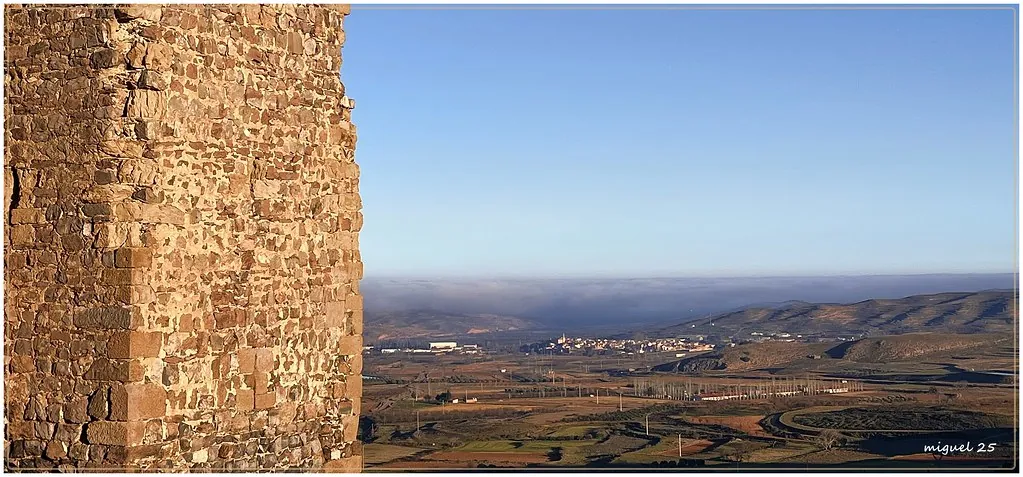
Perched at 765 m on the sun-baked southern flank of the Moncayo massif, the village is barely six streets wide. Stone houses shoulder together as if huddling against the north wind that barrels down the Ebro valley. From the ruined castle you can watch the ridge change colour hourly: limestone grey at dawn, bruised purple after rain, copper when the sun drops behind the cereal plains of Campo de Borja. The view is the main reason people make the 75-minute dash from Zaragoza, and it repays the petrol even if the castle itself is little more than a hollow keep and a staircase that ends abruptly in mid-air.
Witchcraft with Receipts
The curse was never about heresy; it was about water. Medieval Trasmoz owned the only spring capable of powering a forge, and the abbey at nearby Veruela wanted it. When the villagers refused to hand over the water rights, the monks produced witnesses who swore that covens danced on the battlements. Rome obliged, the villagers were cut off from sacraments, and the abbey got its mill. The forgery is so clumsy that even the parish priest laughs about it today, but the story stuck. Gustavo Adolfo Bécquer collected it in the 1860s, and the village has been trading on witchcraft ever since.
Inside the castle keep the Centro de la Brujería displays the tools that "proved" guilt: rusty iron fork for testing floating, a cracked cauldron that looks suspiciously Roman, and a life-sized mannequin of a 16th-century inquisitor sporting Reebok trainers (a curatorial joke that passes without comment). Entry is €3, children half price, and the custodian will insist on demonstrating the sound effects that make the torture table rattle. It is tacky, brief and oddly good fun – more Ghost Train than Imperial War Museum – and the roof terrace gives the best photograph of the Moncayo escarpment without paying for a drone licence.
Below the castle the single-lane main street smells of wild thyme and diesel from the generator that keeps the streetlights flickering. The 18th-century church of Nuestra Señora de la Huerta is usually locked; ring the bell labelled "Don Pascual" and the sacristan will shuffle over from the bakery with a key the size of a croquet hoop. Inside, the Baroque retablo glitters with gold leaf paid for by contraband iron once smuggled down the mountain mule tracks. Ask nicely and Don Pascual will lift the altar cloth to show the scorch mark where, allegedly, a witch transformed herself into a black cat and shot skywards through the roof. The hole was repaired; the legend lingers.
Walking on the Devil’s Staircase
Trasmoz works best as a two-hour stop en route to the Moncayo natural park, but if you have boots there is enough walking to fill half a day. The Sendero de las Brujas loops 5 km through holm-oak and rosemary, passing the abandoned forge whose furnace once kept the whole village in work. Stone slabs are worn smooth where mules dragged ore – locals call it the Devil’s Staircase because the incline is so steep that beasts supposedly climbed on their knees. The path is way-marked but mobile signal dies after the first crest; download the route from the tourist office in Vera del Moncayo before setting off. In April the hillside is polka-dotted with crimson peonies; by July the same earth is cracked like the base of a dry reservoir, so carry more water than you think sensible.
Lamb, Cheese and Other Unholy Pleasures
There is only one place to eat: Bar Trasmoz, opened in 1978 by a London-returned miner who wanted Tetley tea and never quite got it. The menu is chalked on a blackboard and rarely changes: ternasco de Aragón (milk-fed lamb shoulder slow-roasted with garlic and mountain herbs), migas flecked with chorizo, and a vegetarian option of roasted piquillo peppers stuffed with goat’s cheese. Portions are built for harvest labourers; one plate feeds two if you order chips. House red is from the cooperative in Borja – perfectly decent, better if you let it breathe while you argue about whether the excommunication has expired.
Round the corner the Quesería de Trasmoz sells a semi-cured sheep’s cheese that tastes like a mild Manchego with a nutty finish. The owner vacuum-packs wedges so you can leg it through customs, but the shop observes no recognisable timetable. British visitors have posted plaintive notes on TripAdvisor: "Arrived at 11, 14:30 and 16:45 – all closed." The workaround is to order the night before through Bar Trasmoz; the barman’s sister runs the dairy and will leave your parcel under the counter with a receipt written on a beer mat.
When to Risk the Curse
Spring and autumn give crisp air and gold-plated light without the furnace heat of the Ebro basin. The last weekend of June turns Trasmoz into an open-air fantasy convention: the Feria de Brujería brings tarot readers, mead stalls and a procession of hooded druids who bang drums at dawn. Parking backs up for 2 km along the verge; if you must come, arrive before 10 a.m. or leave the car in Vera and walk the final 4 km. Halloween is tamer – mostly primary-school witches with cardboard hats – but the castle hosts candle-lit storytelling that finishes with a shot of patxaran thick enough to varnish a coffin.
Winter is quiet, occasionally snowy, and the mountain road can ice over. Chains are rarely needed but hire companies in Zaragoza will charge you for the day even if you return them untouched. The bar shortens its hours and the museum may close without warning if the custodian’s sciatica flares up. On the plus side you get the ramparts to yourself and the church acoustic is superb for humming Greensleeves while the sacristan pretends not to notice.
Getting There, Getting Out
No train, no bus, no Uber. You need wheels. From Calatayud take the A-68 towards Logroño, exit at 19 "Vera del Moncayo" and follow the JV-522 for 6 km of hairpins. The tarmac is sound but meeting a tractor around bend three will test your clutch control. Allow 90 min from Zaragoza airport, 2 hr 30 min from Bilbao if the A-68 is kind. Petrol stations are scarce after Gallur; fill the tank and the spare jerrycan if you plan night driving – street lighting stops at the village boundary and the darkness is absolute.
Leave time for the Monasterio de Veruela ten minutes down the hill. The Cistercian abbey is Spain’s best-preserved medieval brick pile, English brochures are stacked by the gate, and the café does a respectable flat white while you wait for Trasmoz’s castle key-holder to finish siesta. Combined, the two sites make a satisfying day trip that justifies the hire-car fee without demanding an overnight stay – unless, of course, you fancy testing whether the papal curse still works on British licence holders.