Full Article
about Valpalmas
Ocultar artículo Leer artículo completo
The church bell strikes noon and only two cars sit in the main square. One belongs to the baker who drives in from Ejea de los Caballeros; the other to the village priest. Valpalmas, population 134, is conducting its daily census of engines. At 493 metres above sea level, the air carries the dry scent of wheat stalks and the faint diesel note of a distant combine harvester working the surrounding plateau. This is Aragón’s interior stripped of postcard props: no dramatic peaks, no river gorges, just an ocean of cereal fields that ripple like water when the cierzo wind bullies across from the Ebro basin.
Most visitors race past on the A-127, bound for the better-known villages of Cinco Villas. Those who brake at the turning signed “Valpalmas 3 km” discover a place that measures time by harvests rather than hours. The approach road climbs gently through sun-bleached barley; stone threshing circles, now obsolete, appear every few hundred metres like archaeological footprints. By the time the first houses emerge—low, square, roofed in terracotta—the mobile phone signal has already thinned to one hesitant bar.
A grid for walking, not driving
The village blueprint follows a simple logic: three parallel streets stitched together by alleyways just wide enough for a tractor. Park anywhere; nobody charges and nothing is monitored. The stone church of San Pedro guards the only proper plaza, its tower repaired in 1978 after a lightning strike that locals still describe with cinematic detail. Inside, the temperature drops ten degrees; the walls carry a faint smell of beeswax and the previous century’s incense. A single bulb illuminates a 16th-century retablo whose paint has retreated to the folds of saintly robes, leaving faces ghostly.
Beyond the church, the urban fabric frays quickly. One street ends at a threshing yard where swallows nest in the eaves; another dissolves into a farm track that points towards Tauste on the horizon. The housing stock mixes ochre stone with brick laid in the characteristic Aragonese pattern—three stretchers, one header—designed to withstand both heat and boredom. Many doors still display the family name in metal lettering: “Los Gracia”, “Vidondo e Hijos”. Some are holiday homes occupied two weekends a year; others belong to septuagenarians who can recall when the village supported three grocers and a cinema that showed one film per month.
Lunch at elevation
Altitude changes appetite. At 493 m the sun feels closer than on the coast, and the body craves salt and bulk. The only public dining option is Bar Centro, open from 07:00 until the cook decides otherwise. A hand-written board lists three platos del día: migas with grapes and chorizo (€9), lamb shoulder slow-cooked in wood-fired oven (€12), and a tomato-pepper salad that arrives dusted with the local oregano nobody bothers to label. Wine comes from a five-litre plastic container kept behind the bar; ask for “el del pueblo” and you’ll receive a tumbler of garnacha that costs €1.50 and stains the lips purple. Payment is cash only; the card machine broke in 2019 and nobody has missed it.
If Bar Centro is shuttered—Tuesdays in winter, siesta hours in August—drive ten minutes to Sádaba where Mesón La Villa serves roast suckling pig with crackling that shatters like toffee. Book ahead at weekends; Spanish weekenders arrive from Zaragoza with the appetite of urban escapees.
Walking without waymarks
Valpalmas has no tourist office, no glossy footpath leaflets, and no gift shop selling corkscrews shaped like bulls. What it does have is a 360-degree horizon that invites straight-line marching. Head south on the camino de Valdabra and within twenty minutes the village shrinks to a Lego cluster, the grain silos of Ejea flashing silver twenty kilometres beyond. The track is dead flat, shared with the occasional farmer in a white van who waves without slowing. Wheat stubble scratches ankles in July; poppies puncture the green wheat in April. Take water: there is no shade, and the UV index here regularly tops 9 in summer.
Spring brings another hazard: the celadas, irrigation ditches hidden by grass. Locals navigate them from memory; visitors discover them with a twisted ankle. Mobile coverage is patchy, so tell someone where you’re walking, even if that someone is the barman pouring your breakfast coffee.
When the fields turn white
Winter arrives abruptly. The first cierzo storm usually hits in mid-November, dragging temperatures from 18 °C to 3 °C overnight. Snow is rare but frost is not; the puddles in the threshing yard glaze like brittle mirrors. With no bars lit after 22:00, the village feels closer to the 1950s than to the 2020s. Heating is mostly diesel-fired; the smell lingers in the alleyways at dawn. Roads remain open—gritters work the regional network efficiently—but rental cars without winter tyres skate on the compacted-snow corners. If you plan a December visit, book a vehicle with chains and bring a sleeping bag; country houses lose power when agricultural diggers slice overhead cables.
August paradox
The feast of the Assumption, 15 August, triples the population for forty-eight hours. Returning emigrants pitch tents in olive groves; sound systems powered by portable generators pump out reggaeton until the priest requests mercy at 03:00. A temporary bar under plane trees sells Estrella Galicia at €2 a bottle and offers plastic chairs that sink into the irrigated lawn. The bull-run uses rope instead of wooden barriers; spectators stand on concrete blocks once used for tying mules. If you crave solitude, arrive the week after: litter crews sweep up the spent cartridges, the plaza regains its echo, and prices drop back to agricultural wages.
Getting here, and away
Valpalmas sits 92 km north-west of Zaragoza, 310 km from Madrid. Public transport is theoretical: one school bus departs Ejea at 07:10, returns at 14:30, and does not operate in July or August. A taxi from Zaragoza airport costs €120 pre-booked; car hire for a week starts at €130 with full insurance. The final 3 km are on a single-track road; watch for the grain lorries that barrel around the bends at 80 km/h and expect you to reverse into a barley field. Petrol is cheaper in provincial towns—fill up in Ejea before the village run.
Accommodation is limited to three self-catering houses booked through the municipal website (search “Casa rural Valpalmas Cinco Villas”). Expect stone walls 80 cm thick, Wi-Fi that flickers whenever the microwave turns on, and a note asking you to deposit toilet paper in the bin, not the loo. Prices hover around €80 per night for two; weekly discounts apply in low season. Bring slippers: traditional floors are tiled and cold before May.
Last light
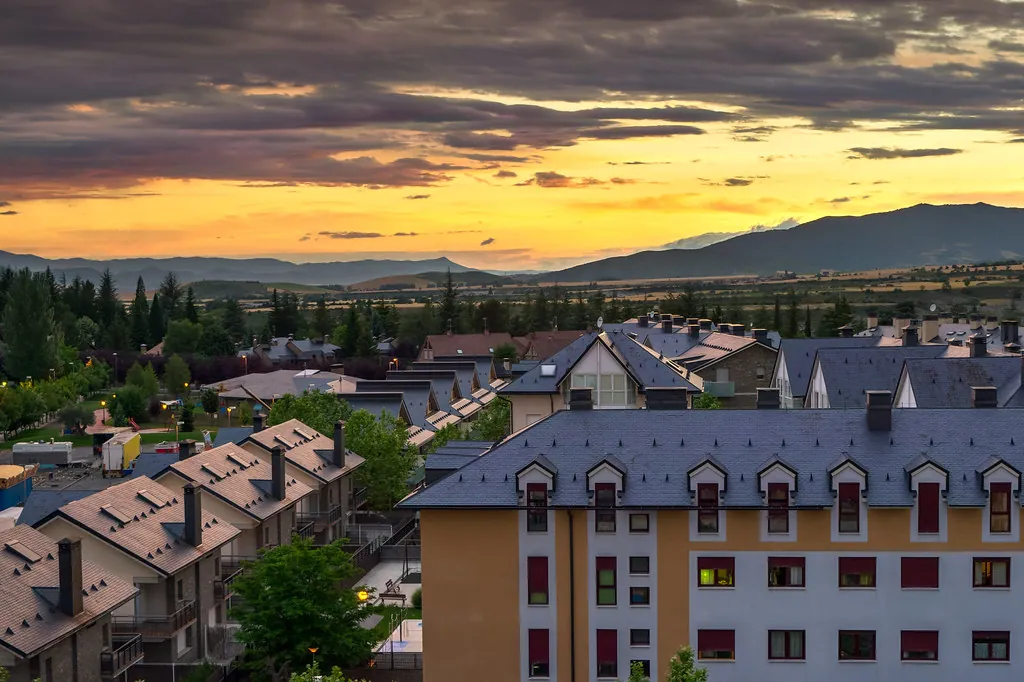
Stay until dusk. The plateau surrenders its heat quickly; thermals rising off the wheat create a shimmer that turns distant silos into mirage islands. Swifts cut parabolas above the church tower, their calls audible in the hush that follows the tractor engines shutting down. When the streetlights—recently converted to LED—flick on, they illuminate more cats than people. Walk to the cemetery gate; from there the fields stretch north until they merge with the sky, an edgeless horizon that explains why so many left and why a few, stubbornly, remain.