Full Article
about Villalengua
Ocultar artículo Leer artículo completo
The church bell strikes noon, echoing across wheat fields that stretch uninterrupted to the horizon. Nobody appears. No café shutters roll up, no locals emerge for lunch. At 770 metres above sea level, Villalengua keeps its own timetable – one governed by combine harvesters and the late-afternoon heat that sends thermometers to 35 °C even in May.
This is the southern edge of Aragón's Campo de Calatayud, a region that guidebooks skip and Spaniards themselves call la España vacía – empty Spain. The village sits 90 minutes' drive east of Zaragoza along the A-2, then twenty minutes north on the N-234 towards Soria. The final approach climbs gently through cereal plots that turn from emerald in April to copper by July. By the time you reach the first stone houses, mobile reception has already begun to falter.
What passes for a centre
There isn't one, really. The main street – Calle San Pedro – runs for 300 metres, enough space for the ayuntamiento, a baker that opens three mornings a week, and Bar California. The latter is the village's only public eating option; inside, a plate of migas fried with chorizo costs €8 and coffee still arrives in glass tumblers. Opening hours are pinned to the door each Monday, usually 10:00–14:00 and 18:00–22:00, but if owner Pepe needs to take his sheep to market the lights stay off all day.
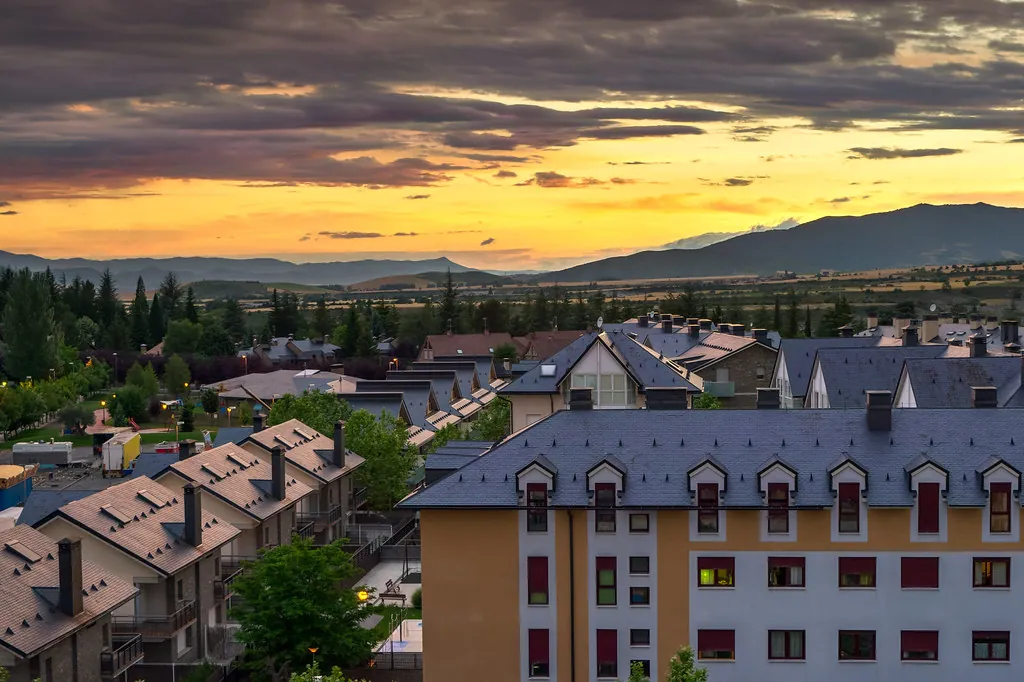
Architecture is utilitarian rather than ornate. Stone houses, most two storeys high, wear centuries of repairs like geological strata. Wooden beams darken under terracotta roofs; walls are whitewashed each spring with lime mixed in the same stone troughs used since the 1920s. The parish church of La Asunción, rebuilt after a fire in 1789, dominates the western ridge. Its single nave and squat tower are visible from every lane, yet the doors remain locked unless you fetch the key from number 14 opposite. Inside, the air smells of beeswax and the stone floor dips visibly where generations have knelt.
Walking without way-marks
Forget signposts. A lattice of farm tracks radiates from the last houses into 360 degrees of horizon. The GR-90 long-distance footpath passes 4 km south, but inside the village boundary you're on your own – which, for experienced walkers, is part of the appeal. Head north-east along the dirt track signed Los Valles and within thirty minutes the settlement shrinks to a grey smudge. Wheat gives way to esparto grass and wild rosemary; the only sounds are hoopoes calling from telephone wires and the wind that arrives fresh from the Moncayo massif, 40 km away.
Spring brings colour: blood-red poppies between the wheat, bee-orchids on uncut verges, and the sharp scent of rain on dry earth. By late June the landscape has burnt blond; walking is best finished before 11 a.m., when temperatures can still touch 30 °C. Autumn is the sweet spot – clear air, threshing crews in the fields, and the chance of a lift back in a neighbour's Land Rover if you look sufficiently footsore.
Winter is a different proposition. At 770 m, night frosts arrive by late October and snow is common from December to March. The N-234 is gritted, but the final 7 km into Villalengua becomes a white ribbon with no passing places. Chains are sensible from November onwards; without them you may spend the night in Calatayud's only open hostal while the village lies silent under 20 cm of powder.
A calendar measured by crops
Tourism here is incidental to agriculture. Visit during the third week of June and you'll meet tractors towing grain wagons to the co-op in Maluenda. September smells of diesel and chaff; entire families turn out to sack lentils, the region's secondary crop. There is no vineyard, no olive press, no artisan cheese cave – just the rhythmic cycle of sow, spray, harvest, repair.
Festivals follow the same calendar. The fiesta patronal, held around 15 August, is less a organised event than a family reunion that spills into the street. A paella the size of a paddling pool appears outside Bar California; someone wheels out speakers for música verbena until 3 a.m. Fireworks consist of a single rocket let off by the mayor's nephew. If you want a hotel bed, book in Calatayud (25 km) – every spare room in the village has been promised to second cousins since March.
Semana Santa is observed, quietly. On Good Friday a dozen residents carry a small carved Christ through lanes barely two metres wide; the only spectators are the household dogs. Christmas means roasted chestnuts and a bottle of patxaran passed from doorway to doorway. New Year's Eve finishes before the national anthem has finished playing from Madrid.
Beds, bread and getting stuck
Accommodation options are, in a word, scarce. There is no hotel, no casa rural registered for tourists, no campsite. The closest beds are in Calatayud: the three-star Hotel Villa de Calatayud (doubles from €55) or the simpler Hostal El Cercado (€35). Both fill fast during the August fiesta and again for the grape harvest in October. A new EV charging point sits in Calatayud's main square – useful because Villalengua itself has none, and only one grocery that opens erratically.
Mobile coverage is patchy. Movistar works on the church plaza; Vodafone disappears the moment you leave the tarmac. Download offline maps before arrival and carry water – the lone drinking fountain in Plaza Nueva is switched off when night temperatures drop below zero.
Car hire is essential. There are four daily buses from Zaragoza to Calatayud (€7.35, 1 hr 10 min), but the onward connection to Villalengua is a school service that runs at 07:20 and 15:10, weekdays only. Miss it and a taxi costs €35. Cycling is feasible if you enjoy gradients: the road from Calatayud gains 250 m over 18 km, often into a headwind that has crossed central Spain unhindered since Ávila.
Should you bother?
That depends on what you expect. If the goal is to tick monuments, eat Michelin-recommended tapas and upload drone footage, stay on the A-2 towards Barcelona. Villalengua offers none of these. What it does provide is a glimpse of rural Spain before rural Spain discovered branding – a place where bread is still delivered from a white van whose driver remembers every customer's name, where the night sky remains genuinely dark, and where the loudest sound at 10 p.m. is the church clock counting the hour to an audience of swallows.
Come with a full tank, a sense of self-sufficiency and, ideally, a smattering of Spanish. Wander the lanes, nod at the elderly men on the bench outside the ayuntamiento, buy a slice of sponge cake that someone's grandmother has baked for the bar counter. Then leave before sunset, because Pepe might close early, and the next coffee is 12 km down the road.