Full Article
about Yebra de Basa
Ocultar artículo Leer artículo completo
The sheep start moving before seven. Their bells clatter down the single street, past stone houses still shuttered against the dawn chill, and out towards meadows that glow amber even in April. By the time the sun clears the ridge above the Alto Gállego, the flock has vanished into the folds of the valley and the village falls quiet again—proper quiet, the sort you notice only when a car finally appears and feels like an intrusion.
Yebra de Basa sits at 880 m on the south flank of the Aragonese Pyrenees, close enough to the French frontier to feel the tug of Atlantic weather yet far enough south to keep winter manageable. The surrounding fields are already green when the ski resorts farther north still lie under two metres of snow, and the air carries the scent of hawthorn rather than diesel. It is, by deliberate neglect rather than design, the anti-resort: 160 permanent inhabitants, no souvenir shops, and a village shop the size of a London kitchen.
Stone, Slate and the Sound of Grazing
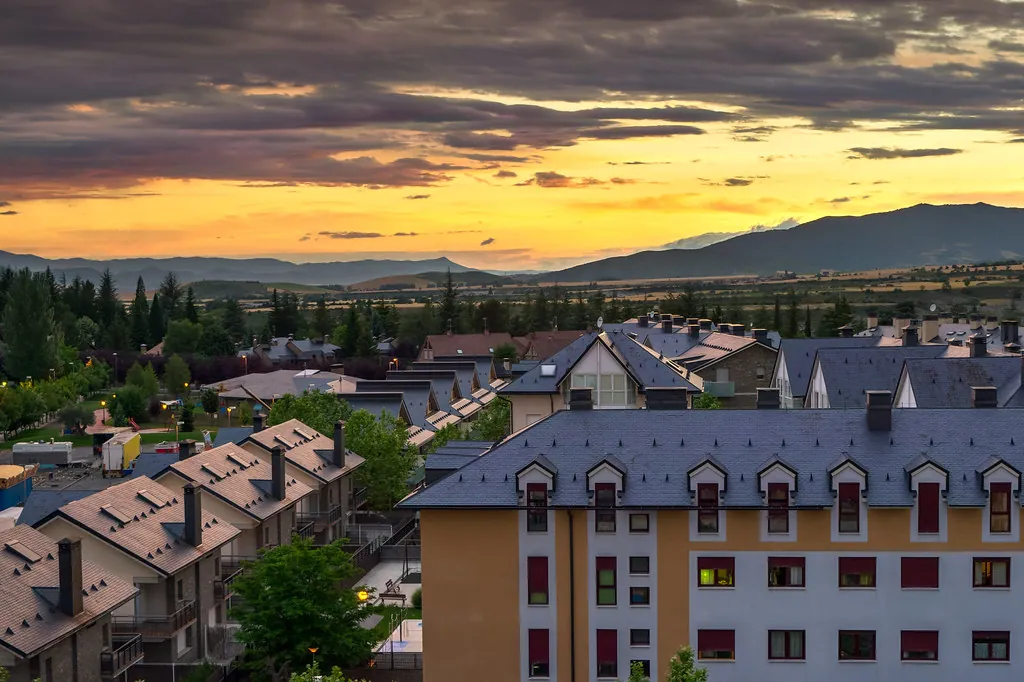
Every house is local work. Walls are built from the same grey-brown limestone that outcrops above the lanes; roofs pitch steeply and finish in heavy slabs of slate meant to shrug off snow. Wooden balconies are small and practical, never wide enough for a postcard breakfast, yet perfect for drying chestnuts or hanging hams. The church tower, the tallest thing for twenty kilometres, keeps its clock ten minutes fast so farmers reach the fields early. Time here is negotiable, but seasons are not.
Walk the lanes at dusk and you pass more animals than people. Cows wear brass bells the size of cricket balls; the note is lower than you expect, a soft F-sharp that carries across the valley and makes mobile reception—already patchy—feel unnecessary. When the bells stop, you know someone has opened a gate and the herd is inside for milking. The silence that follows is so complete that even town-dwellers lower their voices, embarrassed by the sudden vacancy.
Paths that Were Roads Before Engines
Five minutes from the last lamppost the tarmac gives up. A stone track continues, wide enough for a single tractor, climbing gently through oak and service tree towards the abandoned hamlet of Otal. The map calls it a “medium-difficulty” loop of 11 km; your thighs will call it something else after the 400 m ascent. Yet the gradient is steady, the surface even, and on weekdays you meet nobody except the occasional shepherd on a quad bike who raises two fingers in the exact gesture you’d get on a Yorkshire moor.
Higher up, the path forks. Left keeps to the contour, ducking into beech woods where wild strawberries ripen in June and wild boar dig trenches the width of a boot. Right zigzags to a col at 1 350 m where the whole basin opens: south to the cereal steppe around Huesca, north to the limestone wall of the Pyrenees proper. On a clear morning you can pick out the white antenna cluster atop El Turbón, 70 km away, and still hear a dog barking in the village below.
Winter changes the deal. Snow can arrive overnight in November and stay until March; the same track becomes a narrow white shelf where footprints record every visitor—sometimes the only ones all week. Chains are essential, yet the reward is absolute stillness: no machinery, no aircraft, just the soft collapse of snow slipping off a branch.
What Arrives on the Back of a Pick-up
Food in Yebra travels short distances because it has to. The village colmado opens three mornings a week and stocks UHT milk, tinned tuna, and the local brand of detergent that nobody likes but everyone uses. Anything perishable comes from farther down the valley: bread from Biescas, trout from the fish farm at Escarrilla, lamb from a cousin’s farm outside Sabiñánigo. The two bars follow the same rule. At Bar Merendero La Cabaña the menu is written on a blackboard that changes according to what appeared in the back of someone’s pick-up that afternoon—wild mushrooms in October, cardoons in December, a whole lamb shoulder on the day of the transhumance festival.
Order “pollo al chilindrón” if you want the gentlest introduction to Aragonese cooking: chicken stewed slowly with mild red pepper, tomato and a pinch of smoked paprika that never approaches curry heat. Drink is either Somontano wine at €14 a bottle or the house-made clari, a half-fermented apple brew that tastes like Somerset cider left in the freezer. Neither is listed; both appear when you stop asking for a wine list and simply say “¿qué hay?”
When the Village Remembers It Has a Sound System
For fifty weekends a year Yebra shuts down by 22:30. Then August arrives and the population quadruples. Grandchildren who left for Zaragoza or Barcelona come back with extendable dog leads and inflatable paddleboards strapped to the roof. The village square, normally a car park for two tractors and a battered Seat, is fenced off for the fiestas mayores. A stage the size of a removal lorry hosts orchestras that play pasodobles until two in the morning; elderly couples dance under fairy lights while their teenage grandchildren vape discreetly behind the church.
The high point, literally, is the Sunday morning descenso de rapas: young men race down the track from Otal carrying tree trunks the girth of telegraph poles. The winner earns the right to stand the entire village a round of drinks, an honour that costs more than the prize money. By Monday the stage is gone, the square is gravel again, and the last car full of inflatable toys departs leaving only the echo of brass bands and the smell of diesel from the generator.
Getting There, Staying Warm, Leaving Again
The closest airport is Zaragoza, served nonstop from London-Stansted in under two hours. Hire cars live in a cabin opposite the terminal; from the exit barrier it is 125 km of fast dual-carriageway to Sabiñánigo, then 18 km of climbing bends that feel like the last stretch into a Lake District pass. In winter carry snow chains even if the forecast jokes about “light flurries”—the road climbs 400 m in the final ten minutes and shade from the pine plantations keeps ice until noon.
Accommodation is limited to two options: the village albergue, where check-in is a QR code on the door and breakfast is DIY toast with local jam, or a pair of self-catering houses booked through the council website. Both supply electric heaters thick enough to dry walking socks overnight; still, pack a fleece even in July because 880 m feels higher when the sun drops and the wind funnels up from the Gállego gorge.
There is no cash machine; the nearest is in Biescas, 14 km back down the hill. Mobile data flickers between “E” and “3G” depending on cloud cover, so download offline maps before you leave the main road. And if you plan to eat out on Saturday night, ring ahead—both restaurants seat twenty at a pinch, and half of Huesca province seems to like a mountain drive when the weather behaves.
Leave early on departure day. Not because the traffic is fierce—you will meet more horses than cars—but because the morning light turns the stone walls honey-gold for twenty minutes, and the bells start moving again. Watch the sheep disappear round the bend, close the car door quietly, and you will understand why the village needs no souvenir shop: the sound travels with you, clanking softly all the way home.