Full Article
about Barboles
Hide article Read full article
Getting There and First Impressions
Barboles sits about 30 to 40 minutes from Zaragoza, depending on where you set off. The usual approach is along the A‑68, then a turn onto a local road near Alagón. The village is small and easy to enter, with parking typically available near the first streets without much searching.
This is not a place built around visitors. There is no real tourist infrastructure, and options for eating or staying are very limited. It works best as a short stop, a place to stretch your legs before continuing through the Ribera Alta del Ebro. Timing makes a difference. Mornings and late afternoons tend to feel calmer, when activity in the surrounding fields eases slightly.
Streets That Reflect Daily Life
The centre of Barboles is compact and simple to explore. Streets are fairly wide, lined with houses built from brick or adobe. Many properties have large gates, designed for tools, vehicles or storage rather than decoration. There has been little attempt to reshape the village for tourism. What appears is a place that has developed through use, not presentation.
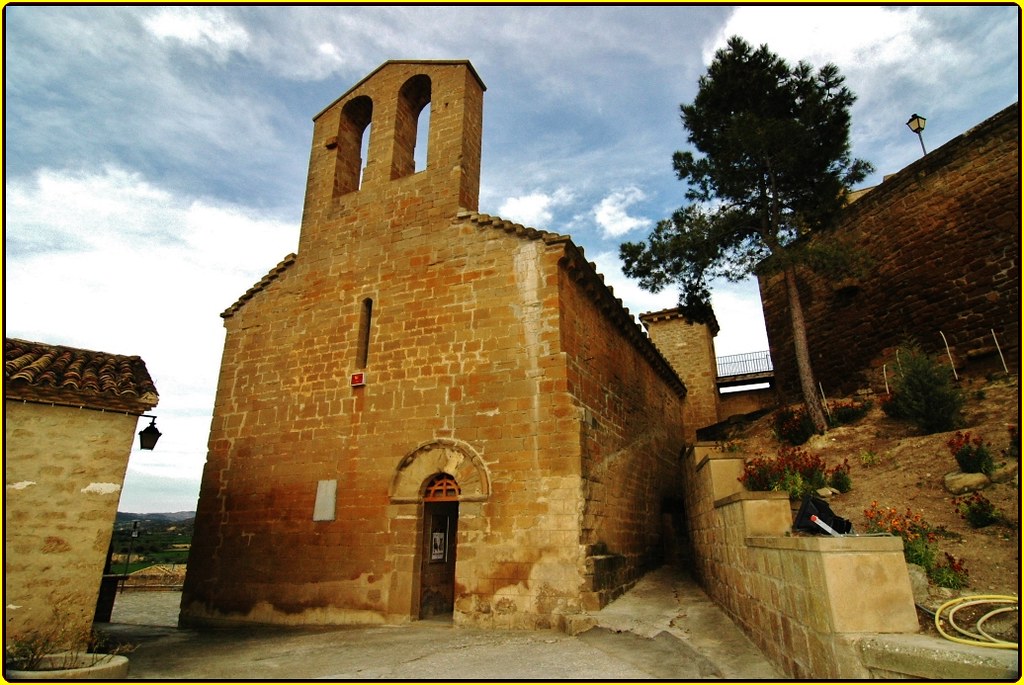
The parish church of San Pedro stands out as the main building. It is a straightforward structure, likely built or altered in the modern period. Its façade is plain, with a clock that marks the rhythm of local life. It does not aim to impress, but it anchors the village visually and socially.
Some façades still carry old inscriptions or small religious details. Elsewhere, repairs and additions show a practical approach, using whatever materials were available at the time. This kind of functional appearance is typical in agricultural communities that were never intended as a display for outsiders.
Fields, Water and Open Ground
Step beyond the last houses and the landscape changes almost immediately. Cultivated plots begin right at the edge of the village. This stretch of the Ebro valley relies on irrigation, and it shows. Irrigation channels run alongside tracks, and fields are laid out in neat, orderly patterns.
The crops vary with the season. There is cereal, some fruit trees, and areas of vegetable growing. The land remains flat, with only slight undulations. There are no nearby hills or wooded areas to break the view. The setting feels open and expansive, characteristic of this part of the Ebro valley.
Small farm buildings appear from time to time, along with sheds used to store machinery. Some are still in active use, while others show signs of partial abandonment. These scattered structures add to the sense of a working landscape that changes slowly over time.
Walking the Agricultural Tracks
Barboles does not offer marked trails or information panels. Even so, walking the tracks around the village is straightforward. Many of these paths are either paved or well compacted, as they are used regularly by farmers.
Any direction out of the village leads to short routes that can be completed in under an hour. These are quiet walks, though it is important to remember that tractors and work vehicles use the same tracks.
The views are not dramatic or panoramic. The appeal lies elsewhere. Fields and irrigation channels stretch out in all directions, forming a continuous, working environment. For anyone interested in how this kind of agricultural landscape functions day to day, seeing it up close has its own appeal.
When to Come
Spring and autumn are usually the most comfortable seasons to visit. The fields are active and temperatures are mild enough for walking without difficulty.
Summer brings intense heat, and shade is scarce once outside the village. Winter can introduce fog across the valley, giving the surroundings a more muted, grey tone. That said, winter is also when the area feels at its quietest.
Local festivities take place around San Pedro, towards the end of June, although exact dates vary from year to year.
What You Will Actually Find
Barboles is not a place that demands hours of exploration. A walk through its streets, followed by a short loop along the nearby tracks, covers most of what there is to see. There are no museums and no major monuments beyond the church.
The interest comes from observing how a small agricultural village in the Ebro valley operates today. Houses are lived in, not preserved. Vegetable plots sit close to the streets. The surrounding fields are active, with a steady flow of rural work shaping the pace of the place.
Practical Notes
The journey from Zaragoza takes under an hour via the A‑68 and local roads. Parking is usually straightforward on arrival.
Do not assume that services will be available year-round. It is sensible to bring water or something to eat if needed.
A simple approach works best here: arrive, take an unhurried walk through the village, then head out along one of the surrounding tracks. In a little over an hour, the essentials reveal themselves. After that, it makes sense to continue exploring the wider Ribera Alta del Ebro.