Full Article
about Boltaña
Hide article Read full article
Late in the afternoon, as the sun drops behind the sierras of Sobrarbe, the stone in Boltaña shifts in colour. It moves from the cold grey of the morning to something warmer, almost reddish, and the streets of the old quarter fall partly into shadow. There is the scrape of a shutter, footsteps on cobbles and, when the wind comes down the valley, the sound of the Ara river not far away.
Boltaña, with just over a thousand inhabitants, works as one of the gateways to Sobrarbe, a historic district in the province of Huesca, in the Aragon region. Many people pass through on their way to Aínsa or towards Ordesa, yet the town keeps its own pace. It feels more like a small administrative centre than a place people simply move through. The Ara runs along one side, and to the north the land begins to rise, gradually at first, then turning into proper mountain terrain.
Climbing through the old town
The old quarter is best taken slowly, on foot. The streets are narrow and at times steep, with compact stone houses pressed close together. Some façades display coats of arms, reminders of earlier periods, and there are iron balconies often lined with plant pots.
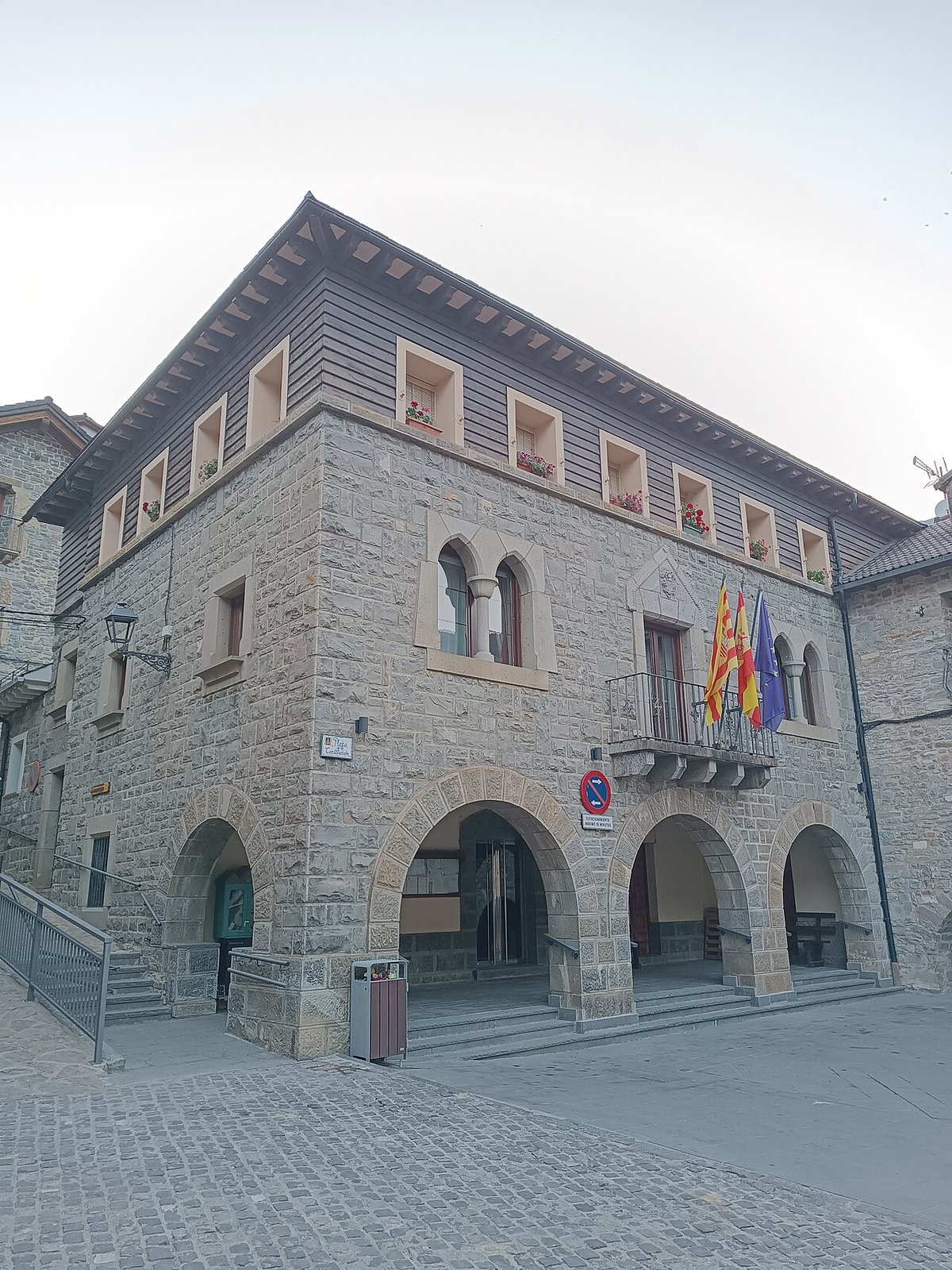
At the centre, the Plaza Mayor still has its wooden arcades. These covered walkways continue to serve a practical purpose, offering shade during strong sun and shelter during sudden summer downpours. Life gathers here in a low-key way, with people passing through, pausing, or sitting out of the heat.
Above this part of town rises the Colegiata de San Pedro. Its origins go back to the Early Modern period, when Boltaña held greater administrative importance in the area. From below, the tower is the most visible feature, standing above the line of rooftops and helping to orient anyone walking up through the streets.
Inside, the space is restrained rather than ornate. Attention tends to fall on the wooden details and on several older pieces that have been preserved. It is a place that reflects the town’s past without excess decoration, in keeping with the overall tone of Boltaña itself.
Up to the castle as the day cools
Above the town, on a bare hill, lie the remains of the castle. The path up is short but steep, crossing low scrub and loose stone. It does not take long to reach the top, though in summer it makes sense to go later in the day, when the sun has lost some of its strength.
What remains are sections of wall and a few heavily eroded structures. The main reason to come up is the view. The Ara valley opens out to the north, and on clear days the mountains that signal the Parque Nacional de Ordesa y Monte Perdido come into view. Below, Boltaña appears compact, its old quarter clustered along the slope.
There is a sense here of how the town fits into the wider landscape. The river, the valley floor and the rising terrain all become easier to read from this higher point.
The Ara and the shape of the valley
The Ara river passes close to Boltaña and strongly shapes the surroundings. It is one of the last Pyrenean rivers without major dams in its upper course, something that shows in the character of the water. After rainfall or snowmelt, it runs clear and fast.
Along its banks there are stretches where people come down to walk or simply sit for a while. In summer, bathers appear in calmer sections of the river, though it is important to pay attention to the current and the condition of the water before going in.
From Boltaña, several straightforward paths lead out towards nearby villages or climb gentle hills that open up views across the valley. One of these is the Cerro de la Corona, a short ascent that helps make sense of the territory. From there, the Ara lies to one side, the Cinca river is not far away, and mountains frame the horizon in every direction.
If visiting in summer with walking in mind, early starts are the most sensible option. Around midday, heat settles between the slopes and some stretches of path offer little shade.
Food from the valley and the mountains
The cooking in this part of Sobrarbe remains closely tied to what the surrounding land provides. Meat stews are common, along with cured sausages produced locally and a range of cheeses made from sheep’s or goat’s milk.
In autumn, mushrooms begin to appear in many kitchens and in local markets, depending on how the season develops. The presence of small livestock farms and family vegetable plots in the area means that much of what ends up on the table has a nearby origin.
The result is a cuisine that reflects both the mountain environment and the rhythm of the seasons, without much distance between production and consumption.
Local life and celebrations
Throughout the year, Boltaña hosts several celebrations linked to its traditional calendar. The patron saint festivals tend to bring back many people who live elsewhere and return for those days. At other times, fairs or gatherings connected to livestock and local trades take place.
These events do not always coincide with a short visit, but when they do, the change in atmosphere is immediate. There are more people in the square, music in the afternoon, and long conversations under the arcades as night falls.
One practical detail stands out: the old quarter is best explored on foot and without rushing. It is common to leave the car in the lower parts of town and continue upwards walking. The streets are narrow and, in some sections, barely wide enough for a vehicle. Moving slowly is simply how Boltaña works.