Full Article
about Fiscal
Hide article Read full article
A village that wakes gently
By mid-morning in Fiscal, quiet is broken by small things: leaves brushing as air moves along the Ara valley, the sharp sound of a wooden door closing, a bird shifting between trees by the riverbank. The village sits at around 770 metres above sea level, in a stretch of Sobrarbe where the valley opens slightly before the road continues north into the Pyrenees.
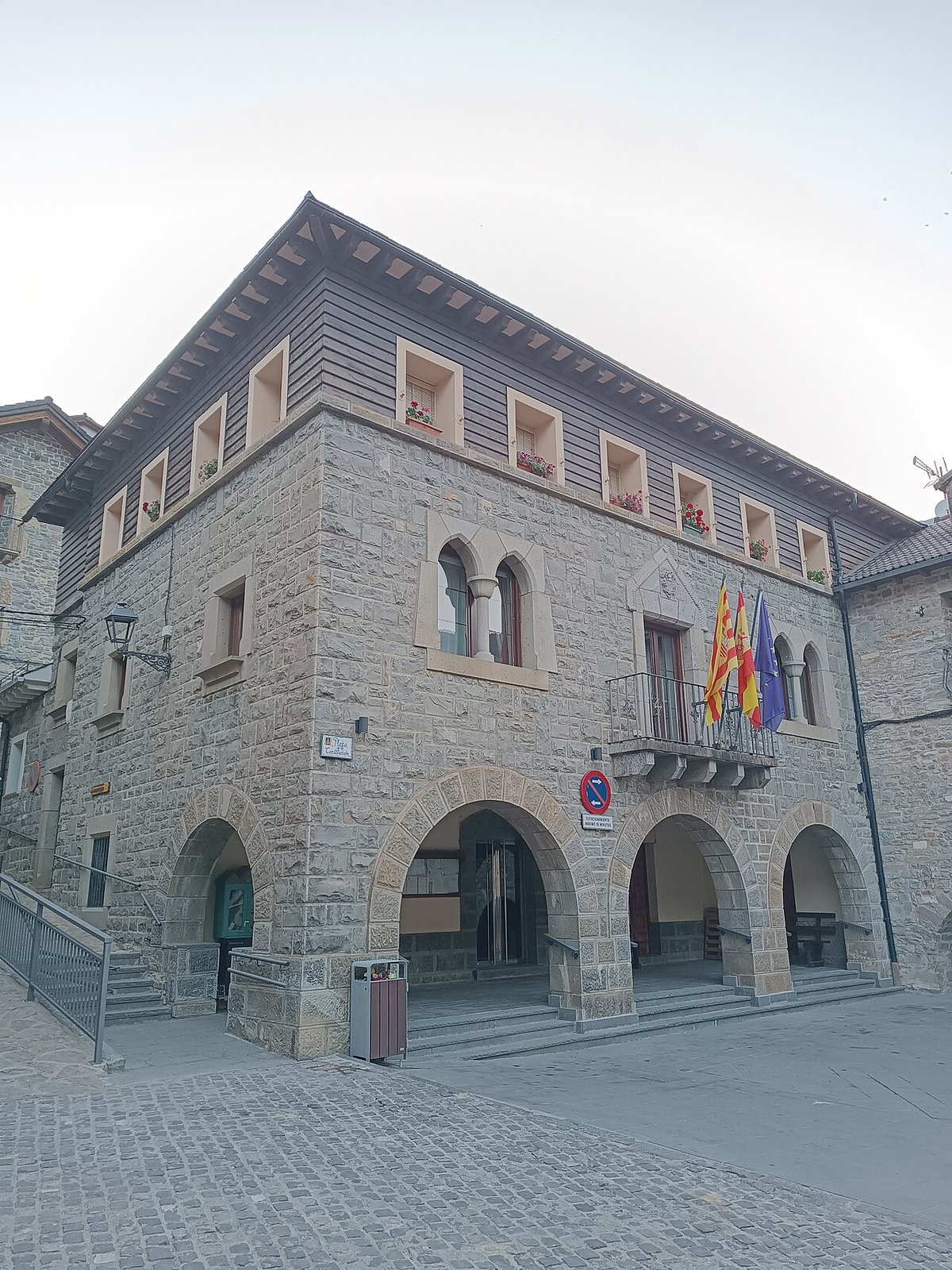
Stone houses, many with dark wooden balconies, catch the light without fuss. The day unfolds slowly here. The centre is compact and easy to walk, with streets that alternate between cobbles and newer asphalt. Facades show the local limestone clearly, sometimes shaped into carefully worked doorways or marked with old coats of arms.
Near the middle stands the church of San Pedro, its square tower visible from several points in the village. The current building is usually dated to the 16th century, although some elements hint at earlier phases. Around it lies one of the few open spaces where the view clears towards the slopes that enclose the valley.
Streets shaped by time
Fiscal is not organised around a single landmark. It makes more sense at walking pace, paying attention to details rather than searching for highlights. Thick wooden doors look much as they did decades ago. In damper corners, moss clings to walls. Small vegetable plots appear beside some houses, quietly maintained.
There are also a few stately homes with coats of arms carved into stone, reminders of families that once held influence in the valley. These are not grand or imposing buildings. They are solid houses, built to withstand long winters.
On rainy days the village carries a distinct scent: damp wood, turned earth, and sometimes wood smoke drifting from a chimney that is still in use. It adds another layer to the sense that daily life here has changed gradually rather than suddenly.
The Ara river and valley paths
One of Fiscal’s defining features is its closeness to the Ara river, just a short walk away. It is one of the last major rivers in the Pyrenees without dams along its main course. That absence is noticeable in the steady sound of flowing water and in the vegetation that lines its banks.
Several paths leave the village and connect it with other small settlements in the valley. Some follow old agricultural routes, passing between fields and bordas, the traditional rural buildings once used for storage or shelter. Others lead into small wooded areas with oak, boxwood and walnut trees.
These are not dramatic high-mountain routes. They are well-used local paths, the kind people rely on for walking or moving between villages. Their appeal lies in their continuity with everyday life rather than in any sense of spectacle.
Autumn changes the landscape noticeably. Greens give way to ochres and yellows, and the ground becomes covered with dry leaves that crackle underfoot. Early in the morning, it is common to walk these paths and encounter very few people.
Light at the edges of the day
Fiscal feels most at ease in the early hours or towards evening. Around midday, especially in summer, heat can linger between the buildings and the central spaces lose some of their calm.
As the sun lowers, light enters the streets at an angle, picking out the irregularities of the stone: cracks, old joints, darker marks beneath the eaves. It is a good time to wander without a fixed route, to head towards the river or to climb slightly above the village for a wider view.
From those small rises, the layout of Fiscal becomes clear, along with the Ara valley stretching southwards. The setting is simple but coherent, shaped by the river, the road and the surrounding slopes.
Mountain cooking and mushroom season
Food in this part of Aragon remains closely tied to local produce. Lamb, hearty stews and seasonal ingredients form the basis of the cuisine. When autumn arrives, mushrooms take on a central role.
Species such as boletus and níscalos, known in English as saffron milk caps, appear in the surrounding forests. Their abundance varies significantly from year to year, depending largely on rainfall.
Anyone planning to go mushroom picking should check local guidance in advance. There are often regulations about where it is permitted and how much can be collected, with controls in place to prevent overuse of the area.
When to come and what to expect
Fiscal tends to be busier in August and during some summer weekends, when the Ara valley sees more visitors heading towards the Pyrenees. For a quieter experience, weekdays or months such as May, June or early autumn are a better choice.
Access is by road, following the course of the Ara. The final stretches include plenty of bends, and it is not unusual to come across tractors or slow-moving vehicles. The journey is best taken at an unhurried pace, allowing time to take in the landscape. Parking in the village is generally straightforward outside the busiest periods.
Rather than a place defined by major attractions, Fiscal works as a calm stop within Sobrarbe. The river runs close by, mountains frame the horizon, and the pace of life remains steady. What stands out is not a checklist of sights, but the experience of walking for a while and listening to the sounds of the valley.