Full Article
about Barbastro
Hide article Read full article
A town that smells like Sunday
Barbastro smells of ternasco on Sunday mornings. That is not a figure of speech. Bakeries in the centre start early, and by mid-morning the scent has spread through the streets. You park, lock the car, and feel hungry before you have walked ten steps.
Parking in the old town comes with its own quirks. Streets look alike, squares carry different names, and at some point you circle twice thinking you have already been there. It is normal. Within ten minutes you either get your bearings or decide it does not matter, because food was the reason for coming.
A cathedral that took its time choosing a style
The cathedral of Santa María sits between periods. Part Gothic, part Renaissance, like pouring a modern beer into a familiar old glass. The mix is visible from the outside, but the key is indoors.
The main altarpiece, carved in white alabaster by Damián Forment, catches the light with a soft glow that recalls icing sugar when it is lit from the side. Many visitors step in, glance at the crossing, take a quick photo and leave. That misses the point. The interest lies in the details. Look at the choir stalls, where the seats display the coats of arms of different city guilds. Once you notice that, the building stops being just a monument and starts to explain how Barbastro worked centuries ago.
Wine, cheese and reasons to return
It would be odd to talk about Barbastro without mentioning wine. The Somontano comarca has been active in that field for years, with wineries that experimented with grape varieties that arrived later elsewhere. The area does not carry the historical weight of more famous wine regions, and it does not seem to be trying to copy them either. It moves at its own pace.
Each spring the city usually hosts a wine fair where many local wineries gather. It is the kind of event where you end up tasting more than planned while someone explains the aromas in each glass. If you arrive by car, the sensible approach is to taste and then buy a bottle to take away.
Wine brings its usual companions. Local sheep’s cheese, cured meats, and other simple bites fit naturally with a glass of red. There is no need to complicate things.
Among dolmens and vultures
A few kilometres from the town centre, several dolmens are scattered across the hills. On a first visit, it is easy to wonder how anyone realised those stones had a past, because from a distance they look like just that. Up close, the shape and the burial chamber become clear, and suddenly you are standing in front of something that has been there for thousands of years.
Paths cross this area and are generally marked, though proper footwear is advisable. This is not a paved stroll. There is scrub, loose stone, and thorns that do not forgive carelessness.
Early mornings offer another sight. Griffon vultures take advantage of the air currents, and in this part of Huesca they are quite common, especially nearer the Natural Park of the Sierra y los Cañones de Guara. From below, they resemble large gliders circling with hardly any effort.
The mystery of chiretas
Ordering chiretas in Barbastro carries a small risk. If you do not know what they are, it shows immediately. The dish consists of lamb tripe stuffed with rice, meat and spices. That description sounds heavier than the reality on the plate.
At first glance, chiretas look a bit like a large sausage cut into slices. Some people add a squeeze of lemon to lighten the flavour.
There is also a strong tradition of baking and sweets. During Semana Santa, fried pastries appear, made from dough scented with aguardiente and usually taken with coffee. Summer festivals often include stalls with trays of homemade baking, based on recipes passed from grandmother to grandchild and rarely written down.
A friendly suggestion
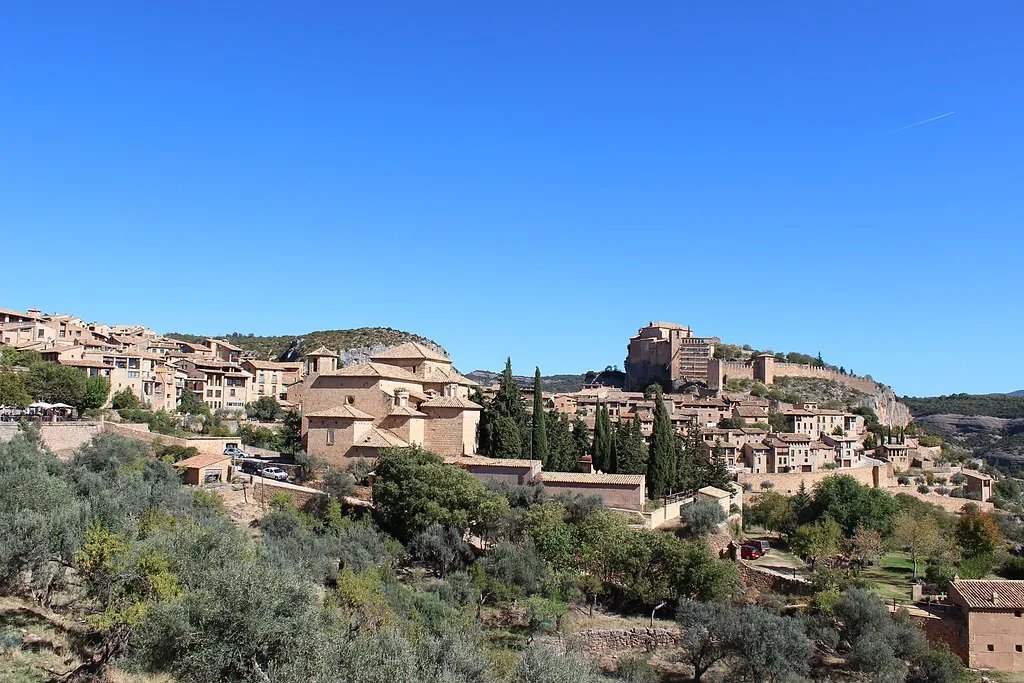
Barbastro is not a place that fills three continuous days within the old town. It works well as a base for exploring the surrounding area. Alquézar lies relatively close, the river Vero has stretches where people head to cool off in summer, and the whole Somontano comarca invites slow travel from village to village.
A simple plan fits the rhythm of the town. Arrive on a Friday around vermouth time, stroll through the Plaza del Mercado and eat without rushing. On the following day, visit the cathedral, then take the road towards the sanctuary of El Pueyo. The climb is noticeable, but the views over the Somontano from above help you understand exactly where you are.
Sunday mornings bring a lively atmosphere around the Avenida de la Constitución, with stalls and people shopping before heading home. It is a good moment to pick up something local and round off the trip.
If time remains in the afternoon, sit in the Parque de la Constitución. Children cycle past, older residents chat about the week, and much of Barbastro seems to pass through without hurry. At that point, the place feels less like a display and more like somewhere people actually live. That, more than anything, explains its appeal.