Full Article
about Estada
Hide article Read full article
A Hilltop in the Somontano
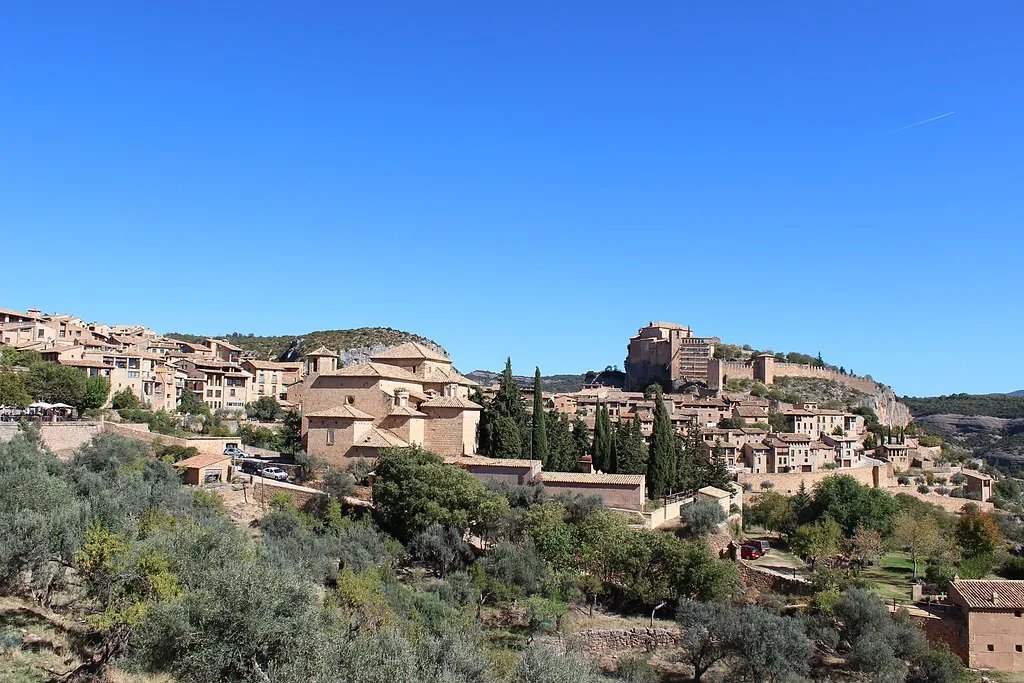
Tourism in Estada begins with the land itself. The village sits at the southern edge of the Somontano de Barbastro, on a low hill that looks out over the valley of the River Vero. The landscape shifts gently here. Dry hills, open fields and the line of the river shape the rhythm of the area.
Estada has around two hundred inhabitants. Agriculture still plays a central role in daily life. Vineyards, olive groves and cereal crops have defined the local economy for generations. From its elevated position, the village opens up wide views across the surrounding countryside. From the outskirts, other settlements in the Somontano can be picked out, along with the patchwork of cultivated land that surrounds the valley.
This is a place to move through slowly. The streets are short, and the houses cluster around the church and the main square. It is not a monumental village filled with standout landmarks. What matters here is understanding how a small agricultural community in the Somontano is organised and how it has evolved over time.
Stone, Earth and the Shape of the Village
At the centre of the village stands the parish church of Santa María. The building reflects different phases of construction. Parts of it appear to date from the late Romanesque period, though later alterations have changed its appearance. Baroque interventions introduced new elements that softened or reshaped the earlier structure.
The tower rises above the rest of the buildings and acts as a visual reference point when approaching Estada by road.
Traditional houses combine stone with rammed earth construction. Many still have wide doorways, originally designed for carts and agricultural work. Some façades display simple coats of arms or inscriptions. These usually point to families that once held a certain standing in the local economy.
Calle Mayor brings together several examples of these houses. They do not form a grand architectural ensemble, but they help tell the story of the village. They reflect a time when farming activity was more intense and closely tied to daily life.
Beyond the built area, the land opens into low terraces used for cultivation. The colours shift noticeably through the year. Spring brings greens across the fields, summer turns the cereal crops golden, and autumn softens everything into more muted tones.
The banks of the River Vero offer a different scene. Here the landscape feels cooler and denser. Vegetation gathers along the water, creating a more enclosed environment that attracts a variety of wildlife.
Paths Through Fields and Low Hills
Several agricultural tracks leave Estada and extend into the surrounding countryside. Some link up with nearby villages. These routes are generally straightforward, with no significant changes in elevation.
One of the most common walks leads towards the hermitage of San Marcos. The path crosses fields and small rises in the land. In spring, the scenery changes noticeably, especially in areas where almond trees grow.
Many visitors use Estada as a quiet base within the Somontano region. From here, it is possible to reach other places in the area by car. These include rock shelters with prehistoric cave art in the surroundings of the Vero, as well as several villages with historical heritage.
Local Traditions and the Calendar
The main festivities take place in August and are dedicated to Santa María. The programme combines religious events with gatherings in the square. Music and shared meals are part of the atmosphere. Many people who have moved away return to the village during these days.
In September, the romería of San Marcos is held. A romería is a traditional pilgrimage, usually involving a walk to a religious site. In this case, residents walk to the hermitage on the outskirts of the village. The day often ends with an outdoor meal, weather permitting.
The grape harvest also has a social dimension. Some families still produce wine for their own consumption. This is not large-scale production, but rather a custom that continues alongside modern life.
During Holy Week, simple processions take place through the streets of the village. They maintain a restrained and sober tone, characteristic of this part of Aragón.
Getting There and Moving Around
From Huesca, the route follows the main road towards Barbastro and then continues along regional roads. The final stretch passes through agricultural areas typical of the Somontano.
The village centre is small and easy to explore on foot. For those heading out along the surrounding paths, it is advisable to carry a map or a basic route track, as some trails are not signposted.