Full Article
about Hoz y Costean
Hide article Read full article
Early in the morning, as the sun edges over the low hills of the Somontano, Hoz y Costean carries the scent of damp earth and old wood. A small stone bridge links the village to the surrounding fields, and the stillness is broken only by birdsong or the soft rustle of leaves in the breeze. With just over two hundred residents, this municipality in the Somontano de Barbastro moves at an unhurried pace that shows in everyday details: shutters opening slowly, tractors heading out towards the fields, short conversations in the middle of the street.
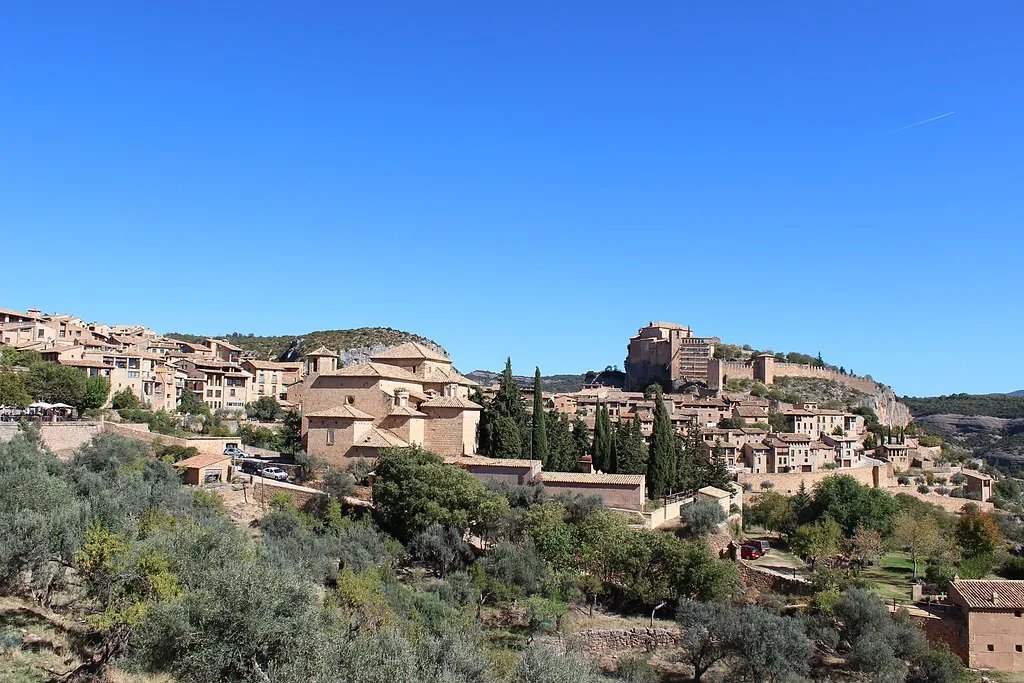
Hoz y Costean does not revolve around grand squares or striking landmarks. Walking through it reveals golden stone walls, narrow lanes that rise and dip with the slope, and a clear, shifting light that changes throughout the day. Barbastro lies only a few kilometres away, close enough for an easy drive, yet the atmosphere here feels entirely different. Traffic noise fades, and the surrounding landscape of vineyards, olive groves and almond trees sets the rhythm.
The shape of an old village
The parish church of San Miguel Arcángel stands above the rest of the village. Its ashlar tower is visible from several points and defines the skyline of the old centre. Inside, baroque altarpieces retain traces of their original colour and gilding, now softened by time. A small open space sits in front of the entrance, where a carved stone coat of arms remains as a reminder of families once tied to this place.
The layout follows the hillside rather than any formal plan. Streets are narrow and sometimes uneven, lined with houses built from sandstone and closed off by dark wooden doors. Wrought-iron balconies project over the lanes, often with simple flowerpots. Coats of arms appear here and there on façades, marking older homes linked to farming and rural work.
Beyond the last houses, the land opens into ravines and small gorges shaped by the river Vero. Rock faces show pale and reddish layers that become especially visible when the afternoon sun falls at an angle. The seasons bring noticeable changes. Almond trees briefly cover the slopes in white and pink during spring, while autumn turns the vineyards to shades of ochre and red just before the grape harvest.
Walking out from the streets
Several agricultural tracks begin at the edge of the village, suitable for walking or cycling. Many follow old routes once used by shepherds and farmers moving between pens, fields and patches of scrubland. These are gentle routes with mild gradients, where vineyards and almond trees appear frequently, alongside small stands of holm oak.
Dry-stone walls line parts of the way, still holding up terraces carved into the land. Scattered along these paths are small rural structures and former animal enclosures, once used to store tools or shelter livestock.
Farming remains central to life in the area. Olive oil, almonds and pork-based products form part of the local food culture, and the wider comarca has a strong tradition of winemaking. Around Hoz y Costean, several wineries operate under the Somontano designation of origin; some open for visits by prior arrangement.
A local calendar
The village calendar reflects long-standing traditions. At the end of September, celebrations take place in honour of San Miguel, the patron saint. Religious events and gatherings among neighbours bring a sense of movement to streets that are usually quiet.
February brings the commemoration of San Blas, marked by simple celebrations centred on the church and local community. Semana Santa is also observed here, with restrained processions moving through the narrow streets without large-scale displays.
When to go and how to move
Hoz y Costean sits a short distance from Barbastro in the Somontano region. It is most easily reached by car, typically via the A-22 followed by a local road that passes through vineyards and cultivated land. Public transport in the area is limited.
Spring and autumn are generally comfortable times to visit. Spring brings flowering fields and mild temperatures suited to walking. Autumn coincides with changing colours in vineyards across this wine-producing comarca; you’ll see more activity in fields then.
Summer calls for some care if planning to walk; central hours can be hot and shade is scarce along open paths. Winter is marked by stillness—cold days, few visitors and wind moving through ravines define it.