Full Article
about Laluenga
Hide article Read full article
A village defined by its landscape
Laluenga, in the Somontano de Barbastro region of Aragón, is best understood by looking at the land around it. The setting leads everything: a gently undulating stretch of dry farmland where cereal crops dominate, alongside patches of almond trees. This is not a dramatic landscape, but a working one, shaped over time by agriculture.
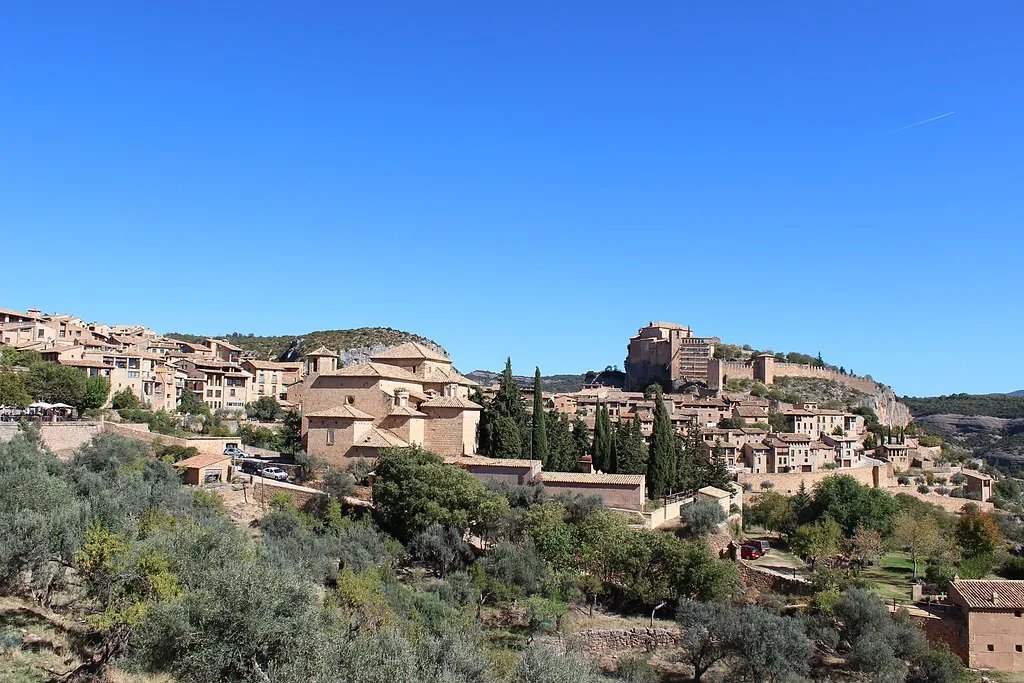
The village itself reflects that relationship with its surroundings. The urban layout gathers around the church of San Salvador, built in the 16th century, which still acts as the main visual reference point. From almost any angle, the church anchors the view, tying together the compact cluster of houses that make up Laluenga.
The church and the beginnings of the village
At the centre of the settlement stands the church of San Salvador. Its structure is restrained, in keeping with many parish churches in the Somontano that were built or remodelled during the early modern period. It does not aim to impress through grandeur, but through solidity and continuity.
Inside, there is a modest Baroque altarpiece. It is not presented as an outstanding work of art, but it carries interest as a reflection of a particular moment in local history, when small rural communities invested in updating and embellishing their churches. It speaks of collective effort rather than individual display.
The oldest streets cluster around this central point. They are not especially monumental, yet they form a coherent whole that reflects traditional architecture in the area. Stone and adobe houses sit side by side, with whitewashed façades and tiled roofs. Some buildings retain carefully worked stone doorways or iron balconies, quiet reminders of past agricultural prosperity.
A village shaped by farming
Laluenga’s layout makes sense when seen through its traditional function as a farming community. Many houses include interior courtyards, former animal quarters or storage spaces attached to the main living areas. These features point to a way of life directly tied to the harvest and to the seasonal rhythms of the land.
Beyond the village, the landscape opens out into one of the more expansive parts of the Somontano. Fields of cereal cover most of the terrain, broken up by plots of almond trees. Towards the end of winter, when the almond blossom begins, the appearance of the surroundings shifts noticeably. The pale flowers contrast with the still-cool tones of the dry farmland, adding a brief but distinct change to the scene.
The routes leading out of Laluenga are primarily agricultural tracks rather than marked walking trails. Even so, they can be followed on foot or by bicycle without much difficulty. These paths connect the village with others in the surrounding comarca, offering a sense of how closely linked these rural settlements are.
A slow walk through the streets
The village centre is small and can be covered quickly. The interest lies in paying attention to details rather than searching for major landmarks. Carved stone doorways, occasional coats of arms on façades and interior courtyards that still preserve agricultural structures all give clues to how the village has functioned over time.
Laluenga is not filled with monuments, and it does not try to be. Instead, it offers a clear view of how a village in the Somontano has operated for centuries. In places with fewer than two hundred inhabitants, the connection between home, work and landscape remains very visible. That continuity is part of what defines the experience of being here.
Festivals and the local calendar
The annual rhythm of the village becomes more noticeable during its festivities. The main celebrations usually take place in August, when many people who live elsewhere return to Laluenga. During those days, the atmosphere shifts, and the village takes on a livelier tone compared to the rest of the year.
In January, the feast of San Antón is still observed. Traditionally linked to the protection of animals and the agricultural world, it reflects customs that remain present in many rural parts of Aragón. These events are less about spectacle and more about maintaining practices that have long been part of local life.
Practical notes for visiting
Laluenga is located in the Somontano de Barbastro, just over half an hour by car from the city of Huesca. The approach follows local roads that pass through the agricultural landscape typical of the comarca.
The village itself can be explored in a short amount of time. Those who choose to walk along the tracks leading out into the fields should wear comfortable footwear, as many of these routes are unpaved agricultural paths.
There is little in the way of tourist infrastructure. That is part of its character. A visit here tends to be quiet and brief, closer to a walk through a working village in the Somontano than to a conventional tourist stop.