Full Article
about Naval
Hide article Read full article
A village that hits the pause button
You know that feeling when you step out of a noisy bar into a quiet street? Naval is a bit like that. You park the car, get out, and the soundtrack just... changes. The only background noise is maybe a distant tractor or two dogs figuring out their differences. Your shoulders drop about two inches.
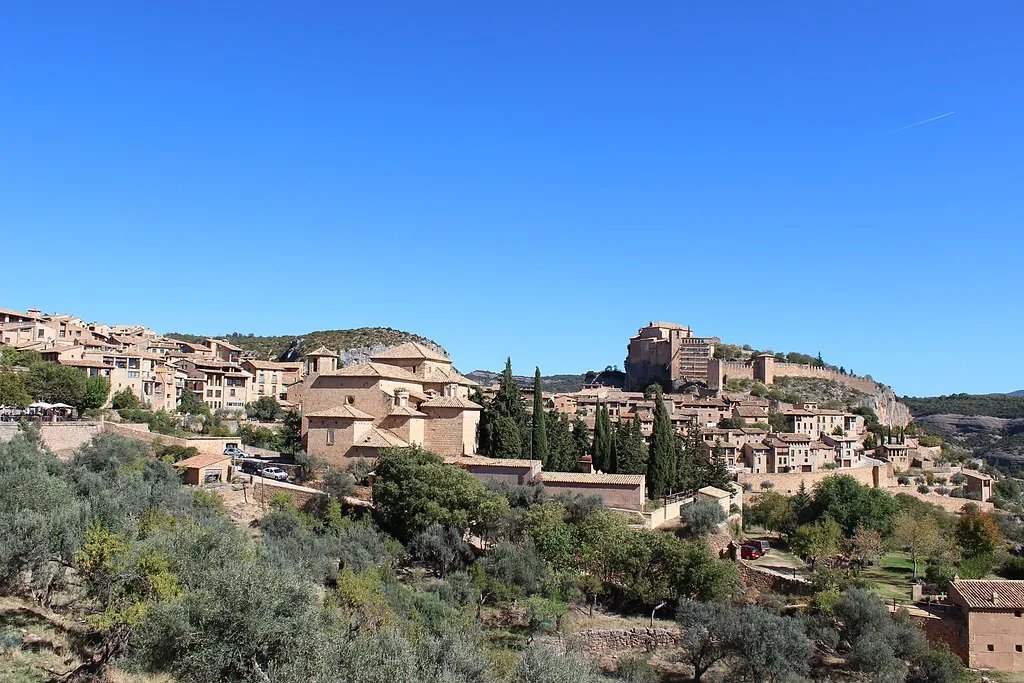
This is Naval, in the Somontano de Barbastro. About three hundred people live here, which means you’ll see more cats than tourists on a normal Tuesday. It’s not a museum piece. People actually live in those stone houses—you can tell by the laundry hanging out and the 4x4s parked awkwardly on the cuesta.
Land, work, and the ghost of the salt pans
Look at the land around Naval and it tells you everything. It’s dry, open farmland, stitched together with vineyards and almond trees. No dramatic mountains, just a big sky and a lot of hard work baked into the soil.
For centuries, this place ran on salt. The old saltworks are just outside town—a network of shallow pools that look like geometric art from a distance. They don’t pump out salt commercially like they used to, but they’re still there, silent and kind of beautiful in a rusty, industrial way. It’s the kind of detail that reminds you this village wasn’t built for postcards; it was built for a job.
Streets with better stories than most museums
The old quarter isn’t big. You could race through it in ten minutes if you wanted to miss the point entirely. The trick is to walk slow enough to let your eyes wander upwards. You’ll spot carved coats of arms on facades that have seen better days, and inscriptions above doorways that make you wonder who lived there.
The church of San Juan Bautista pops up between houses like it’s trying not to be noticed. Its brick bell tower isn't trying to dominate anything—it just fits, same as everything else here.
The real social hub is the plaza. It's not fancy. A few benches, some trees for shade. But come late afternoon, it fills up with folks who've known each other for decades. Grab a spot and just listen for a while; it's better than any guided tour.
Walking where nothing happens (and that's the point)
If you need to stretch your legs, follow any of the dirt tracks leading out of town. They wind through fields of holm oak and rosemary scrub—the classic, no-nonsense landscape of the Somontano.
Don't expect epic vistas or signposted viewpoints. The appeal here is in the subtle stuff: how the light turns golden an hour before sunset, or the smell of thyme after a light rain. Come in late February or early March if you can; when the almond trees bloom, those dusty fields go temporarily insane with pink and white flowers.
Vineyards next door
Naval sits right in the middle of Somontano wine country. A five-minute drive in any direction will have you surrounded by vines.
Time your visit for the vendimia (the grape harvest) if you want to see a buzz of activity—tractors up and down the tracks, crews in the fields. Once it's over, by October or so, everything slips back into its usual sleepy rhythm.
The food here follows suit: solid, no-frills stuff from what grows nearby. Think migas (fried breadcrumbs with whatever's handy), ternasco (local lamb roasted simply), and bread so good you'll want to eat it plain. It's fuel for people who work outside.
So when should you go?
If you want noise and action, aim for late June during the fiestas for San Juan Bautista. The population triples overnight with people coming home to celebrate.
For the other 50 weeks of the year? Naval is for slowing down. For wandering empty streets in the morning sun, walking a rural path until you get bored, and ending up back on that plaza bench with absolutely nothing urgent to do. It’s not glamorous. But for a few hours, it feels entirely real