Full Article
about Olvena
Hide article Read full article
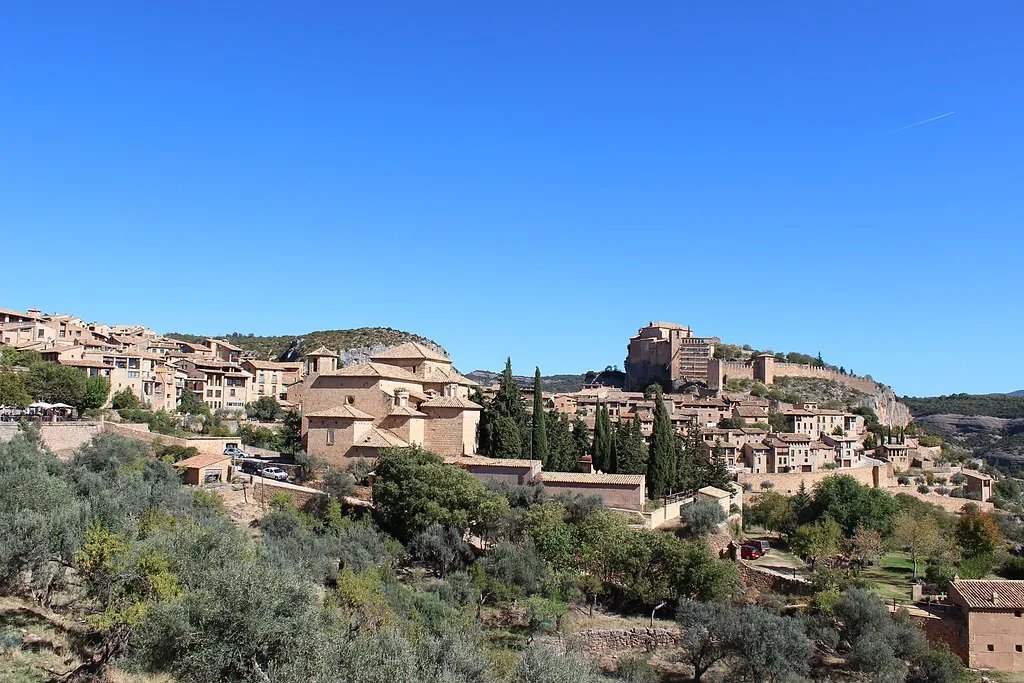
The church bell in Olvena rings seven times, the sound travelling clear and thin over sixty-three rooftops. Down in the valley, a ribbon of mist still clings to the Vero river. This is the hour when you hear your own footsteps on the cobbles, when the sun hits the upper stories of the stone houses and leaves the streets below in cool shadow. The day starts slowly here.
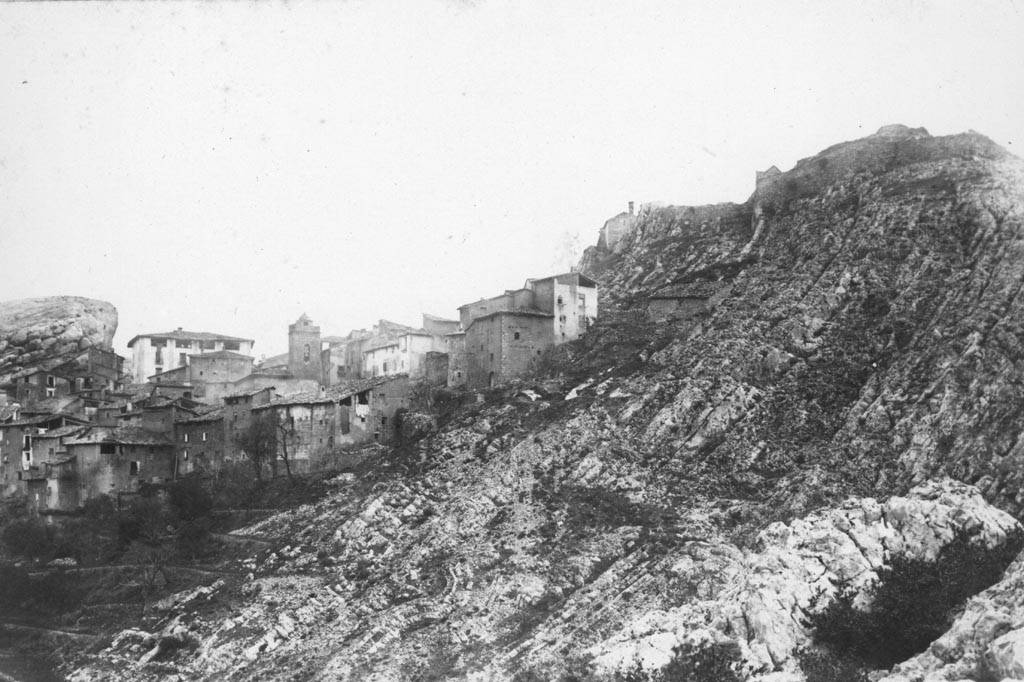
Olvena rests on a low hill, a compact cluster looking out over the Vero valley. From the paths that ring it, the view is one of orderly, open farmland. Broad squares of cereal fields are stitched with lines of almond and olive trees. Beyond them, the first folds of the Sierra de Guara rise, a hazy blue barrier on the horizon. The air in spring carries the chalky scent of almond blossom; by late summer, it smells of dry earth and hot pine.
The village itself is a short network of lanes. They curve and dip gently between houses of rough stone and rendered wall. Some doors are dark, aged wood; others are newer, painted green or blue. You notice the practical details: a wrought-iron grille over a cellar vent, a stone trough collecting water from a tap, terracotta pots of geraniums on a windowsill still shuttered against the morning. You can walk from one end to the other in five minutes, but it’s better to take twenty.
A dirt track leads east from the last house, dropping quickly into the agricultural land. This is where you walk. The path is wide, used by tractors, and rolls easily past fields and scrub. Rosemary and thyme scratch at your ankles if you stray to the edge. The only sounds are often the crunch of gravel underfoot and the call of a blackbird from an almond grove. A kestrel might hang in the air ahead, watching for movement in the stubble. These are not dramatic hikes, but spacious walks where your gaze can stretch for miles.
Getting here requires attention. The road up from Barbastro is a winding secondary route, about a thirty-minute drive. The final climb is narrow, with blind curves and stretches where two cars must negotiate carefully. You park where the asphalt ends, at the village entrance. The car stays there.
Come in spring or autumn. Summer midday sun on these exposed tracks is intense. The reward for an evening visit is the light; it comes in low and sideways, turning the stone façades a deep amber and setting the dry grass in the valley ablaze. The heat of the day lifts, and the village settles back into its quiet.
Local life has its pulse. In summer, feast days bring music to the plaza and a procession through the streets, gatherings for those who live here and those who return. For most of the year, though, the rhythm is marked by simpler things: a shutter being opened, the smell of woodsmoke in late afternoon, a conversation between neighbours across a balcony.
Olvena asks little of you. It’s a place for a slow stroll through its lanes, for a longer walk out into those open fields, and for sitting on a bench as the light fades behind the sierras. It feels less like a destination and more like a breath held between journeys.