Full Article
about Laviana
Festival and nature in the Nalón
Hide article Read full article
A valley shaped by industry
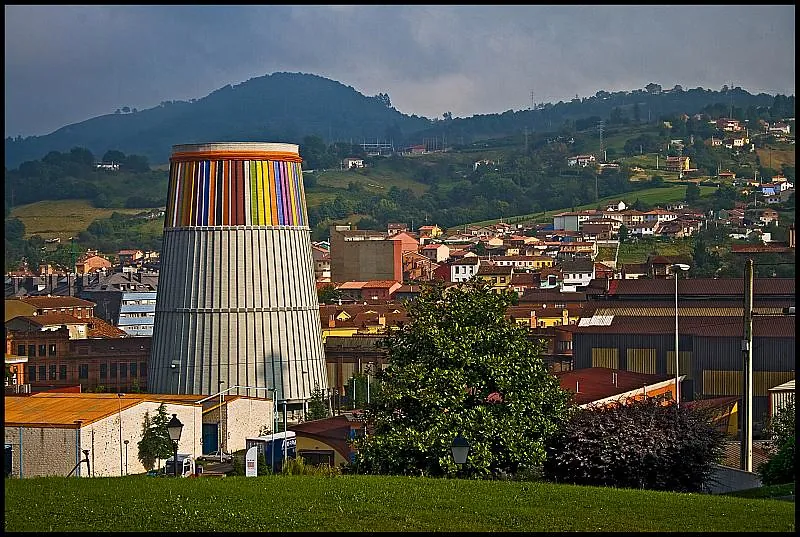
The train that runs up the Nalón valley tells the story before you even step off. From the carriage window the slopes look torn and replanted in equal measure, villages clinging to hillsides above the river, streets dropping steeply towards the valley floor. Laviana grew to the rhythm of coal, and the landscape still carries that imprint.
This is not a neat, flat plaza settlement. Laviana, whose administrative centre is La Pola de Laviana, stretches along a narrow valley hemmed in by mountains that rise beyond a thousand metres. The river dictates the layout. Many streets slope decisively downhill towards the centre, where the weekly market still takes over the main square in La Pola.
Coal transformed the area in the second half of the nineteenth century, when Asturian industry demanded fuel for factories and steelworks. Mines opened across the Nalón basin, and settlements expanded around the pits. La Pola became the administrative and commercial hub for the surrounding mining communities. Working-class neighbourhoods climbed the hillsides in places such as El Condao and Barredos, their position dictated by shafts and galleries rather than aesthetics.
That industrial past is not tidied away. It explains why villages sit where they do, why roads bend abruptly, why some hills appear cut back. For visitors, it offers context rather than spectacle. The story of Laviana begins underground.
Churches, towers and a rural past
Long before the mining boom, small communities were already established along the valley. In Villoria stands the church of San Nicolás, described as the only surviving church of Romanesque origin in the municipality, although the present building has undergone several alterations. Its position, slightly apart from the main cluster of houses, reflects an older pattern. Many early churches were built before villages assumed their current form.
The building is sober in appearance, particularly when compared with later churches erected during the mining expansion. Those newer temples, found in districts such as El Condao or Barredos, belong to a different era and a different social landscape.
South of the Nalón the terrain opens out a little. Meadows and chestnut groves break up the slopes, and villages such as Entralgo and Villoria long maintained a more agricultural economy, even as mining spread through much of the municipality. Traces of older routes still link these settlements. Sections of former paths towards the mountain passes of the cordillera survive, with cobbled stretches and flanking walls that hint at their historic use by muleteers and livestock herders moving between valley and plateau.
Entralgo preserves a simple but telling structure: an eighteenth-century hórreo, the traditional Asturian granary raised on stone pillars. Built of wood and supported on pegollos, it now functions as a small ethnographic space. The building helps to explain how rural households organised storage before coal reshaped daily life. Each June, the village marks San Juan with bonfires that reclaim the square at dusk, a reminder that older rhythms persist alongside industrial memory.
On higher ground near El Condao lie the fragmentary remains of the so-called Torreón del Condao. What survives is limited, yet its elevated position above one of the narrowest stretches of the Nalón suggests a medieval watchtower guarding the passage through the valley. The setting makes strategic sense. From there, the river corridor is clearly visible.
Laviana also has literary associations. Armando Palacio Valdés was born in La Pola in 1853 and set several of his novels in these valleys. His best-known work, La aldea perdida, portrays rural life before the great mining expansion, capturing a world on the cusp of profound change.
The Alba valley and the return of the forest
Mining declined towards the end of the twentieth century, and the mountains began to alter once again. On many slopes, oaks, chestnuts and hazel have reclaimed ground once disturbed by extraction. The transformation is especially evident in the Alba valley to the north of the municipality.
From the outskirts of La Pola begins the well-known Ruta del Alba. The path follows the course of the river into a gorge, advancing between rock walls and stretches of Atlantic woodland. The water forms pools along the way, and the air feels noticeably damper than in the open valley below. For decades these streams were linked to mining activity. Today the vegetation has thickened, and the landscape appears more enclosed.
The route continues upstream towards higher ground in the sierra. From those upper reaches the structure of Laviana becomes clear: a narrow valley enclosed by mountains that comfortably exceed a thousand metres, with the limestone profile of Peña Mea dominating much of the horizon. The sense of enclosure is striking. Weather can shift quickly at altitude, and even short walks gain height faster than expected once the valley floor is left behind.
Spring and autumn tend to suit walking best. The Alba woodland changes markedly with the seasons, and outside the height of summer the valley settles into a calmer rhythm. In summer, warmth can linger in the narrow basin. In winter, mist may sit low along the river.
Practicalities in a steep landscape
Laviana lies in the upper stretch of the Nalón basin, less than an hour by road from Oviedo and the central Asturian coast. A train still runs up the valley and stops in La Pola, although services are less frequent than in the past. The railway journey itself offers a gradual introduction to the terrain and its industrial history.
A car makes exploration easier, particularly for reaching hillside villages and the start of walking routes. The municipality spreads along the valley floor and up the surrounding slopes, and distances that appear short on a map often involve steady climbs. Public transport connects the main settlements, yet options thin out in the evening and on quieter days.
Within La Pola, the layout remains compact enough to explore on foot. Streets descend towards the central square, where the weekly market continues a long-standing tradition. The gradient is part of daily life here. Good footwear helps.
Laviana does not present itself as a museum piece. It is a working Asturian valley community of around five thousand residents, shaped first by farming, then by coal, and now by a slower process of adjustment. Forest returns to former spoil heaps. Old paths re-emerge between villages. The river keeps its course through it all.
For British travellers used to coastal Asturias, Laviana offers a different perspective on the region. Mountains press close, industry forms part of the view, and history is read in slopes and street plans rather than in grand monuments. The appeal lies in understanding how landscape and livelihood have been bound together here, and how both continue to evolve.