Full Article
about Cudillero
The most picturesque village on the coast
Hide article Read full article
A Harbour Built by Necessity
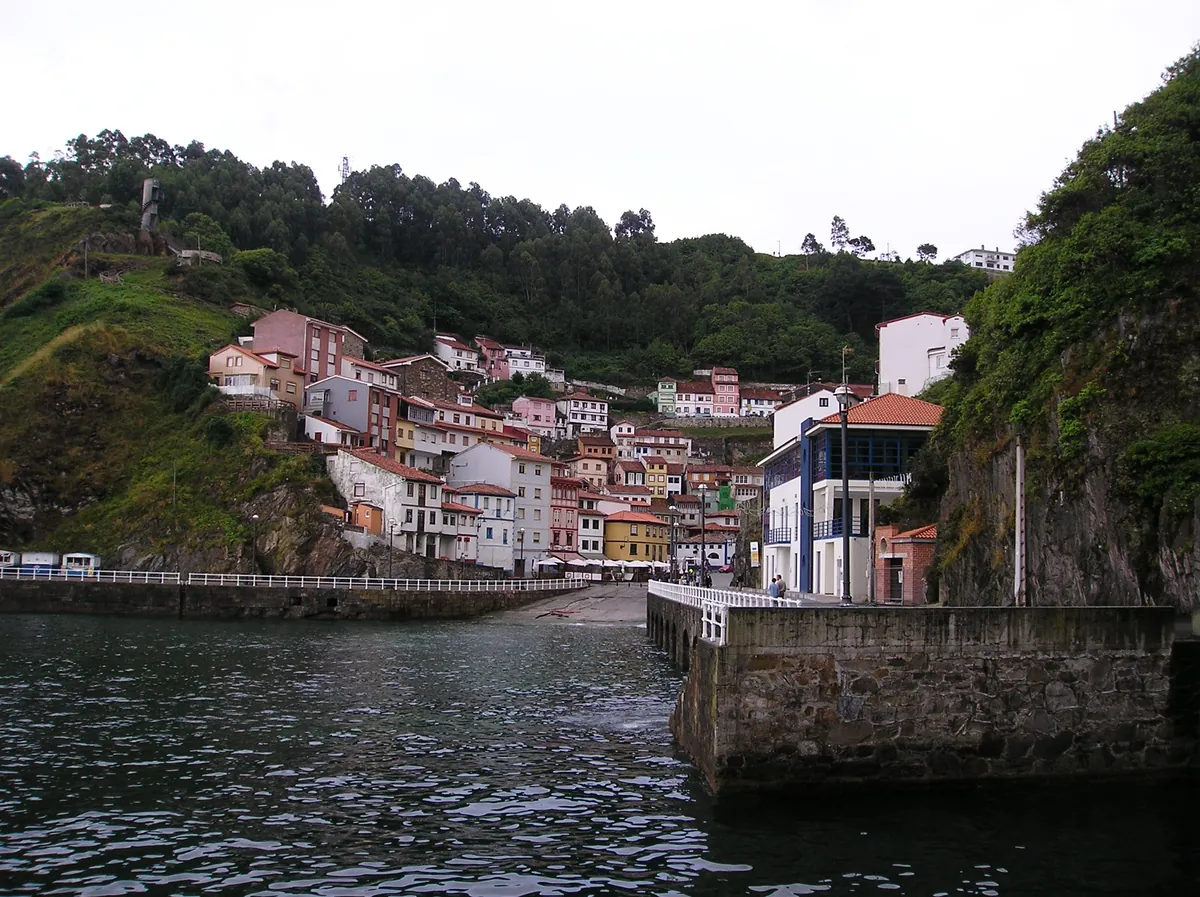
In Cudillero, the sea does not sit politely at the edge of town. It pushes into a narrow valley between cliffs and leaves barely enough level ground to stand on. That constraint explains almost everything. The harbour lies at the bottom, boats tucked into a natural curve of water, while white houses with dark roofs climb the slope above in irregular terraces. The streets are staircases more often than they are streets. Flat routes are rare.
The people here call themselves pixuetos, a name that comes from pixín, the monkfish that fills their nets. Fishing shaped the settlement from the start. Written records mention the place in 1232, though the Cudillero that feels familiar today began to take form in the 15th century, when boats loaded with sardines and monkfish were already making their way inland to trade.
The harbour is still the village’s centre of gravity. It looks almost theatrical from a distance, but this is no stage set. The houses were positioned as they are because there was nowhere else to put them.
Faith, Watchfulness and a Valley Entrance
One of the earliest permanent buildings was the Church of San Pedro, dating from the 16th century. It stands above the harbour, paid for gradually by local residents. Its position is practical as well as spiritual. From the churchyard, there is a clear view of the natural shelter where boats once anchored, and for a long time it served as an informal lookout over the entrance.
Higher up, partly absorbed into the fabric of surrounding houses, sits the Capilla del Humilladero. Usually dated to the 13th century, it is small and austere, built of masonry with dressed stone at the corners. It once marked the point where the old road entered the village. Tradition held that travellers would kneel before the Virgin here before continuing. Today it still signals a shift, from the tight-knit fishing quarter to the agricultural areas of the valley beyond.
Cudillero makes sense when seen from above. A walk along the Ruta de los Miradores links several high viewpoints: El Baluarte, La Garita, La Atalaya and El Pico. The route runs for just over two kilometres, and the climbs are constant. Each stop reveals a different angle: the horseshoe shape of the harbour, the tangle of stairways, the line of cliffs stretching west. It also clarifies why so many street names refer to steepness. Comfortable shoes with grip are essential. Cobbles can be slippery, especially after rain, and rain can arrive quickly off the Atlantic even in summer.
When the Village Laughs at Itself
On 29 June, the day of San Pedro, the rhythm changes. The morning begins with a seafarers’ mass. Later comes the Amuravela, one of Cudillero’s best-known civil rituals. A local resident climbs into a boat placed on the quay and recites verses in the pixueto dialect. The text reviews the year’s events: disputes, mishaps, small scandals. The tone is satirical. The tradition is usually traced to the 19th century and retains much of its original character. It is less a performance for outsiders than a public act of collective self-mockery.
August brings a noticeable swell in population. Families who have spent generations summering here return, and the calendar fills with popular celebrations. Narrow streets are taken over by improvised tables, cider poured from height to aerate it, and freshly cooked fish. The harbour, though, continues to function as it always has. Boats leave at dawn and return by mid-morning, a routine that has changed little over decades.
Outside high summer, evenings can feel subdued. After day visitors leave, the village quietens quickly. Kitchens tend to close early. Spring and autumn offer milder temperatures and fewer crowds, and suit those who prefer to explore without weaving through tour groups.
Cliffs to the West, Wetlands Inland
A few kilometres from the centre, the landscape shifts dramatically. Cabo Vidio is one of the most exposed points along this stretch of coast. The ground ends in a dark cliff that drops almost sheer into the Cantabrian Sea.
From Oviñana, a short path leads to the edge. The walk is not long but climbs decisively. At the top, the shape of western Asturias becomes clear: rock platforms carved by waves, cracks opened by the sea, small caves visible only at low tide. On days of rough water, the sound of the surf reaches the ears before the sea comes fully into view.
Turn inland and the scene changes again. The Las Dueñas peat bog is an Atlantic wetland where the ground feels spongy underfoot, dark with centuries of accumulated plant matter. Peat has built up slowly here from layers of vegetation. Plants adapted to acidic soil grow in this environment, including some insect-eating sundews. A wooden boardwalk crosses the area, allowing visitors to pass without sinking into the terrain.
Eating by the Tides and Steep Realities
Local cooking depends heavily on what arrives at the quay. In spring, pixín appears frequently, prepared with cider or simply fried. The flesh is firm and substantial. There is also boroña preñada, a maize bread stuffed with oily fish that fishermen once took to sea because it kept well through a long working day.
Cudillero rewards those prepared to move slowly. Distances are short, yet the gradients demand patience. The centre is largely pedestrian, and parking sits higher up the slope. Anyone arriving by car should be ready for a downhill walk at the start and a steady climb at the end.
This is not an easy destination for wheelchairs or heavy luggage. Many routes involve steps, tunnels and sharp inclines. Privacy can be thin, too. Houses stand close together, and sound carries up and down the terraces.
Yet that tightness is part of the point. The village was not planned for visitors. It was assembled out of necessity, shaped by rock and tide. The result is a place where geography still dictates daily life, where cliffs frame the horizon and the harbour remains the anchor. Cudillero does not smooth out its edges. It asks for steady footing and a little time.