Full Article
about Ibias
Land of basket-makers and sun
Hide article Read full article
Where the River Sets the Pace
At eight in the morning in Cecos, the river Ibias runs clear and loud enough to carry across the village. Few doors are open. Slate houses hold the night’s damp, and the air carries the smell of cold wood smoke and wet grass. Light filters through chestnut trees and catches on dark roofs. A car passes occasionally. More often there is the call of a late-rising cockerel or the blunt knock of a tool in a vegetable plot.
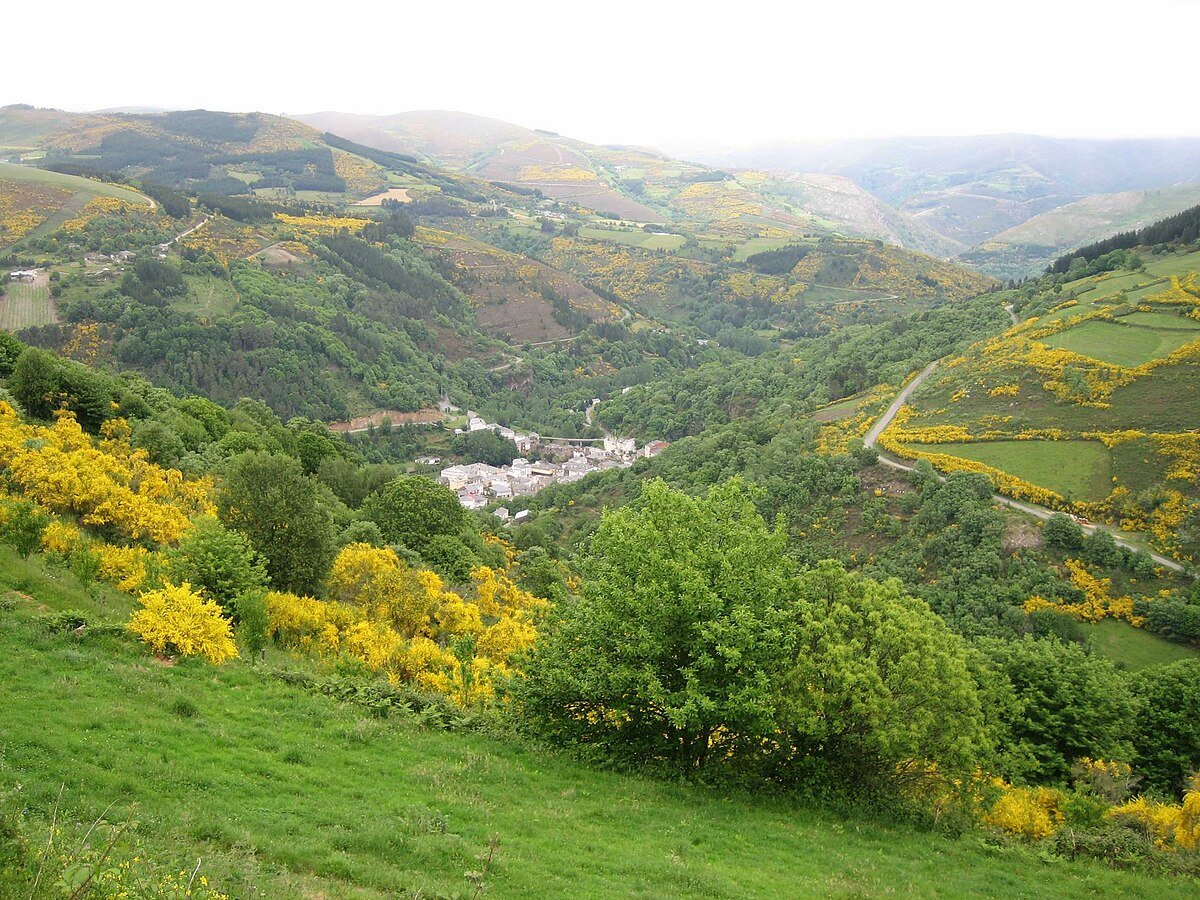
This is Ibias, in western Asturias, a wide and scattered municipality where distances on the map tell only part of the story. Valleys fold into one another, and each seems to keep its own tempo. Roads twist through oak and chestnut woodland, narrowing without warning. Mobile signal drops in and out. On paper two villages may look close; in practice, the journey takes longer than expected.
The name is pronounced EE-bee-ahs, with the stress on the first syllable. It helps to say it correctly.
A Landscape That Works for Those Who Live Here
Much of Ibias is forested. Oak and chestnut cover the slopes, broken by steep meadows where cattle still graze. The terrain sits high enough to feel distinctly mountainous, and the weather follows suit. Even in summer the air can cool quickly once the sun dips behind the ridges. In winter, smoke lifts from chimneys by mid-afternoon and access along smaller roads can become more complicated.
San Antolín de Ibias acts as the centre of the municipality. It is modest in scale, with a handful of streets, administrative buildings and houses where slate remains the dominant material. Most visits begin here, whether to stretch legs after a careful drive or to pick up basic supplies before heading further uphill.
Beyond it lie smaller villages such as Cecos, Marentes and Seroiro. Many retain their traditional layout: stone houses with slate roofs, barns attached to living quarters, meadows running almost to the doorstep. In summer the steady rasp of cicadas fills the edges of the lanes. In colder months, the scent of burning wood settles low in the air.
These are not places arranged around visitor timetables. Tractors move slowly along the road. Dogs guard fields. People work in kitchen gardens. The rhythm belongs to residents first.
Brown Bears and Regulated Forests
Ibias forms part of the area where the Cantabrian brown bear moves. Sightings are rare. More common are signs: disturbed earth in the forest, tracks in mud after rain. Walkers are expected to behave accordingly—keep noise low, stay on paths.
Part of the municipality borders Muniellos, one of the best preserved oak forests in Europe. Entry into its core is strictly regulated and requires a permit with a daily quota, secured well in advance through a public lottery system. Without one, access is limited to surrounding forest roads and viewpoints; you can glimpse the dense mass of trees but not enter it.
The restrictions shape how a visit unfolds. Plans need to be made weeks ahead if Muniellos is your focus.
Walking Between Villages
Walking here means linking hamlets via tracks and rural paths. Surfaces vary. After several days of rain, which is not unusual, sections can become slippery with mud and loose stone.
The reward is rarely a single dramatic viewpoint. It is cumulative. Roe deer at dawn if luck allows. Birds of prey circling above clearings. More often there is something quieter: wind through oak leaves, the crunch of dry foliage underfoot.
Signage is minimal beyond village limits. Anyone venturing further than a short stroll should carry a proper map—the IGN 1:25,000 series works well—and let someone know their intended route.
Practicalities: Time and Terrain
Time behaves differently here. Attempting to drive several valleys in a single day often results in more hours behind the wheel than on foot. Roads demand attention: tight bends, narrow stretches and frequent need to pull in for oncoming vehicles or logging trucks.
A small car makes life easier on these roads.
Fuel up before heading into higher zones like Seroiro or Pelliceira; petrol stations are few and far between. Coverage for mobile phones disappears for long stretches. Offline maps are useful, though old-fashioned paper still has its place. If you come between October and March, pack for cold mornings; frost is common in these valleys. Spring brings wildflowers along meadow edges; autumn turns the chestnut woods copper.
A Short Visit, Done Properly
Those with only a couple of hours do not need an ambitious plan. Start in San Antolín. From there, drive a short distance to a nearby village such as Cecos. Park at the entrance and walk. A few minutes on foot are enough to register the essentials: the sound of the river, vegetable plots pressed close to houses.
The temptation is to cover ground. The wiser approach is to pause. Sit on a stone wall or a bench and watch how the light shifts across the slopes. Notice how quickly the temperature drops once the sun moves behind a ridge.
Ibias does not respond well to haste. Distances deceive. Sunday and Monday tend to be especially quiet; many small shops will be closed. The place rewards those who arrive prepared, with time in hand.
There are no grand set pieces here. What exists instead is continuity: slate roofs dark with moisture, smoke rising in winter, cicadas in summer. It feels closer to parts of northern Wales than to any coastal version of Spain. The mountains shape everything, from climate to conversation.
Spend long enough for the roads to stop feeling like obstacles and start feeling like part of the place itself