Full Article
about Agaete
A seaside village of white houses and volcanic contrasts, known for its natural pools and the fertile valley where coffee is grown.
Hide article Read full article
A small place that takes its time
Agaete feels a bit like that friend who suddenly decides to roast coffee at home. At first it sounds like a phase. Then you try it and realise they were serious all along. Tourism in Agaete works in a similar way. You arrive expecting another coastal town in Gran Canaria, then a few details shift that impression, starting with the coffee.
The municipality is small, just over five thousand residents. Even so, it draws a steady flow of visitors through the year, especially around the Puerto de Las Nieves. There are plenty of tourist beds for a place of this size, roughly a couple of thousand. On paper that should be obvious. In the street, it is not. The overall feel is not of a town taken over by tourism.
Coffee grown on volcanic ground
People here talk about coffee straight away. It can sound like a local story polished for visitors, but it holds up.
Coffee plants grow in the valley of Agaete. That is unusual in Europe, and more so on volcanic terrain. The plants cling to terraces and cracks in dark soil, shaped by a very particular microclimate. Rock walls keep warmth in, moisture drifts down from the pine forest above, and temperatures stay mild for most of the year.
The beans are picked by hand and dried in the sun in a fairly traditional way. Later they turn up in cafés across the area and in specialised shops on the island. A common order is a cortado “leche y leche”, a coffee with two kinds of milk that is typical here. It is not about claiming the best coffee in the world. It has character, and more importantly, it makes sense to drink it here, where it is grown.
The rock that lost its tip
For years, many visitors came to Agaete for the Dedo de Dios. It was a vertical rock rising from the sea in front of the port, like a finger pointing upwards.
The Atlantic can be rough when it wants to be. A strong storm in the mid-2000s broke the formation and the tip fell into the water. Old photos make the impact clear, the silhouette was striking.
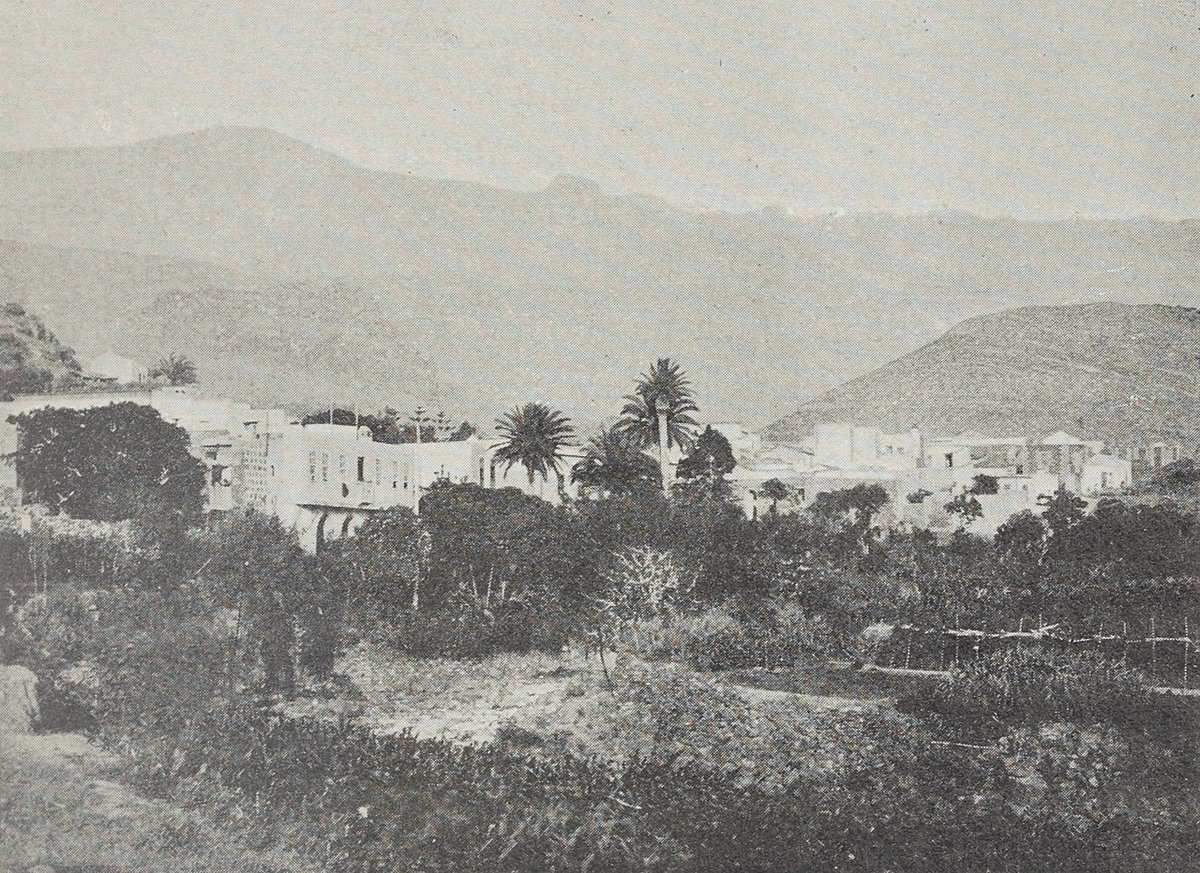
Even without that full shape, the Puerto de Las Nieves keeps its identity. Fishing boats sit alongside ferries that travel to Tenerife. A line of white houses climbs the slope behind. The square in the morning shows a familiar mix: locals with their daily shopping, people stepping off the boat, and day visitors looking for a photo. It is busy without feeling staged.
Fiesta de la Rama: a shared surge of energy
Agaete changes pace during the Fiesta de la Rama. The celebration usually falls in early August and, for a few hours, the town shifts completely.
The scene can surprise anyone who has not seen it before. Thousands of people walk towards the sea carrying branches, striking them on the ground in time with the music. The origins lie in old rituals asking for rain. Today it feels more like a collective release built around sound, movement and heat.
There is no clear line between visitors and locals. Everyone is in the street with a branch in hand. If you stand still for too long, someone will gently pull your arm to keep you moving with the rest. It is participatory by nature, and that shapes the atmosphere.
Fish straight from the harbour
At the port, the logic is simple: fish comes in from the sea and goes straight to the kitchen.
Preparation stays straightforward. You will often see it fried or cooked on the griddle, served with papas arrugadas and mojo, the wrinkled potatoes and sauces typical of the Canary Islands. The focus is on the product, with generous portions in the style common to fishing towns.
There are other local flavours worth trying. Queso de flor, a cheese made in this part of Gran Canaria, often appears with miel de palma, a syrup from palm sap. It may sound unusual on paper, but the combination works.
It is worth stepping a little beyond the first line of the port. A short walk up into the town changes the feel. Places there keep a slower, more domestic rhythm in the kitchen, without the constant flow of people by the waterfront.
The busy moments and the quiet ones
Agaete has its more complicated days. When ferry arrivals, excursions and the weekend coincide, traffic at the entrance to the town can build up. At those times, the Puerto de Las Nieves seems larger than it really is.
There are also calm periods. Outside the peak of summer, the natural pools of Las Salinas become much quieter. People sit on the rocks, look out at the sea, and the pace eases.
Many visitors arrive, take a quick photo at the port, have a coffee from the valley and move on. Staying a bit longer changes the perspective. A conversation with someone from the town or a walk through the valley reveals something else. Agaete does not revolve only around visitors. It functions first for those who live here, and that shapes everything else that follows.