Full Article
about Agulo
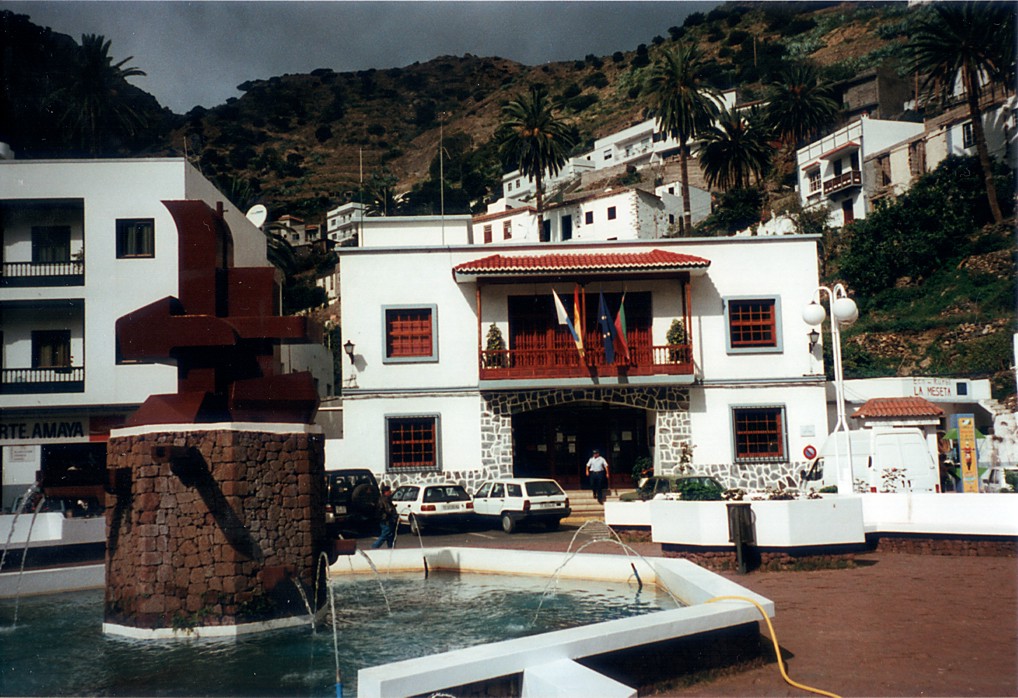
Known as the "bonbon of La Gomera" for its beauty and upkeep; set on a natural terrace overlooking Teide, with cobbled streets.
Ocultar artículo Leer artículo completo
The road to Agulo corkscrews upward from San Sebastián until the Atlantic suddenly drops away and Tenerife's Pico del Teide appears, floating like an island in the sky. At 260 metres above sea level, Agulo perches on La Gomera's northern escarpment, its white houses and red-tiled roofs stacked so steeply that some back gardens sit atop neighbours' chimneys.
This isn't one of those orchestrated hill towns where every viewpoint has a souvenir stall. Agulo's 1,100 inhabitants still live as they always have, squeezing vegetables from terraces carved into near-vertical slopes, moving at the unhurried pace of agricultural time. The village spreads across a natural amphitheatre facing northwest, which means Atlantic weather systems hit it full force. When clouds roll in, visibility drops to ten metres and the famous glass platform at Mirador de Abrante becomes pointless. When skies clear, the vista across to Tenerife ranks among the Canary Islands' most spectacular.
The Mechanics of a Vertical Village
Walking Agulo means negotiating gradients that would give a mountain goat pause. Calle La Ladera climbs at angles exceeding 20 per cent, its cobbles worn smooth by centuries of boots and, more recently, the occasional hire car whose driver has seriously misjudged the terrain. The village's oldest quarter, Barrio de Lepe, tumbles down the slope in a maze of alleyways so narrow that residents can shake hands across opposing balconies.
Traditional Canarian architecture survives here not as museum pieces but as working buildings. Houses sit low to the ground, their thick stone walls insulating against summer heat and winter Atlantic winds. Wooden balconies, dark with age, project over the street. Look closely and you'll spot the distinctive "tea" wood from local juniper trees, prized for its resistance to rot in the salty air. Many façades still bear the original stone troughs where generations of women washed clothes before plumbing arrived in the 1970s.
The Church of San Marcos squats at the village's highest point, its squat bell tower and rounded roofline more fortress than place of worship. Built in the 16th century with profits from sugar cane, the interior displays the restrained decoration typical of rural Canarian churches. Visit during the April fiesta and you'll find it filled with villagers carrying palm fronds, maintaining traditions that predate the building itself.
Where the Mountain Meets the Sea
Agulo's relationship with the Atlantic is complicated. The village turns its back on the ocean practically, though not visually. Generations have farmed the terraces (bancales) that step down the mountainside, creating a complex irrigation system of stone channels that still function. Bananas, avocados and the local palm honey (miel de palma) provide income where tourism remains secondary.
Yet the sea beckons. The path to Playa de Santa Catalina drops 400 metres through agricultural land and abandoned smallholdings, emerging at a black-sand cove where Atlantic swell usually renders swimming impossible. What appears on maps as a beach functions more as a geological curiosity – a place to contemplate the ocean's power rather than enter it. The walk down takes 45 minutes; the climb back up, considerably longer.
Local fishermen maintain a handful of traditional boats, painted in the same colours as the houses. They launch from a natural rock platform when weather permits, continuing practices that sustained the village before tourism arrived. Early morning sees them mending nets in the harbour, using techniques unchanged for centuries.
The Reality of Remote
Agulo's isolation is both its charm and its challenge. The 35-kilometre drive from San Sebastián takes an hour minimum, longer if you encounter the twice-daily bus negotiating the hairpin bends. Mobile phone reception vanishes in the old quarter, though the Digital Web Lounge opposite the tourist office offers free computers for those needing connectivity.
Dining options remain limited to a handful of establishments. La Vieja Escuela occupies a converted schoolhouse where the menu hasn't changed substantially since it opened. Expect tortilla thick as a textbook, papas arrugadas with mojo sauce sharp enough to make your eyes water, and lemon pork that arrives in portions sized for agricultural labourers. Service stops promptly at 3 pm; arrive hungry after 2.30 pm and you'll find the kitchen closing around you.
The village shop stocks basics but little else. Wise visitors stock up on water and snacks in Hermigua or San Sebastián before the final climb. This isn't negligence – it's economics. With barely a thousand potential customers, maintaining comprehensive inventory makes little sense.
Weather and When to Come
Agulo's north-facing aspect creates its own microclimate. When southern La Gomera bakes in 30-degree heat, Agulo might be shrouded in mist with temperatures struggling past 18°C. Winter brings genuine rainfall – 600 millimetres annually compared to San Sebastián's 200 – which explains why the village remains green when much of the island turns brown.
Spring offers the best compromise: clear skies, temperatures in the low twenties, and terraces carpeted with wildflowers. Autumn runs a close second, though Atlantic storms can arrive with little warning. Summer brings the most reliable sunshine but also tour buses disgorging passengers for the obligatory Teide photograph before shepherding them onward.
The Honest Assessment
Agulo delivers exactly what it promises: an authentic slice of rural Canarian life with views that justify the journey. It also requires realistic expectations. This isn't a place for action-packed holidays or sophisticated dining. Evenings wind down early; nightlife consists mainly of locals gathering in the square to discuss the day's events.
Crowds arrive in waves when cruise ships dock at San Sebastián, then vanish just as quickly. Between these invasions, the village returns to its natural rhythm. Two hours provides sufficient time to explore the historic centre and photograph the famous view. Three to four hours allows for a proper meal and perhaps the descent to San Marcos beach. Anything longer requires either serious walking plans or a genuine interest in watching rural life unfold at its own pace.
The glass platform at Mirador de Abrante attracts Instagrammers like moths to flame, but the real rewards lie in the details: the sound of irrigation water trickling through ancient channels, the smell of woodsmoke from houses that still cook on open fires, the sight of terraces that represent centuries of backbreaking labour to coax crops from near-vertical land.
Come prepared for steep climbs, changeable weather and the possibility that the famous view might be shrouded in cloud. Accept these variables and Agulo offers something increasingly rare – a working village that happens to be beautiful, rather than a beautiful village that has ceased to work.