Full Article
about Haría
Known as the valley of a thousand palm trees; a green, craft-focused municipality that holds part of César Manrique’s legacy.
Hide article Read full article
Where the Landscape Flips
There is a moment on the LZ‑1 road, just after Guinate, when Lanzarote seems to change its mind. The black lava that dominates much of the island suddenly stops, and in its place appears a green valley that feels almost out of context. That unexpected shift is Haría.
After days among volcanic terrain that can resemble another planet, arriving here feels abrupt. The contrast stands out straight away. Slopes filled with palm trees replace the dark, solid flows seen elsewhere on the island. It looks less like a gradual transition and more like a clean break.
This is the Valle de las Mil Palmeras. The name suggests a thousand palms, though there are far more, spread across hillsides and cultivated land. Many of them have been here for generations. Lava from the eruptions of the 18th century never reached this northern corner, and that absence shaped everything that followed.
A Village on the Hillside
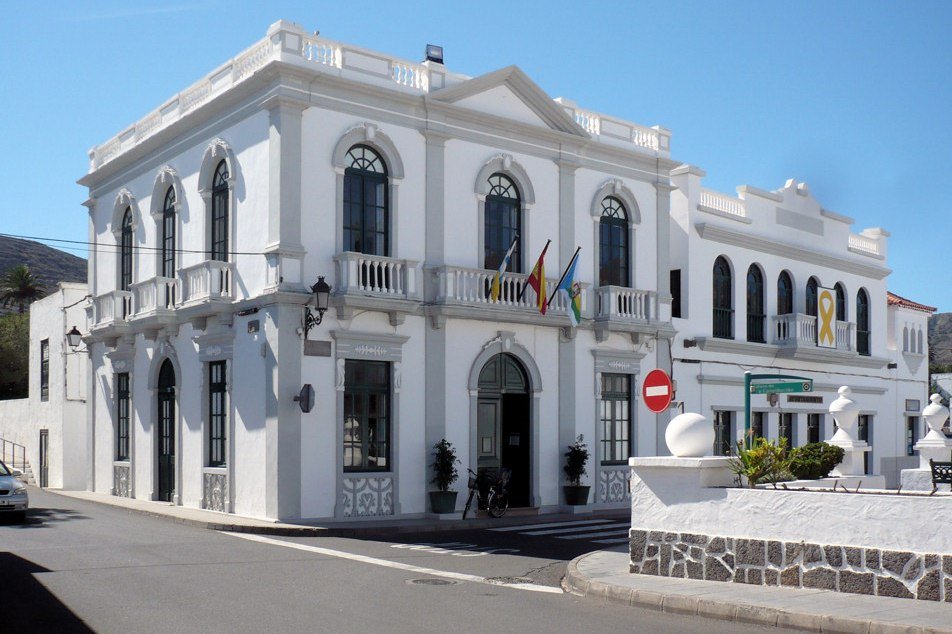
Haría sits on a slope at around 270 metres above sea level, surrounded by ravines and traditional farmland. White houses, green doors, quiet streets. The setting feels settled rather than staged.
Just over five thousand people live across the municipality. They are spread between small settlements in the valley and along the coast. The centre often seems quieter than that number suggests. Much of daily life happens outside the village core, either in the fields or further afield for work.
The layout reflects that rhythm. Streets are calm, and movement is unhurried. The valley itself plays a constant role in the background, visible from different angles as the ground rises and falls.
The Square That Downplays Itself
Plaza de León y Castillo forms the centre of Haría. It does not try to impress. Tall palm trees provide shade, cars sit parked nearby, and benches fill with people who recognise each other.
On Sunday mornings, the square usually hosts an artisan market. The scale is small, with local products and traditional sweets on display. It is the kind of place where purchases are often unplanned. Some of the homemade bienmesabe, a sweet typical of the Canary Islands, tends to disappear quickly, so arriving later can mean missing it altogether.
One side of the square is taken up by the parish church. Its tower draws the eye first when entering the space. The rest of the building is more restrained, with a style that belongs to another time. It is not the kind of church that dominates photo collections, but it works well as a meeting point. There is usually someone waiting, leaning on the railing, or watching the slow movement of the square.
Eating Across the Valley and Coast
The municipality includes several villages such as Máguez, Arrieta and Órzola. Distances between them are short, and moving from one to another by car takes only a few minutes.
In Máguez, traditional bars serve food without much fuss. Papas arrugadas arrive with mojo de cilantro made in-house. This green mojo has a strong flavour, with a noticeable touch of garlic. It is different from the milder versions sometimes found in more tourist-focused areas.
Closer to the coast, in Arrieta and Órzola, menus often feature caldo de pescado, fried vieja or cherne. The cooking stays simple and direct. Fish, potatoes and gofio appear as standard accompaniments. These are everyday dishes here, part of routine rather than something designed for display.
Walking North Towards the Sea
A walking route links Haría with the area around Órzola. Many guides describe it as “moderate”, though that depends on how the legs feel that day. The path is not technical, but it includes long stretches, and the northern wind can be strong.
The views are the main reason to take it. From the higher ground near the Mirador de Guinate, the Risco drops steeply towards the sea. Across the water, La Graciosa appears almost suspended on the horizon. Many visitors stop at the viewpoint, take a photo and head back.
Continuing on foot towards Órzola brings gradual change. The valley recedes, the coastline becomes more present, and the wind gains strength. The route ends in a quiet fishing village, which also serves as the departure point for boats heading to La Graciosa.
When to Go
Haría works at almost any time of year. The climate in the north of Lanzarote tends to be mild and steady.
March usually brings the fiestas de la Encarnación, when the village becomes busier than usual. Summer shifts attention towards the coast, especially in Arrieta, where there is more activity. Winter often leaves the valley slightly greener than the rest of the island.
A visit in November can mean temperatures around 24 degrees by mid-morning, with softer light over the palm trees. That contrast between dark volcanic terrain and the green valley is what tends to stay in mind.
Staying a While
Haría does not lend itself to a quick stop. It is not a place for a fast photo before moving on. The pace here rewards slowing down: a walk around the square, a pause for a drink, a look out over the valley from a nearby viewpoint.
With more time, the coast is close enough to explore, and the Mirador de Guinate offers a wider perspective. Haría is not among the most famous spots on Lanzarote. That may explain why it still holds on to something less common on the island, the feeling of a place that is lived in, rather than arranged.