Full Article
about Agüimes
Municipality with a well-preserved historic center and windy coastal areas ideal for water sports; noted for its cultural and theatrical activity.
Hide article Read full article
A village that greets you with a devil
At the roundabout on the way in, a bronze devil stands watching with a slightly bad temper. It is the first thing seen in Agüimes, and it sets the tone. This is not a place that limits itself to flowerpots or signposts. For years, the village has been filling its squares and corners with sculptures.
It quickly becomes clear that the devil is just the beginning. Bronze figures appear throughout the historic centre, scattered in a way that feels deliberate but not forced. They are part of how the place presents itself, quietly shaping the experience of walking through it.
Park above and walk down
The historic centre is pedestrianised, so cars stay on the edges. The easiest options are the car park near the market area or the one by Plaza de San Antón. There is usually space, and from either point it is about a three-minute walk into the centre.
At weekends things get busier, but not to the point of frustration. A short loop or two normally solves it. Saturdays bring an agricultural market, and Tuesdays a flea market. Arriving late can mean waiting for someone to leave, but spaces do open up.
Once parked, everything is within easy reach on foot.
Wandering without a plan
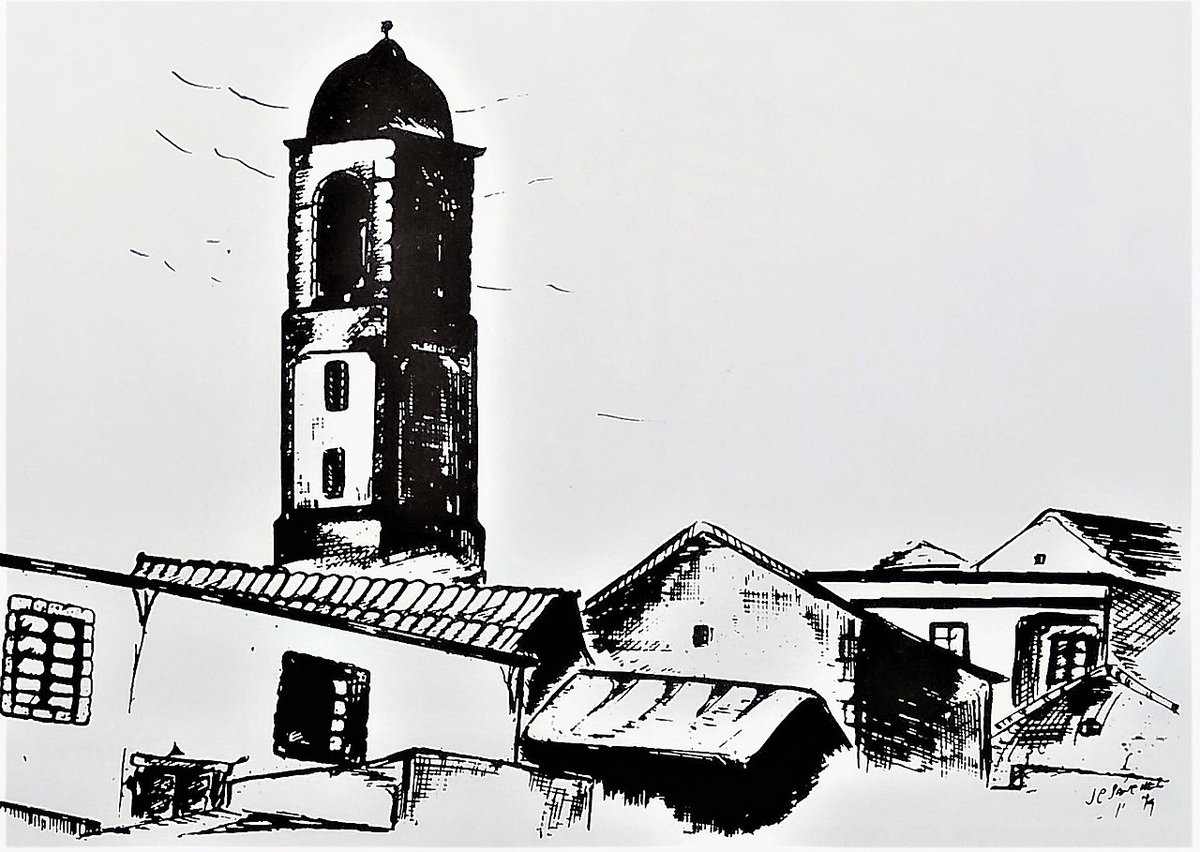
Start in Plaza de San Sebastián. The church here has a dome with twelve windows, something that does not appear elsewhere in the Canary Islands. It is not especially beautiful in a conventional sense. It is unusual, and that alone is enough to make people stop and look.
Walk around the building and notice the bell tower. It leans. Locals will say it is not crooked, that the rest of the world is straight.
From the square, several short streets branch out. They tend to end quickly, either at another small square or at the road. At many corners, there are bronze sculptures: a friar, a farmer, a child with a cat. There are dozens across the historic centre. Seeing a few is enough to understand the idea behind them.
One of the most telling streets is Callejón de San Juan. Here, volcanic stone houses line the way, with wooden doors and hanging plant pots. The place has not been polished for photographs. It looks old, but it is still lived in. Some doorways are low, and narrow channels run along the streets to carry water when it rains.
There is no need for a map. The layout encourages wandering, and the scale keeps everything manageable. The experience comes from turning corners and noticing details rather than ticking off sights.
Ravine, caves and the pull of the wind
A short drive away lies the Barranco de Guayadeque. The walking route PR GC 05 begins near the cemetery and runs for about ten kilometres there and back. The path is clear, though there is loose stone in several sections.
Partway along, aboriginal caves appear in the landscape. Some are signposted, others are still inhabited. It is a place where daily life and history sit side by side, and not everything is presented as a display.
For those not interested in walking, the road into the ravine offers a simpler way to explore. Within a few kilometres, caves carved into the rock come into view, along with a small interpretation centre. It becomes a stop-and-look kind of visit: park, take in the surroundings, move on.
The route eventually leads towards the coast at Arinaga. Here the seafront stretches out in a long, open line. The sand is black, the water clear, and the wind is often strong. That wind draws people with sails and boards. Whether it suits lying on a towel depends entirely on the day.
Straightforward food, familiar flavours
Food in the area sticks to local traditions without much fuss. Rabbit in salmorejo is still common. The sauce includes cumin, and it is usually served with mojo on the side. Pork leg in almond sauce also appears, along with gofio in different forms. Gofio, a toasted grain flour typical of the Canary Islands, shows up in several dishes.
In the Barranco de Guayadeque, some places serve meals inside caves carved into the rock. The setting tends to leave a stronger impression than the food itself. Whether that balance works depends on expectations.
Closer to Arinaga, simple bars offer sancocho. This dish combines salted fish, potatoes and escaldado de gofio, a softened version of the flour. The broth is drunk afterwards. If it does not appeal, the cup can simply be left.
The overall approach to food is direct and local, without much interest in presentation.
Festivals and a final note
Each January, the village stages an Auto de Reyes, a short performance related to the Epiphany. It takes place in the square, and people from the municipality tend to fill the space well before it begins.
In September, there is a traditional ascent from Temisas, with participants carrying water and gofio on their shoulders. It is more of a local curiosity than an event designed for visitors.
Agüimes can be explored in half a day. A walk through the historic centre, a look at a few sculptures, and a visit to the barranco if there is a car available will give a clear sense of the place. With extra time, Ingenio is only a few minutes away, and Temisas sits higher up in the mountains.
If not, a calm walk through the streets is enough to understand what Agüimes is about.