


Castilla-La Mancha: plateau, windmills, and vineyard horizons
La Mancha wine country: 475,000 hectares of vineyard
The DO La Mancha is the world's largest wine designation by area: 475,000 hectares of vineyard on a plain between 600 and 700 metres altitude. Airén, a native white grape, is the most-planted variety on Earth — in Castilla-La Mancha alone it covers over 200,000 hectares. The DO Valdepeñas, tucked at La Mancha's southern edge, groups 23,000 hectares where cencibel (tempranillo) was traditionally fermented in buried clay jars of up to 16,000 litres — a method several wineries have revived as an artisanal technique.
Tablas de Daimiel and the Ruidera lagoons
Tablas de Daimiel (National Park, 3,030 ha) is Europe's last surviving river-overflow wetland: the Guadiana and Cigüela spill across a flat plain with no gradient. Aquifer 23, over-pumped for irrigation, shrank the wetland to 10 % of its original extent by 2009; since 2012, emergency transfers from the Tagus-Segura and rainfall have partly restored water levels. Eighty kilometres southeast, the Ruidera Lagoons are 15 stepped lakes linked by tufa (travertine) barriers, dropping 120 metres over 25 km.
Quixote, windmills, and the Júcar gorges
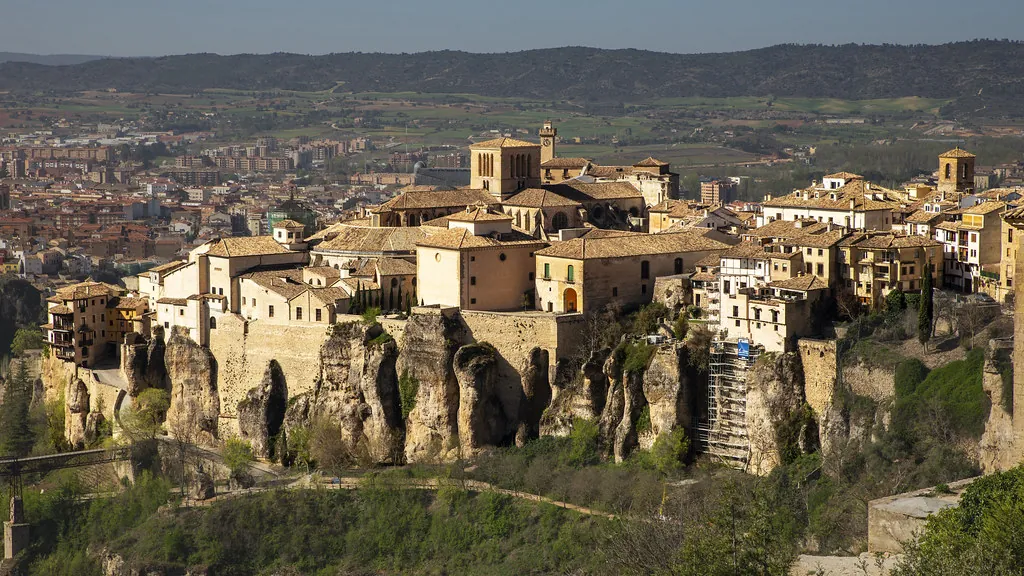
Consuegra and Campo de Criptana together keep 19 hilltop windmills, 12 of which are open to visitors and date from the 16th to 18th centuries. At the eastern edge, the Cuenca highlands present a landscape opposite to the plateau: the Ciudad Encantada assembles dolomite formations shaped by 90 million years of erosion, and the Júcar and Huécar gorges frame the city of Cuenca — with hanging houses perched on a 60-metre bluff above the river since the 15th century.