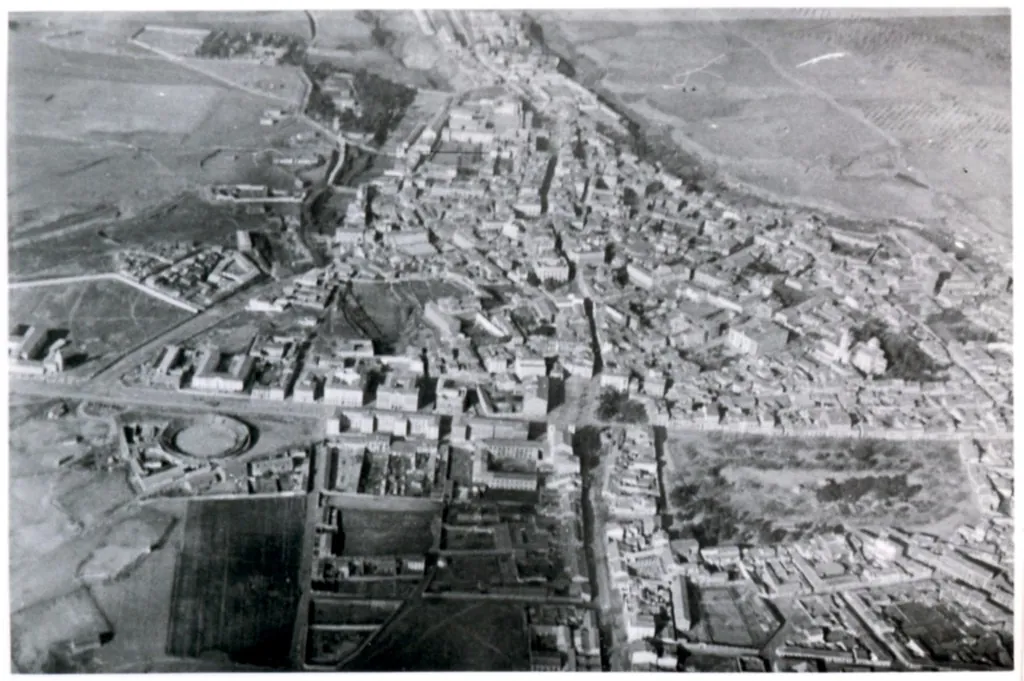
Vista aérea de Buciegas
Instituto Geográfico Nacional · CC-BY 4.0 scne.es
Castilla-La Mancha · Land of Don Quixote

Buciegas

Buciegas appears as a pale smudge against straw-coloured cereal fields, 817 metres above sea level and precisely 4½ minutes after you’ve driven pas...

36 inhabitants · INE 2025
817m Altitude

Why Visit

Mountain Church of San Pedro Walk through the historic center

Best Time to Visit

summer

Fiestas de la Virgen de la Olma (May) agosto

Things to See & Do
in Buciegas

Heritage

  • Church of San Pedro
  • cave cellars

Activities

  • Walk through the historic center
  • Photograph

Festivals
& & Traditions

Fecha agosto

Fiestas de la Virgen de la Olma (mayo)

Las fiestas locales son el momento perfecto para vivir la autenticidad de Buciegas.

Full Article
about Buciegas

Tiny Alcarrian village with rock-cut caves; folk architecture

Ocultar artículo Leer artículo completo

The Village That Shrinks in the Rear-View Mirror

Buciegas appears as a pale smudge against straw-coloured cereal fields, 817 metres above sea level and precisely 4½ minutes after you’ve driven past the last farmhouse. One blink and the place is gone: a limestone church tower, a dozen white cubes, a stand of cypresses. The road, CM-2105, narrows so sharply on entry that wing mirrors kiss the stone walls. By the time the engine cools you’ve already walked the length of the single street—twice—and counted more barn doors than neighbours.

The 2023 padron lists thirty-six residents. Summer fiestas swell the number to roughly a hundred, when the diaspora returns with folding chairs and cool-boxes, but even then Buciegas feels less like a village than a pause between horizons. The Alcarrian plateau stretches east towards the sickle-shaped Júcar gorge and west into the dry valleys of Guadalajara; wheat, barley and rosemary scent the air; the only soundtrack is wind and, very occasionally, a tractor coughing across stony topsoil.

What Passes for a Centre

There is no square, no café terrace, no souvenir shop selling fridge magnets. Life organises itself around the porticoed church of San Pedro Apóstol, locked more often than not yet still the default meeting point. Stand here at 11 a.m. on a weekday and the silence is so complete you can hear your own pulse. Look up: storks have built a wicker-thick nest on the belfry, and their clacking bills replace the absent church bells.

Beside the north transept a single stone bench catches the morning sun. Older men—three of them on most days—sit in order of arrival, caps pulled low, discussing rainfall with the same intensity others reserve for football transfers. They are happy to answer questions, though English is non-existent and even Castilian arrives slow and rolled, consonants dried out by decades of plateau air. A polite “¿Perdone, hay algún bar por aquí?” produces laughter and the information that the last permanent bar closed when Spain still had pesetas. The nearest coffee is nine kilometres away in La Almarcha; the nearest cold beer, twelve.

Architecture Without Adjectives

Buciegas never merited a defensive wall, a ducal palace or a silk exchange. What it does possess is an intact lesson in rural building logic: limestone quarried on site, timber beams of chestnut or holm oak, Arabic tiles fired in nearby Tarancon. Rooflines dip and rise like a gentle respiration; walls are whitewashed yearly, giving the settlement its bleached brightness under high-altitude sun. Notice the wooden granaries raised on mushroom-shaped stones—mouse deterrence—and the tiny barred windows designed for shooting, not for views.

The oldest doorway belongs to Calle del Pozo number 7: a horseshoe arch dating, according to a 1986 survey, to the late fifteenth century. Nobody lives there now; the iron latch is fused shut and swallows nest in the recess. Peer through the crack and you see an interior patio where a single pomegranate tree drops fruit onto collapsed roof slates. No heritage plaque, no entry fee, no audio guide—just a house ageing at its own speed.

Walking the Blank Spaces

Maps of the surrounding country show a spider’s web of farm tracks: white lines on yellow parchment. None are way-marked, yet the topography is forgiving; you would have to work hard to get lost. A recommended loop of 7 km heads south past the threshing circles, drops into the seasonal gully of Arroyo del Valle and returns along the ridge used by the high-tension power lines. Gradient is negligible, stout shoes suffice, and from the ridge the plateau folds away like a calm brown ocean.

Spring brings the most comfortable temperatures—low twenties at midday, sweater weather after dusk—and the wheat shows acid-green against red soil. In late May poppies erupt along the verges, splashes of crimson so vivid they seem digitally enhanced. Autumn is quieter, colours muted to biscuit and bronze, the air sharp enough to make the 817 m altitude noticeable when you stride uphill. Summer is best avoided unless you enjoy 35 °C shadeless trudging; winters are cold, often below freezing at night, but rarely snowy enough to block the CM-2105.

Mobile reception flickers in and out; download offline maps before leaving Cuenca. Carry a litre of water per person—there are no fountains once the village is behind you—and remember that every field edge is private land. Farmers tolerate walkers who stick to the tractor ruts; straying into cereal crops invites shouted Spanish that needs no translation.

The Gastronomy You Have to Drive For

Buciegas itself offers no meals, though if you knock at the house adjoining the church you can sometimes buy a jar of raw honey for six euros. The owners keep hives on the scrubland south of the village; the honey smells of rosemary and thyme, sets grainy, and is superb on toast made from the dense, crusty loaves sold in Priego, twenty minutes east.

For anything more elaborate, point the car towards Campillo de Altobuey (18 km) where Mesón Casa Crespo turns local lamb into pink, rosy chops served on heated terracotta. Expect to pay €16 for a half-ration—enough for two light eaters—plus a couple of euros for a glass of basic Manchuela red. Closer, in La Almarcha, the bakery opens at 6 a.m. and sells empanadas filled with tuna and pisto for breakfast; the coffee comes sugar-sweet unless you specify "amargo".

When the Village Comes Back to Life

Fiestas patronales revolve around the feast of St Peter, normally the weekend nearest 29 June. Dates shift to accommodate returning families, so check with the Cuenca tourist office a fortnight ahead. For three days Buciegas acquires fairy lights, a sound system powered by a diesel generator, and a bar improvised under a canvas awning. Proceedings begin with a Saturday evening mass amplified so loudly that the priest’s sermon distorts into echo. Afterwards, long tables appear in the street; everyone brings food to share, paper plates circulate, and plastic cups of beer cost one euro—proceeds to the church roof fund.

Sunday dawns with a procession: the statue of San Pedro, garlanded in artificial roses, is carried the length of the street and back while two teenagers ring hand-bells. Fireworks are modest—nothing on the scale of Valencian pyrotechnics—but the bangs reverberate across empty farmland like gunshots. By Monday lunchtime the generator is loaded into a pickup, the last cousin drives away, and Buciegas subsides into its habitual thirty-six.

Getting There, Getting Out

Public transport is theoretical: one school bus passes through at 7 a.m. on term-time weekdays, returning at 2 p.m. Otherwise you need wheels. From Cuenca take the N-320 towards Tarancón, turn right at San Clemente onto the CM-2105, and follow signs for La Almarcha—then Buciegas. The final 12 km twist through wheat and olive plantations; asphalt is patchy but passable for a standard saloon. Petrol stations are scarce; fill the tank in Cuenca.

Accommodation options lie 25–40 minutes away: a clutch of rural casas rurales around Campillo de Altobuey, or the small Parador in Alarcón if you fancy four-star comfort inside a medieval castle. Wild camping is tolerated along the dirt tracks provided you arrive after dusk, leave at dawn, and carry all rubbish out. Light no fires—summer sparks travel fast across stubble.

The Honest Verdict

Buciegas will never feature on a postcard rack. It offers no swimming pool, no artisan boutiques, no tapas trail. What it does provide is a calibration point for travellers who have grown weary of curated experiences: a place where the loudest noise is a stork clacking on the tower, where front doors stay unlocked, and where the horizon remains ruler-straight in every direction. Come if you want to measure Spain’s rural heartbeat at its quietest; skip it if you need a flat white within walking distance. Either way, fill up before you arrive—because once the church bell falls silent, the next espresso is half an hour down the road and the plateau shows no intention of hurrying for anyone.

Key Facts

Region
Castilla-La Mancha
District
La Alcarria
INE Code
16038
Coast
No
Mountain
Yes
Season
summer

Livability & Services

Key data for living or remote work

2024
Housing~5€/m² rent · Affordable
Sources: INE, CNMC, Ministry of Health, AEMET

Planning Your Visit?

Discover more villages in the La Alcarria.

View full region →

More villages in La Alcarria

Traveler Reviews