Full Article
about Cañaveruelas
Near the Buendía reservoir and the Roman ruins of Ercávica; rich in history.
Hide article Read full article
Getting to Cañaveruelas
Cañaveruelas sits around 55 minutes by car from Cuenca. There is no useful public transport for a day trip, so travelling by car is the realistic option. From Madrid, the usual route is down the A‑3 to Tarancón and then along secondary roads into the countryside.
This is pure Alcarria, a region of Castilla La Mancha known for its open farmland and gently rolling terrain. Around Cañaveruelas, the landscape is fairly flat, with little dramatic change from one season to the next. Fields stretch out in broad sweeps, and the horizon often feels wide and uninterrupted.
Parking is straightforward, largely because few people come. Near the centre there is a small area where you can leave the car. Visitors should not expect tourist infrastructure or information boards on every corner. There are no permanent shops open throughout the year, and if you need somewhere to eat or stay overnight, the usual solution is to look in larger villages several kilometres away.
A Village of Few Streets
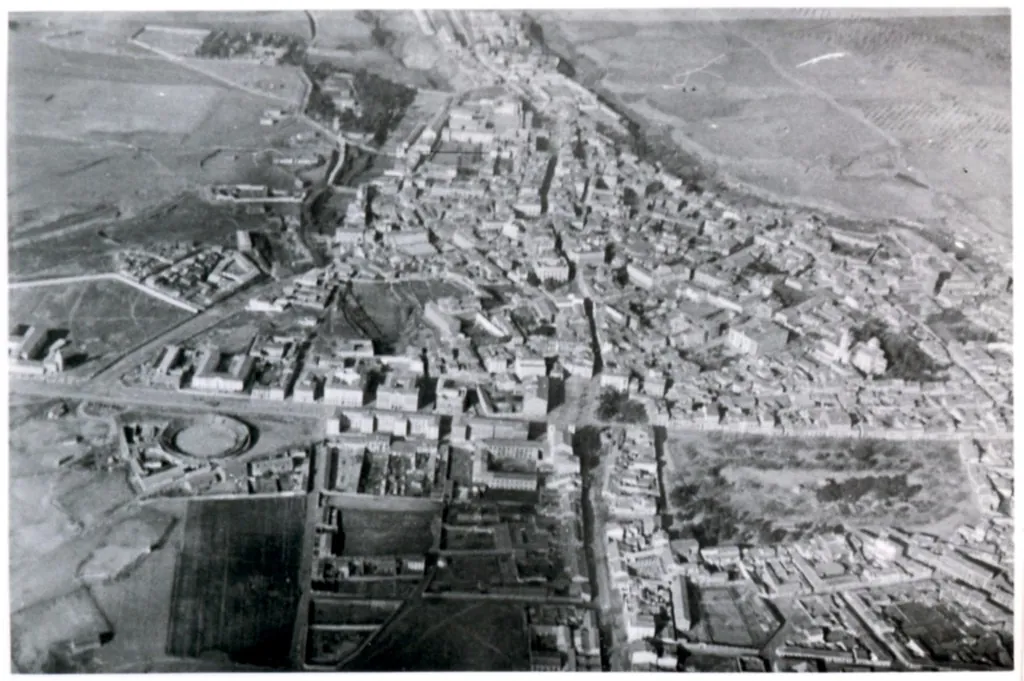
Cañaveruelas is small even by the standards of the Alcarria. It has only a handful of streets and barely a couple of points that draw attention.
The Iglesia de San Pedro stands on the main square. It is a simple masonry building with a square tower and a weather vane on top. The square is usually quiet. On weekdays, it can feel almost empty.
Beyond the church, the village is made up of traditional houses built without display or ornament. Thick walls, small windows and wooden gates define much of the architecture. In some properties you can make out old wine cellars or small corrals, reminders that daily life here revolved around farming for generations. That agricultural past still shapes the layout and atmosphere of the village.
There are no museums, no marked heritage routes, and no cluster of sights to tick off. Cañaveruelas is the sort of place you walk through slowly, taking in its scale and simplicity rather than searching for standout monuments.
Walking the Agricultural Tracks
If there is a reason to come to Cañaveruelas, it is to step beyond the village and follow the surrounding farm tracks. There are no official signposted routes. The paths are working tracks used by farmers and by people heading out to their plots of land.
Some of these tracks slope down towards small ravines where low Mediterranean vegetation grows. You might notice thyme, gorse and scattered holm oaks. With a bit of luck, birds of prey such as kites or kestrels can be seen perched on fence posts.
The landscape is open and exposed. In spring the fields turn green, and the air can feel softer. By late summer, cereal crops dominate and the colours shift to dry yellow. There are no major landmarks or dramatic viewpoints, yet walking for a while along these tracks gives a clearer sense of what this part of the Alcarria is like: agricultural, expansive and quiet.
Anyone planning to explore should bring a map or GPS. The tracks intersect frequently and there is no signage to guide you back if you take a wrong turn.
Local Life and Seasonal Festivities
Decades ago there were more bars operating in Cañaveruelas. Today activity is irregular. Many premises have closed, and others open only at certain times of the year.
Village festivals remain tied to the local calendar and especially to summer, when people who live elsewhere return. These celebrations typically include religious processions, simple open‑air dances known in Spain as verbenas, and gatherings of neighbours. They are not designed to attract visitors but to bring together those who still have a connection to the village.
Depopulation is visible. Many houses are used only during holidays, and employment continues to revolve largely around agriculture. The rhythm of life is shaped by the seasons and by the needs of the fields rather than by tourism.
For anyone unfamiliar with rural Spain, this pattern is common in parts of Castilla La Mancha. Smaller villages see their population drop during much of the year, then fill out briefly in summer or during key festivities. Cañaveruelas fits that pattern closely.
When to Go
Spring and autumn are generally the most comfortable times for walking in the area. In summer the sun can be intense, and there is little shade once you leave the village.
A simple approach works best: come with the idea of a calm stroll and then continue on to another point in the region. Cañaveruelas can be seen quickly. Taken on those terms, it fits easily into a day exploring the wider Alcarria.
This is not a destination packed with attractions or facilities. It is a small agricultural village where the pace is slow and the landscape does most of the talking. For some travellers, that understated character will be precisely the appeal.