Full Article
about Castejón de Henares
Overlook on the Henares River; small town with views and a palace-house
Hide article Read full article
A Small Village on the High Plateau
Tourism in Castejón de Henares begins with its setting. This small municipality in the upper Alcarria sits on a plateau at around 900 metres above sea level, surrounded by open farmland, dry ravines and agricultural tracks. Just over sixty people live here today. The scale remains that of a working rural village, where the rhythm of life still follows the agricultural seasons and family houses reopen in summer when relatives return.
Reaching Castejón de Henares means travelling along the kind of secondary roads typical of the Alcarria: gentle hills, wide expanses of moorland and long stretches with barely any traffic. The approach prepares you for what you will find. There is no grand entrance, no sudden change of scene, just a gradual arrival into a landscape shaped by farming.
Within the village, stone, adobe and whitewashed walls dominate. These are the traditional materials of this part of the province of Guadalajara, chosen to withstand cold winters and dry summers. Among the houses, old corrals, barns and former livestock sheds still appear, reminders of the importance livestock once had in the local economy.
The overall feeling is one of quiet isolation. There is very little signage and almost no traffic. The layout is simple: a handful of streets clustered around the church, with tracks leading out towards the fields.
A Compact Village with a Long Rural Memory
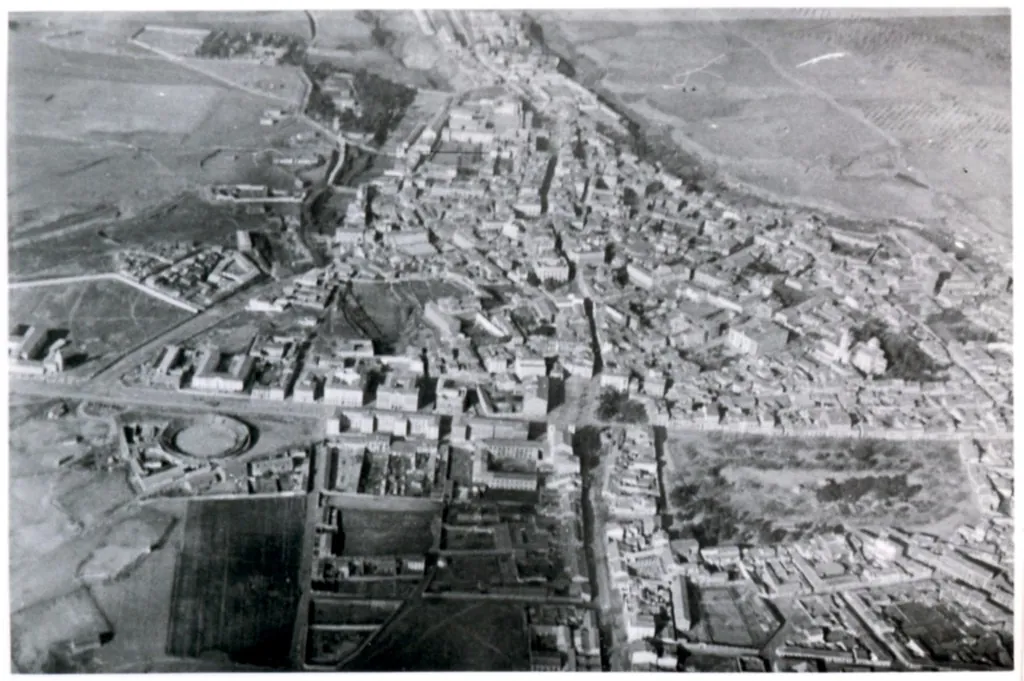
The appeal of Castejón de Henares lies not in major monuments but in the village as a whole. The houses form a compact group of masonry buildings, with agricultural extensions that reflect a domestic economy closely tied to the land.
At the centre stands the parish church, dedicated to San Miguel. It is a sober building, in keeping with the rural architecture of the area. Most churches in the Alcarria were built or remodelled between the 16th and 18th centuries, often in several phases. In small villages, construction tended to progress when funds were available, which explains the mixture of periods seen in many of these temples.
Beyond the built-up area, the surrounding landscape helps explain how people have lived here. From nearby hills, the plateau of the Alcarria stretches out in every direction: cultivated fields broken up by dry ravines and small valleys. The colour of the land changes markedly with the seasons. In spring, the cereal crops turn the fields green. By summer, once harvested, the tones shift to gold and ochre.
Close to the village, traces of traditional agricultural life remain visible. There are eras, the circular threshing floors where grain was once processed, half-ruined corrals, stone troughs and fountains that served livestock. They are not signposted or prepared as visitor attractions. They are simply part of the everyday landscape, still present but no longer central to daily life.
Walking the Tracks of the Upper Alcarria
The best way to explore the surroundings is on foot, following the agricultural tracks that radiate from the village. There are no officially marked walking routes, yet the paths are clear and usually lead towards fields and low hills from which much of the upper Alcarria can be seen.
The terrain is straightforward, mostly flat or gently undulating. It is worth bearing in mind that shaded stretches are few and far between. In summer, the sun can be intense and there is very little tree cover away from the ravines.
The wide skies are part of the experience. Birds of prey are frequently seen gliding overhead. With a little patience, it is possible to distinguish red kites or common buzzards circling above the fields. There are no bird hides or specific facilities for wildlife observation. Stopping on a rise and watching the horizon is enough.
The sense of space is constant. Fields extend towards the skyline, broken only by shallow dips in the land. The absence of infrastructure or visitor services reinforces the impression that this is a working landscape first and foremost.
Food and Practicalities
There are no bars or restaurants in Castejón de Henares. For a meal or basic shopping, it is necessary to head to larger villages in the surrounding area.
The cuisine of this part of the Alcarria remains closely linked to traditional produce. Lamb features prominently, as do migas, a rustic dish made from breadcrumbs fried with ingredients such as garlic and meat. Embutidos from the matanza, the traditional pig slaughter, are also typical. Honey is another defining product. The Alcarria has been known for its honey for centuries, and it remains one of the best-known foods associated with the region.
Visitors should approach Castejón de Henares with realistic expectations. There are no tourist services within the municipality and no accommodation options in the village itself. A stop here is usually brief: a walk through the streets and another along the surrounding tracks are enough to gain a sense of the place.
Traditions and the Annual Rhythm
As in many small villages, the year changes noticeably when summer arrives. Families who live elsewhere return to their ancestral homes, and the population temporarily increases. This is when most gatherings and celebrations take place.
The patron saint is San Miguel. His liturgical feast day falls at the end of September. In some villages in the area, however, celebrations are moved to warmer dates to make it easier for neighbours and descendants to come together. The exact timing can vary, but the role of these festivities is clear: they provide an opportunity to reconnect with the village and with each other.
Getting There
Castejón de Henares is reached via regional roads that connect with the main road network of the province of Guadalajara. The final stretch runs through the open fields of the upper Alcarria.
There is no regular public transport to the village, so arriving by car is the usual option. Given the lack of services and accommodation, a visit is best planned in combination with other villages in the comarca. Castejón de Henares is not a destination filled with attractions to tick off. It is a place to pause briefly, walk its compact streets, look out across the plateau and understand how life has unfolded for generations on this high Castilian plain.