Full Article
about Chiloeches
Growing municipality near the capital; it preserves manor houses and heritage.
Hide article Read full article
At eight in the morning, as the sun begins to lift the low mist from the fields, the air in Chiloeches carries the scent of turned earth and cereal crops. A few cars are already heading down towards Guadalajara, the provincial capital just a few minutes away. In the older streets, shutters remain half closed and flowerpots have only just been watered.
Tourism in Chiloeches has little to do with grand monuments or marked trails. The appeal lies elsewhere: in the rhythm of an Alcarrian village that lives very close to the city, yet still holds on to unhurried scenes of daily life.
Honey, esparto and the pulse of the square
In the Plaza Mayor, where the municipal library now stands, neighbours lean on the railing to chat or cross the square with shopping tucked under an arm. By mid-morning the quiet is broken by small domestic sounds: a broom brushing the ground, a window pushed open, the thud of a rug shaken out in the sun.
For a long time, esparto grass formed part of the local economy. During the colder months, when there was less work in the fields, many households braided ropes and made mats or rugs. Today, esparto remains largely as a memory of a craft that was once common across much of the Alcarria, the historic region of rolling countryside in central Spain.
Honey has a stronger presence. The Alcarria is known for its beehives, and the fields around Chiloeches are rich in thyme and rosemary. Some residents keep hives nearby. The municipal coat of arms even features a honeycomb with bees, a clear symbol of this longstanding link to beekeeping.
Up to the hill above the village
At the end of certain streets the tarmac suddenly gives way to dirt tracks. One of these climbs towards what is known as the Cerro del Castillo. The slope makes itself felt, particularly in summer when the sun beats down directly, but at the top the landscape opens out.
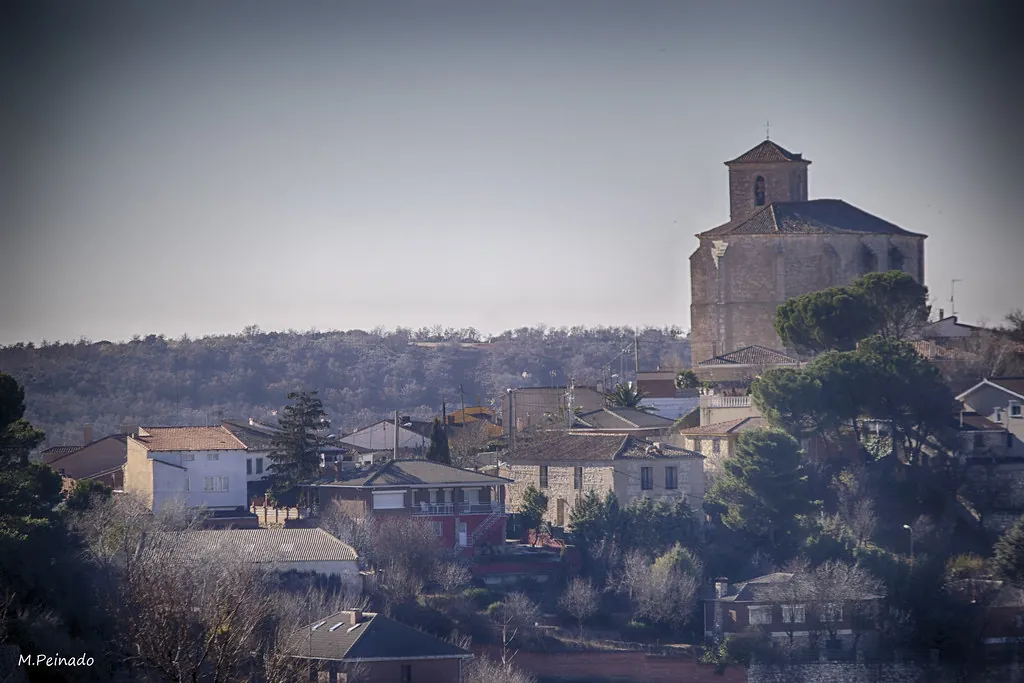
From here, Chiloeches appears with its straight streets and low houses. Beyond lies the spread of Guadalajara, which edges a little closer each year. When there is a breeze, the only sounds are the hum of electrical cables and the distant noise of the motorway.
Ancient remains have been found in this area, including fragments of pottery and other materials that suggest the hill was occupied long ago. There are no information boards or visible excavations. Most people come up simply for the views or for a walk beyond the edge of the village.
If you plan to make the climb, early morning or late afternoon is more comfortable. The hillside offers very little shade.
A palace on Calle Mayor
Along Calle Mayor, a façade appears that is larger and more austere than its neighbours. This is the former palace of the Marquesses of Chiloeches, built when the locality passed into seigneurial hands in the Early Modern period.
The building has been closed for years and the interior cannot be visited. From the street, it is possible to glimpse the courtyard and stone walls, with weeds pushing up between the slabs. Even so, the façade maintains a certain presence, especially when late afternoon light strikes the stonework and lengthens the shadows cast by the balconies.
The history of Chiloeches is closely linked to the period when the village depended on different lords. As in many places in the Alcarria, changes of ownership, taxation and wars brought unsettled episodes.
When the village heads to the countryside
At the end of April, Chiloeches celebrates a well-known local pilgrimage called the Fiesta Chica. On that day, many residents walk up to the hermitage and then continue the gathering out in the countryside, setting up folding tables, sharing food and settling into long after-lunch conversations in the open air.
It is a very Alcarria scene: extended families beneath the trees, dishes passed from one table to another, children racing along the tracks. The event is not designed with visitors in mind. It remains a local custom that is still very much alive.
The patron saint festivities take place later in the year, in September. For several days the village hosts activities and popular events that draw together residents and those who return to Chiloeches for the occasion.
Practical notes for a visit
Chiloeches lies a few kilometres from Guadalajara and is best reached by car via a regional road. Many local residents work or study in the capital, so there is constant daily movement between the two places.
If you want to stroll at ease, avoid the central hours of the hottest summer days. The village sits in a fairly open area and the sun can be intense. Spring and autumn are more comfortable times to explore. The surrounding countryside changes colour with the seasons, and the paths around the edge of the built-up area can be followed without hurry.
Late afternoon is particularly pleasant. Light drops gently over the fields of the Alcarria, the air cools a little, and the streets fill again with neighbours stepping out for a walk before night falls.
Chiloeches does not compete with larger destinations in Castilla La Mancha. Its appeal lies in its everyday details: the scent of honey in the fields, the memory of esparto work, the climb to a hill with no signposts, and a square where conversation still sets the pace.