Full Article
about Hueva
Hill-clinging town; sweeping views and picota cherries
Hide article Read full article
A Small Place with Its Own Logic
Some villages work like those roadside bars where the same people stop every day. There is no decoration designed to please everyone, yet everything makes sense to those who use it. Hueva, in the comarca of La Alcarria in Castilla La Mancha, feels a bit like that.
This is a very small municipality, hovering around a hundred residents. There are no monumental squares or streets laid out for photographs. The houses stand where they stand because someone built them decades ago to live in, to store tools or to keep out the winter cold of the Alcarrian plateau.
Camilo José Cela passed through this region on his famous journey through La Alcarria, a literary travel account well known in Spain, though Hueva almost always falls outside the usual itineraries. It is easy to see why. The landscape here is understated: cereal fields, gentle hills and wide tracks crossing the countryside as if someone had stretched a long rope over the earth.
Hueva does not try to impress. It simply carries on.
A Village in the Plainest Sense
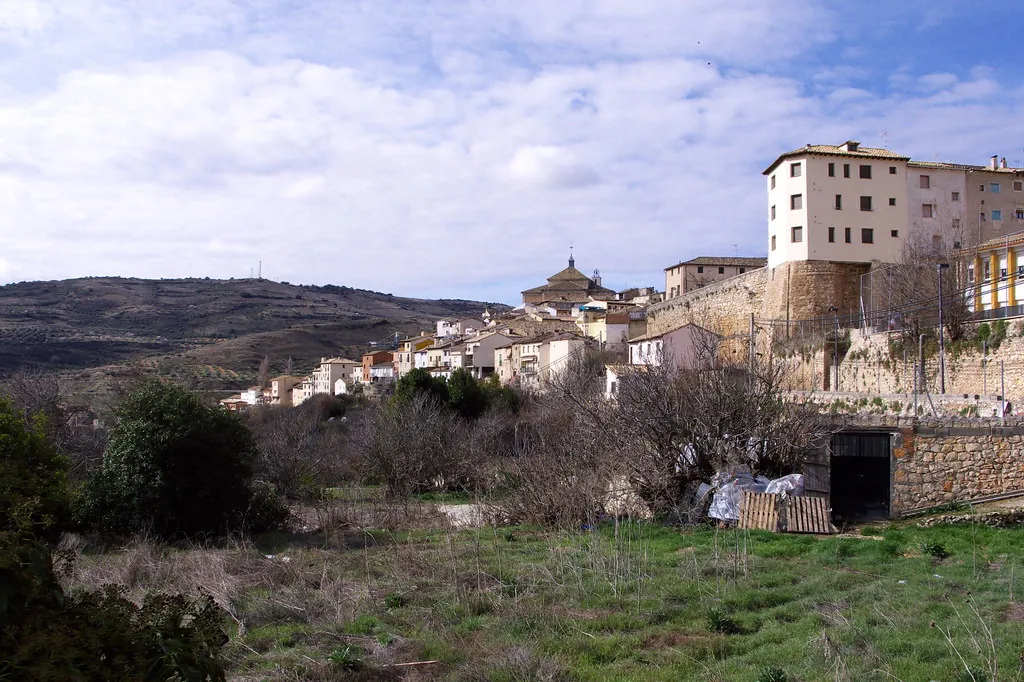
Walking through Hueva feels a little like stepping into a friend’s garage in a rural village. Everything has a purpose, nothing is arranged to impress. Stone and mud houses, large wooden doors and a few wrought iron balconies that have watched many winters pass.
At the centre stands the parish church of the Asunción. It is neither monumental nor elaborate. Instead, it conveys that Castilian restraint that brings to mind an old town hall or a rural school: solid walls, very little ornament.
A short stroll is enough to grasp the rhythm of the place. A neighbour offers a greeting. Corrals are still in use. Whitewashed façades reflect the strong light of the meseta, the high central plateau of Spain. Within ten minutes, it is fairly clear how everything fits together.
There is no grand route to follow. The interest lies in observing how daily life is organised in a settlement of this size, where the built environment answers practical needs rather than aesthetic ones.
Walking Out into La Alcarria
If there is one thing that makes sense in Hueva, it is to leave the centre behind and walk. Rural tracks begin almost at the edge of the last houses.
The landscape is typical of La Alcarria. Open, calm, with nothing breaking the horizon. At times it feels like looking across an enormous table covered with a green cloth in spring and a golden one in summer.
There are no steep climbs or technical routes. These are dirt paths cutting through cereal fields and patches of low scrub. From time to time, old rural constructions appear: corrals, small stone shelters or stretches of wall whose builders are long forgotten.
A walk here resembles that long turn around the block after a family Sunday lunch. There is no specific goal. Just the act of moving, letting the fields slide by and noticing the slow shifts in colour and light.
The scale of the surroundings plays a part. The broad horizons typical of La Alcarria give a sense of space without drama. It is not a landscape of peaks or ravines. It is a landscape of continuity.
Open Light and Long Horizons
Photography works differently in Hueva. There are no waterfalls or jagged mountains to frame. The interest lies in the light.
At sunrise and again towards the end of the afternoon, the fields change. Colours turn warmer and the hills seem softer. The transformation is subtle but clear, like lowering the brightness on a phone at night so that everything becomes calmer.
Even a simple camera captures those long Alcarrian horizons well. The appeal is not in a single landmark but in the way sky and land meet in wide, uninterrupted lines.
For anyone interested in landscape photography, patience matters more than equipment. Waiting for the right light can reveal the quiet shifts that define this part of Castilla La Mancha.
When the Village Fills Again
For much of the year, Hueva is quiet. Very quiet. Then summer arrives and the atmosphere shifts.
Festivities are usually held in August, when relatives and people who still keep a house in the village return. Streets that are normally silent fill with conversation, improvised music and long gatherings that stretch into the evening.
There are also religious celebrations that continue in a modest format, including Semana Santa. The processions are short, the floats simple, and the participants all know one another. It is less a spectacle and more a shared custom, repeated because it always has been.
At the table, as in much of La Alcarria, substantial dishes appear when families gather or fiestas are under way. Cordero, migas and local produce remain central. Miel alcarreña, the honey for which the region is well known across the province, often features in markets and celebrations.
Food here is tied to reunion. It is part of the rhythm of return, when those who left for work or study elsewhere come back for a few weeks and the village briefly regains a busier pulse.
Hueva on a Route through La Alcarria
Hueva is not a destination for a full day of packed activities. It resembles those short roadside stops where you stretch your legs and look around before continuing.
A walk through the village, another along the nearby tracks, and that may be enough. In a short time, its structure and pace become clear.
Perhaps that is the point. To see how a small village in La Alcarria continues to function without many added layers. Just as it is. Much as it has been for generations.
Hueva does not compete for attention. It offers something simpler: a glimpse of everyday continuity on the Castilian plateau, where light, land and routine still shape the experience of place.