Full Article
about Mazuecos
Agricultural village with a Soldadesca tradition; near the Tajo
Ocultar artículo Leer artículo completo
The church bell strikes noon and the only reply is a tractor changing gear somewhere beyond the stone houses. At 700 metres above sea level, Mazuecos sits high enough for the air to feel thin and clean, yet low enough for the summer sun to hammer the cereal fields that roll right up to the last street. This is La Alcarria, the plateau east of Madrid where villages are measured less by monuments than by the quality of their silence.
A Grid for Wheat, Not for Tourists
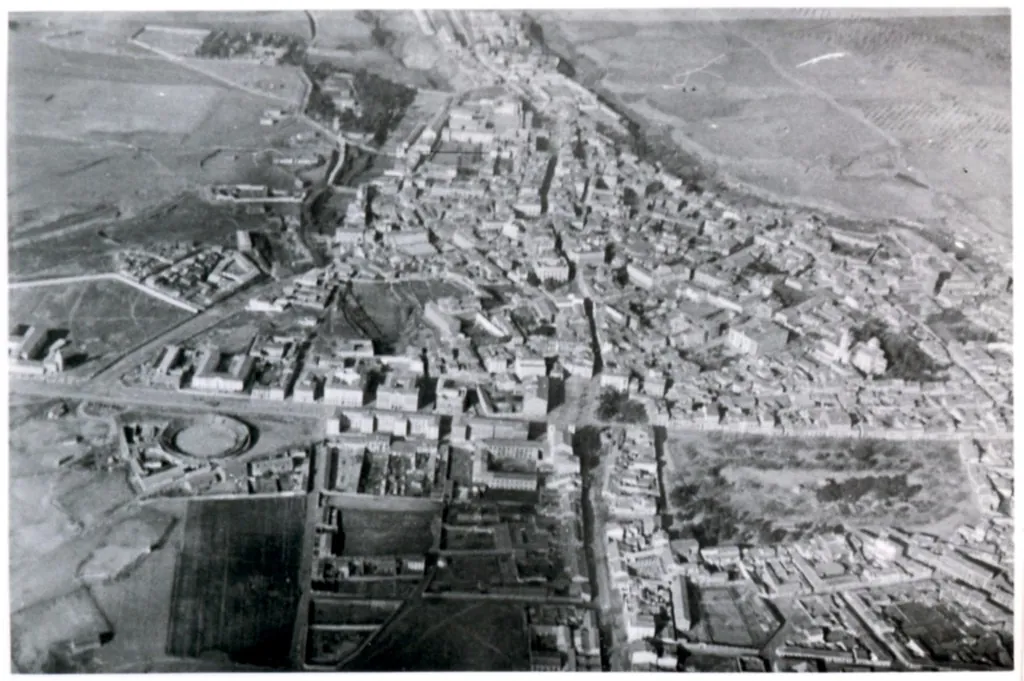
There is no car park, no interpretation centre, no craft shop. Visitors leave the CM-101 onto a short service road that becomes Calle Real, the village’s single artery. Houses of ochre stone and whitewashed mortar line both sides; many still have wooden doors wide enough for a mule, though today they shelter small cars. The pavement is barely two flagstones wide—enough for one person, provided they breathe in when a neighbour passes.
Mazuecos’ population hovers around 260, a figure that doubles in August when Madrilenian families return to shuttered homes. The 2019 census recorded 97 dwellings, of which 28 are permanently occupied. That ratio explains the atmosphere: life continues, but at the speed of wheat. Fields outside the nucleus stretch for kilometres, stitched together by unmarked dirt tracks that farmers still call by the names of grandparents.
Walking the village takes forty minutes if you dawdle. The 16th-century parish church of San Pedro occupies the high point; its tower was rebuilt after lightning in 1934 and the stone still looks freshly chiselled. Opposite stands the former school, closed since 2004 when the last two pupils moved to Guadalajara. Through the window you can see desks ranked as if the teacher has only stepped out to fetch chalk.
Heat, Cold and the Wind Between
Altitude shapes the calendar. Frost can arrive in October and linger until April; winters of minus eight are routine. Spring and autumn offer the kindest light and temperatures that hover in the low twenties—perfect for the network of agricultural lanes that fan out towards neighbouring villages. Summer, on the other hand, is uncompromising: 35 °C by mid-morning, shade limited to the south side of houses, and cicadas loud enough to drown conversation. If you come between June and August, start walking at dawn and retreat indoors by two o’clock.
There are no signed footpaths, so navigation reverts to instinct and the helpful habit of placing stone cairns at junctions. A gentle 7-kilometre loop heads north-east to the abandoned hamlet of Valhermosa, passing two threshing circles now colonised by poppies. The return leg uses the Cañada Real Conquense, an old drovers’ road wide enough for twenty sheep abreast; you may meet a lone quad bike, but rarely another walker. Mobile coverage is patchy—download an offline map before setting out.
What Passes for Lunch
The village bar, Casa Agustín, opens at seven for coffee and closes when the owner feels like it. A coffee con leche costs €1.20; a caña of beer is €1.50. There is no printed menu—ask what’s available. On Thursdays it might be cordero al estilo de la abuela, slow-roasted lamb with bay leaves; on Saturdays, migas ruleras, fried breadcrumbs speckled with chorizo and grapes. Vegetarians receive a plate of grilled peppers and the sympathetic shrug of a cook who grew up in post-war Spain.
For anything fancier you drive twelve minutes to Cifuentes, where Mesón de la Virgen serves Alcarrian honey-glazed kid shoulder at €18. The honey carries the village’s postcode: hives dot the surrounding hills, and beekeepers sell 500-g jars from front-door fridges for €6. Take cash—card machines are viewed with suspicion.
When the Plaza Fills Up
Festivity is seasonal and short. The fiestas patronales begin on 15 August with a mass followed by a paella for anyone who brings a chair. Plastic tables appear in Plaza Mayor at midday; by three the village is asleep; by ten a playlist of 1990s Spanish pop crackles from loudspeakers nailed to the church. Fireworks are modest—two rockets and a sparkler tree—because the budget must also cover new nets for the football goalposts.
In January, the feast of San Antón turns the same square into a bonfire. Residents bring animals—mostly dogs, occasionally a bemused donkey—for a sprinkling of holy water. The priest works fast; the temperature is close to freezing and even the dogs look eager to get home. Afterwards, neighbours share mantecados, crumbly shortbread that tastes of aniseed and pig fat. Tourists are welcome but not announced; if you join the circle you will be offered a biscuit within minutes.
Getting There, Staying There
The practical bit no one tells you: Mazuecos has no hotel, no rural cottage industry, not even a village noticeboard with rental keys. The nearest beds are in Cifuentes (12 km) or, for something more atmospheric, the parador in Sigüenza (35 km). Most day-trippers base themselves in Guadalajara, 85 km west along the A-2. From London, fly to Madrid-Barajas, pick up a hire car and allow 90 minutes on the CM-101—tolls are negligible but petrol stations thin out after Torija.
If you insist on public transport, ALSA runs one daily bus from Madrid’s Estación Sur to Guadalajara (55 min), then a second coach on to Cifuentes (40 min). From Cifuentes you need a taxi—pre-book because ranks are theoretical. Total journey from airport: roughly four hours, longer on Sundays. A car is less bother and lets you string together villages such as Palazuelos, Valdenoches and Valdepeñas de la Sierra, each barely a smudge on the wheat.
The Honest Verdict
Mazuecos will not change your life. It offers no epiphany, no Instagram explosion, no tale to trump the dinner table. What it does provide is a calibration of scale: how small a community can be and still function, how large a landscape feels when you walk across it with only skylarks for company. Come for the quiet, the lamb, the scrape of boots on dusty stone. Leave before the church bell reminds you that the 21st century is still waiting, impatient, down the mountain.