Full Article
about Millana
Municipality of Guadalajara
Ocultar artículo Leer artículo completo
The church bell strikes noon and the only other sound is a dog barking at its own echo. From Millana's modest summit—825 m above the cereal-coloured quilt of La Alcarria—you can count the village's 113 inhabitants by the washing lines. Guadalajara city lies 40 km east; Madrid, an hour and a quarter beyond that. In between stretches a high plateau that Camilo José Cela crossed in 1946 and found "so quiet you can hear the wheat grow". Not much has broken the silence since.
A Plateau that Breathes Slower
At this altitude the air thins and the thermometer behaves oddly. Summer midday can touch 36 °C, yet nights drop to 14 °C; bring a fleece even in July. Winter, conversely, keeps snow longer than the provincial capital—roads occasionally close after hard frosts—so December visits require winter tyres and a Plan B. Spring and early autumn give the kindest light: oat stubble turns bronze at sunset, bee-eaters wheel overhead, and the 10 km loop south to the abandoned threshing floors takes exactly three hours with binoculars and a water bottle. Shade is scarce; locals walk at dawn.
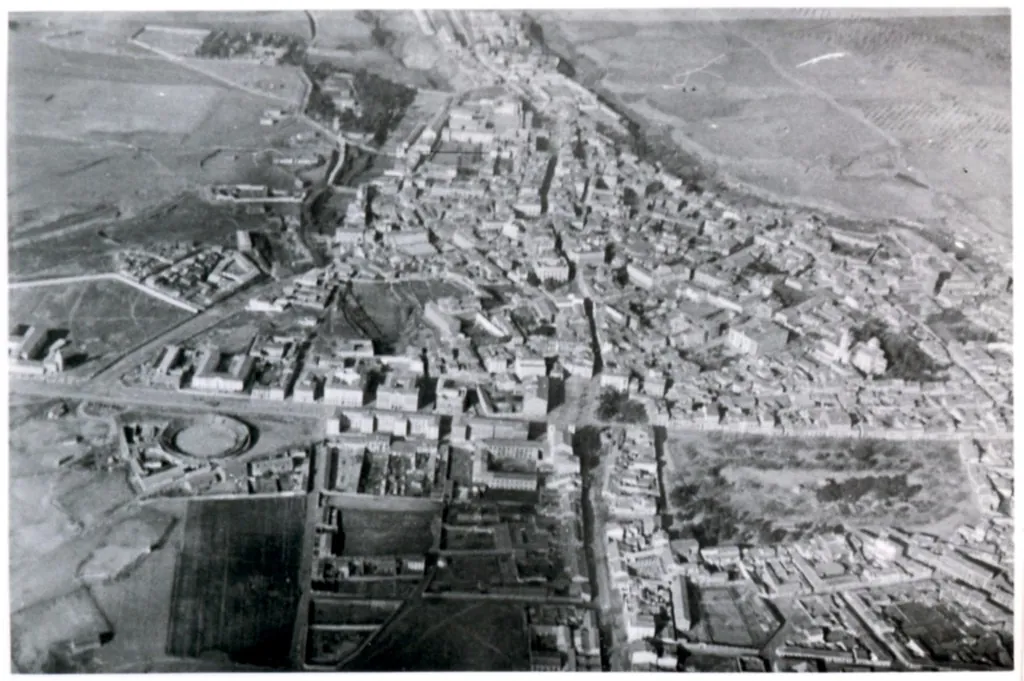
The village itself sits on a low limestone ridge. Every lane tilts, gently but perceptibly, so the stone houses appear to lean into the wind that sweeps up from the Tagus basin. Masonry is chunky, mortar the colour of dry earth; timber doors are small to keep out the draught that rolls across the meseta. There is no centre as such, just a widening where the church stands and the delivery van can turn round. You can walk from one end to the other in eight minutes—ten if a tractor is blocking the way.
What Passes for Sights
The parish church of Nuestra Señora de la Asunción keeps the hours of its parish priest, who drives in from Brihuega on Sundays. If the wooden door is ajar you'll find a single-nave interior, whitewashed every spring, and a 17th-century retablo whose gilding was touched up in 1973. Otherwise admire the tower from outside: stone slate, four levels, no tourist board plaque. Opposite, the old bread oven—now a toolshed—still smells of burnt flour after rain. That is more or less the cultural circuit.
The real architecture is domestic. Peer through the iron grilles and you'll spot carved stone sinks, courtyards with a single lemon tree, and loft hatches where grain once fed the family mule. One house retains a medieval dovecote; the pigeons have been replaced by a wifi router whose signal barely reaches the pavement. Most dwellings are second homes now, owned by Madrilenians who arrive on Friday night and leave before the bread man on Monday. Their absence keeps the volume down and the rental price for a two-bedroom cottage under €220 a week—if you can find an owner willing to let.
Paths that Unravel the Horizon
Millana's best museum is outside the village. A lattice of farm tracks, many still marked as "cañada real" on the IGME 1:50,000 map, fans out across wheat and olive. The shortest useful circuit heads west to the Arroyo de la Mata, 4 km out and back, passing an Iron-Age necropolis the locals call Las Tumbas. Nobody charges, nobody guides; a knee-high wire fence stops the sheep, not the curious. Longer hikes link with the GR-124 long-distance trail that bisects La Alcarria from Alcolea del Pinar to Brihuega. A fit walker can reach the latter in three hours, refill at the fountain under the Arab gate, and catch the 14:15 bus back to Millana—except on Tuesdays, when there isn't one.
Cyclists find the same tracks ideal for gravel bikes: hard-packed clay, gradients that rarely top 6%, and virtually zero traffic. The only hazard is the loose chippings left after threshers have dragged the wheat heads across the ground. A bell is pointless; the dog will hear your tyres crunching long before you appear.
Food without a Menu
There is no bar, no shop, no ATM. The nearest bread arrives in a white van that toots at 10:30; if you miss it, drive 12 km to Cifuentes where the bakery opens until 13:00 and again at 17:30. For a sit-down meal, Brihuega has three mesones serving cordero al horno—expect €18 for half a roast shoulder, enough for two. The regional DO honey, milflores from lavender and thyme, sells for €8 a kilo at the cooperative on the CM-201; locals swear by a teaspoon stirred into goat's milk before bed.
Picnickers should stock up in Guadalajara before the climb. The stone tables beside the cemetery have views west towards the Sierra de Altomira, but no bins; take your orange peel home or the farmer will, rightly, curse you in perfect Castilian.
When the Village Remembers Itself
Festivities happen on the weekend closest to 15 August. The population quintuples. A sound system appears on a trailer, the church is draped in lights, and someone produces a foam machine that turns the single crossroads into a disco until 03:00. Outsiders are welcome but not catered for: bring your own chair, your own beer, and—crucially—earplugs if you hoped for rural silence. By Tuesday the decibels drop back to dog-level, the rubbish lorry hauls away the empties, and Millana returns to its default setting of hush.
Smaller, gentler, is the Romería de la Cruz on 3 May. Half the village walks two kilometres to a limestone outcrop, blesses the fields, then shares migas—fried breadcrumbs with garlic and pancetta—out of a single cauldron. Visitors who turn up with a bottle of wine are invited to dip in; plastic plates appear from the boot of a SEAT Ibiza as if by magic.
Getting There, Getting Out
From Madrid's Avenida de América take the ALSA coach to Guadalajara (55 min, €7.50), then the weekday-only bus to Cifuentes (45 min, €4). A taxi for the final 12 km costs €25—book in advance because only two cars serve the area. Driving is simpler: A2 to Guadalajara, CM-21 north, then CM-2022; the last 6 km twist uphill through holm-oak scrub and are paved but narrow. In winter carry snow socks even if the forecast claims "light frost"; the micro-climate surprises.
Leave time for the detour to the Roman bridge at Río Grande, 9 km north. It is single-track, stone, and unsigned—exactly the sort of structure other regions would fence off and charge for. Here you simply park on the verge and walk across, listening to the water slide over granite. No gift shop, no audio guide, just the wind funneling down the valley and the faint smell of wild marjoram crushed under your boots.
The Honest Verdict
Millana will not change your life. It offers no epiphany, no Instagram explosion, no tale for the pub beyond "I once spent a weekend where the loudest noise was a pigeon". What it does give is a calibration device for urban speed: a place where mañana still means tomorrow, not "in five minutes", and where the horizon remains wide enough to let the eye stretch. Come for 36 hours, pack a paperback and walking boots, and leave before the silence starts feeling smug rather than soothing.