Full Article
about Mondéjar
Historic town with important Renaissance heritage; famous for its wine
Hide article Read full article
Morning over the plain
The bells of Santa María Magdalena strike eight while the sun is still gentle on the open plain. From the square, a thin mist lifts slowly over the olive groves, as if someone were pulling back a blanket. Tourism in Mondéjar often begins at this hour, when the air carries the smell of firewood and freshly baked bread, and the quiet is broken only by the baker starting his van.
This small town in Castilla La Mancha wakes without fuss. The centre gathers around the parish church and the main streets that slope towards it. Early light softens the stone and keeps the heat at bay, making it the best moment to walk before the day settles into its steady rhythm.
Stone that keeps its own time
Following the so called Ruta del Renacimiento reveals how time behaves here. It does not rush forward, it layers itself onto façades and doorways. The parish church of Santa María Magdalena began to rise in the 16th century. Its Plateresque doorway, richly carved in pale stone, still holds a warm golden tone. At midday, the surface seems to trap the light rather than reflect it.
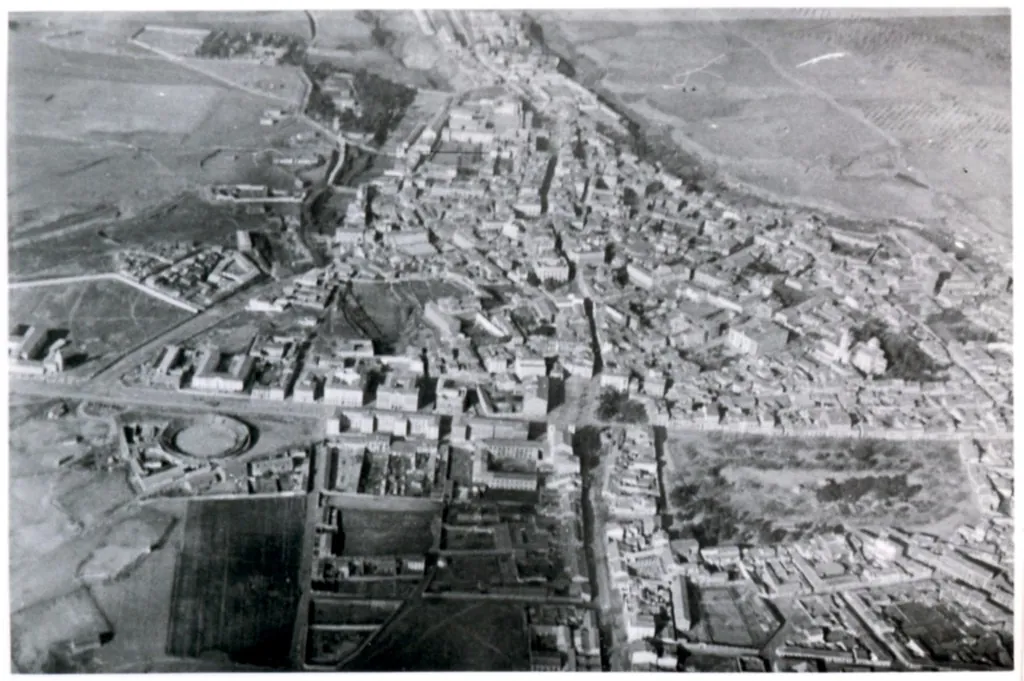
A short distance away stand the ruins of the convent of San Antonio. Today, the façade and sections of wall remain, open to the sky. The Mendoza family ordered its construction at the end of the 15th century. Over the years, many of its stones were reused in other buildings around the town. Older residents still recount how some were taken to build the bullring at the beginning of the 20th century, a practical decision that folded the convent’s fabric into everyday life.
Inside the church, the atmosphere shifts. There is the scent of extinguished candles, aged wood and a trace of incense lingering in the side chapels. The carved figures have faces softened by centuries of passing hands. Enter mid morning, when the door is left ajar, and the light falls diagonally across the pews, catching dust suspended in the air. It is a simple scene, yet it says much about how worship and routine have intertwined here for generations.
The arch that vanished
In 1947, the old Arco de la Villa was demolished because the scheduled coach struggled to turn beneath it. For decades, it survived only in old photographs that circulated around the town, reminders of a more enclosed Mondéjar.
A few years ago, a reconstruction was erected on the same spot. It is not exactly the same, streets and vehicles have changed too much for that, but it helps to imagine how the entrance to the historic centre once looked when the town felt more folded in on itself.
From the arch begins Calle Real, climbing with a steady incline towards the square. Pavements are narrow and the cobbles uneven. Drivers will find it easier to leave the car outside the centre and walk up. The ascent is short, and it allows the details to come into focus: iron balconies, worn thresholds, and the gradual opening of the square at the top.
Gazpacho, served warm
Mention gazpacho in Mondéjar and it does not mean the chilled tomato soup familiar elsewhere in Spain. Here, gazpacho alcarreño is a hunting stew. Rabbit or partridge, depending on the household, is cooked slowly with pieces of torta cenceña, an unleavened flatbread broken into the pot. The result is thick, almost eaten with a fork rather than a spoon.
It is usually prepared in a wide pan set at the centre of the table so everyone can help themselves. Many families make it when the first cold days arrive. In November, during the fair of San Andrés, an event celebrated here for centuries, the scent of stew mingles with honey and sheep’s cheese brought by market stalls. The atmosphere is direct and unhurried. Conversations stretch out, paper bags change hands, and transactions feel personal rather than hurried.
Food in Mondéjar is tied to season and gathering. The arrival of colder weather signals more than a shift in temperature, it brings dishes that are filling and shared. Even for visitors unfamiliar with La Alcarria, the region’s historic comarca, the flavours offer a clear sense of place.
Beneath San Sebastián
Below the hermitage of San Sebastián lies a small crypt reached by a narrow staircase. The light is dim, and the air remains cooler than outside even in summer.
Inside stand near life size plaster figures representing characters associated with the local tradition of the “judíos”. The exact date when they were placed there is uncertain. Stories in the town say that during the January romería, a traditional pilgrimage, some people go down with a torch to see them. Touching their foot is said to bring good luck. The toes are smooth, worn down by many hands over time.
The crypt adds another layer to Mondéjar’s sense of accumulated years. Above ground, the hermitage marks a point of devotion and gathering. Below, the figures stand in semi darkness, bound to oral tradition as much as documented history.
When to go, and what to expect
September is often a good time to walk through Mondéjar. The heat eases, nights turn cooler and the church stone takes on a deeper golden hue at sunset. During the fiestas of Cristo del Calvario, the town shifts pace. Music carries late into the night, especially from the area around the hermitage.
August brings more movement, particularly at weekends when many cars arrive from Madrid. Those seeking a quieter stroll through the centre will find weekdays and early mornings more suitable.
Around midday, Mondéjar slows noticeably. Between two and four in the afternoon, many shutters are lowered and the streets grow almost empty. It is a good moment to sit in the square or wander towards the outskirts, where paths begin to thread through the olive groves.
Before heading back towards the N‑320, it is worth pausing at one of the higher points surrounding the town. From there, the open plain of La Alcarria stretches out, lined with olive trees. The church tower rises above the tiled roofs. As evening approaches, a light mist appears again, softening edges and blurring contours. Mondéjar seems to hover in the middle of the countryside, suspended between stone and field, routine and memory.