Full Article
about Zorita de los Canes
Historic town on the Tagus dominated by its fortress; home to Recópolis
Hide article Read full article
A village that appears almost by accident
Some places enter your journey without much warning. You are driving through La Alcarria, following a secondary road, and after a bend a castle suddenly rises on a hill. That is often how Zorita de los Canes first appears: briefly, unexpectedly, with its silhouette watching over the Tajo valley.
The village itself is tiny, with fewer than a hundred residents. What gives it weight is not its present size but its past. The streets are short, the houses simple, and there is stone everywhere, much of it old. This is not a place designed to fill a full day. Still, for anyone curious about the history of this part of Guadalajara province, it rewards a pause, a walk, and a look around.
The castle above the Tajo
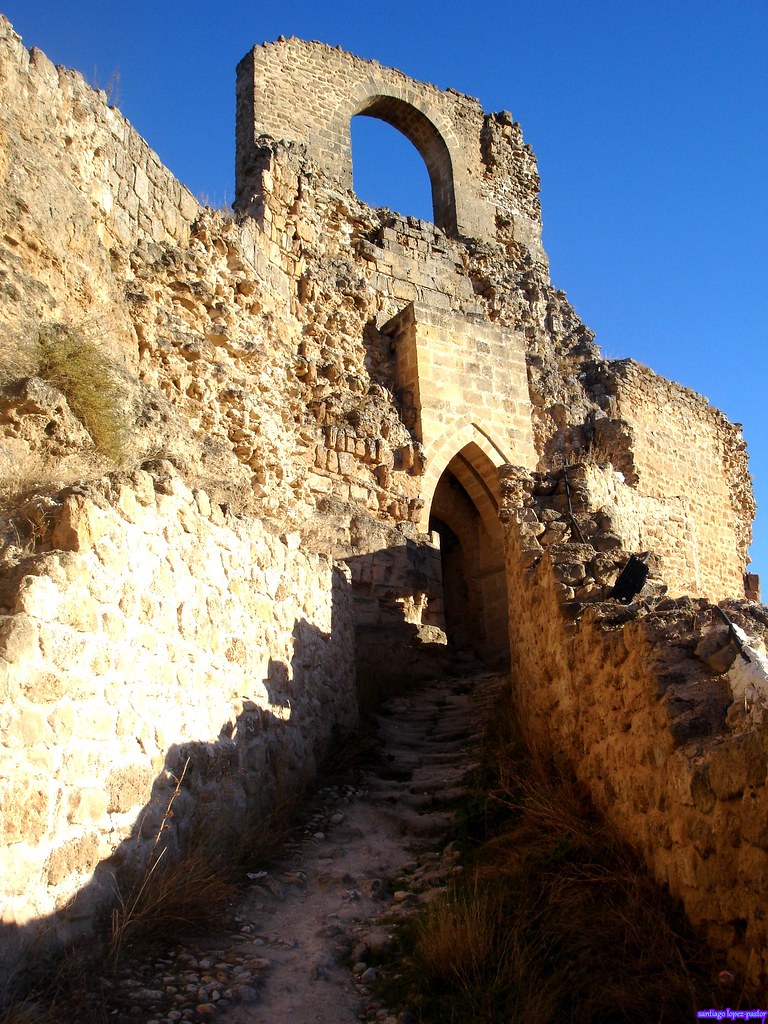
The castle is the first thing that draws the eye. It stands on a rocky spur above the river, visible from a distance and clearly chosen for its position. From up there, the entire valley lies open.
Its origins go back to the Andalusi period, and later it passed into the hands of the Order of Calatrava, who reshaped it during the Middle Ages. Today, sections of wall, towers and much of the defensive structure remain.
The climb up is worth it less for any single feature than for the overall setting. Below, the Tajo winds through the landscape. Around it stretch open cereal fields, and at the foot of the hill the village looks small and quiet. It is easy to see why this spot mattered for so long.
There are no staged displays or reconstructed scenes. The site feels open and restrained, with stone as the dominant presence. It invites observation rather than spectacle.
Recópolis and the Visigothic past
Just outside the village lies Recópolis, one of the best-known Visigothic archaeological sites in the Iberian Peninsula. The city was founded in the 6th century and is traditionally linked to King Leovigildo.
What makes Recópolis interesting is that it is not just a scatter of ruins. The layout of the city can still be read. There is a palatine area, a basilica, and zones where workshops and homes once stood. With a bit of imagination, and some help from the interpretation centre, the remains begin to form a clearer picture.
For those interested in archaeology, this site alone can justify the stop in Zorita de los Canes. It offers a rare glimpse into a period that is not always easy to visualise, especially in such an open and legible setting.
A small place, without decoration
The centre of Zorita de los Canes is brief. In ten or fifteen minutes, it can be covered on foot.
The parish church is simple, with stone walls and very little ornament. Around it are traditional houses typical of the area. Some have been carefully updated, others seem unchanged for decades. The overall feeling is calm, the kind of quiet that is noticeable even in the middle of the afternoon.
There are no hidden monuments tucked into corners of the village. The main interest lies outside its streets: the castle above, the river below, and the wider landscape that frames everything.
Walking between history and landscape
For those who prefer to explore on foot, there are paths linking the castle, the Tajo valley and the area around Recópolis. These are not demanding routes. They are straightforward tracks that cross open ground and lead down towards the river.
Walking here helps connect the different elements. The fortress overlooks the passage through the valley. The Visigothic city sits near the water. Around them stretches the broader landscape of La Alcarria, open and dry.
Spring and autumn are especially comfortable times for walking. In summer, the sun is strong, as it is across much of this part of Castile.
How long to spend
Zorita de los Canes works best as a stop rather than a destination in itself. It suits a slow morning: a walk through the village, a climb to the castle, a visit to Recópolis, and some time by the river.
In three or four hours, it is possible to see everything at an unhurried pace.
If you are travelling through La Alcarria, among reservoirs, small villages and quiet roads, it fits naturally into the route. It is one of those places that does not require much time, yet leaves the feeling of having touched a very old layer of Castile’s history.